

Zenaida Dove vs Mourning Dove
Zenaida aurita versus Zenaida macroura
Play a quiz with Zenaida Dove and Mourning Dove
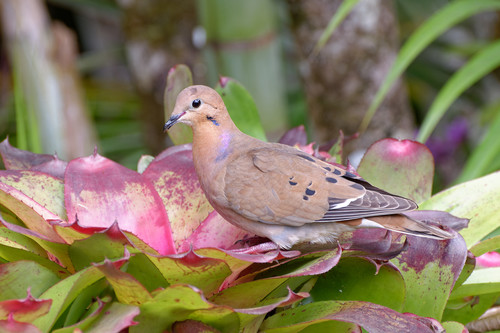 Zenaida Dove
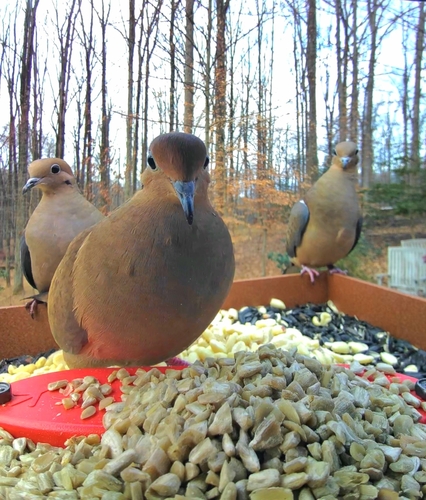 Mourning Dove
In short
The most reliable field mark to separate Zenaida Dove from Mourning Dove is seen in flight: Zenaida Dove shows a clear white trailing edge on the wings, which Mourning Dove lacks. Zenaida Dove is also smaller, with a shorter, more rounded tail, and overall darker coloration. Mourning Dove has a longer, pointed tail with white outer feathers, a paler overall look, and lacks the white wing edge. Both can be confusing when perched, but structural and subtle plumage differences, especially in the tail and wing pattern, are key for confident identification.
Identification tips
- White trailing edge on wing (in flight, all ages): Zenaida Dove shows a clear white line along the trailing edge of the wing; Mourning Dove never shows this. This is the single most reliable separation, especially for birds flushing or flying away.
- Tail shape and pattern (all ages): Mourning Dove has a long, pointed tail with white outer feathers and black inner feathers, often flashing white when the bird takes off. Zenaida Dove’s tail is shorter, more rounded, and lacks the strong white outer tail feathers.
- Overall size and structure: Zenaida Dove is more compact and heavier-bodied, with a shorter tail and a chunkier appearance. Mourning Dove is longer, slimmer, and more streamlined, especially noticeable when perched or in flight.
- Plumage tone: Zenaida Dove is darker and more uniformly brownish, while Mourning Dove is paler, with a gray-brown back and pinkish underparts.
- Wing spots: Mourning Dove has distinct black spots on the wing coverts; Zenaida Dove lacks these or has much less prominent spots.
- Facial marks: Mourning Dove has a crescent-shaped dark patch below the eye; Zenaida Dove does not show this mark.
- Neck iridescence (adults, especially males): Mourning Dove males may show bright purple-pink neck patches and a bluish crown, which are absent or much duller in Zenaida Dove.
- Juvenile appearance: Both are scaly and duller as juveniles, but the white trailing edge on Zenaida Dove’s wing remains diagnostic in flight.
- Flight style: Mourning Dove is swift and buoyant, often with a whistling sound from the wings; Zenaida Dove appears heavier and more direct in flight.
- Habitat context: In the Caribbean and Yucatan, both can be present, but Zenaida Dove is more likely in coastal, scrubby, or urban settings; Mourning Dove is more widespread in mainland North America.
- Voice: Use call pace as a clue—Zenaida Dove is faster, Mourning Dove is slower and more plaintive—but beware overlap and observer bias.
- Perched confusion: When perched, focus on tail length and shape, overall bulk, and wing pattern if visible; avoid relying solely on color, as lighting can mislead.
- Subspecies variation: Mourning Dove subspecies differ subtly in color and size but always lack the white wing edge; Zenaida Dove subspecies are similar in field marks relevant for separation.
- Abundance: Mourning Dove is extremely common in North America; Zenaida Dove is abundant in the Caribbean but rare elsewhere—consider location when in doubt.
- Pitfalls: Beware of Mourning Dove’s white outer tail feathers being mistaken for a white wing edge; always check the location of the white—on the tail for Mourning, on the wing for Zenaida.
Size
Zenaida Dove is slightly smaller and heavier-bodied, measuring about 28–30 cm in length and weighing around 159 g. Mourning Dove is longer at about 31 cm, but typically lighter (average mass closer to 128 g), with a more slender, elongated profile. The tail of Mourning Dove is notably longer and more pointed, contributing to its streamlined appearance, while Zenaida Dove’s tail is shorter and more rounded.
Plumage
- In flight (all ages): Zenaida Dove shows a distinct white trailing edge on the wings, which is absent in Mourning Dove. Mourning Dove instead has white outer tail feathers and a long, pointed tail.
- Adults (perched): Zenaida Dove is darker overall, with a more subdued brownish coloration, while Mourning Dove is paler, with a light gray-brown back and pinkish underparts. Mourning Dove has black spots on the wings and a distinctive crescent-shaped dark patch below the eye. Zenaida Dove lacks the strong black spots and facial crescent.
- Juveniles: Both species' juveniles are generally duller and scaly, but the white trailing edge on the wing in Zenaida Dove remains a key mark in flight. Mourning Dove juveniles are darker and have a more scaly appearance, but their tail shape and lack of white wing edge persist.
Behaviour
Both species forage on the ground, often in open or semi-open areas. Zenaida Dove is more likely to be seen feeding close to water and may be found in urban parks or beaches in the Caribbean. Mourning Dove is more widespread and abundant in North America, often seen perched on wires or flying swiftly with a whistling wing sound. Zenaida Dove tends to appear heavier and more deliberate in movement, while Mourning Dove is sleeker and more buoyant in flight.
Habitat
Zenaida Dove is resident throughout the Caribbean and the Yucatan coast, favoring lowland scrub, coastal plains, beaches, and urban parks. It can also be found at higher elevations in Jamaica. Mourning Dove is widespread across North America, found in open country, farmland, suburbs, and city edges. Overlap is limited to the Caribbean and parts of the Yucatan; context can help, but both can occur in urban and open habitats.
Voice
Both species have a mournful cooing call, but Zenaida Dove’s is faster-paced (cooOOoo-coo-coo-coo), while Mourning Dove’s is slower and more drawn-out (cooOOoo-wooo-woo-woooo). The difference can be subtle and is best used as supporting evidence, not a primary field mark.