

Motmot

Yellow-winged Flatbill vs Lesser Elaenia

Tolmomyias flavotectus versus Elaenia chiriquensis

Play a quiz with Yellow-winged Flatbill and Lesser Elaenia
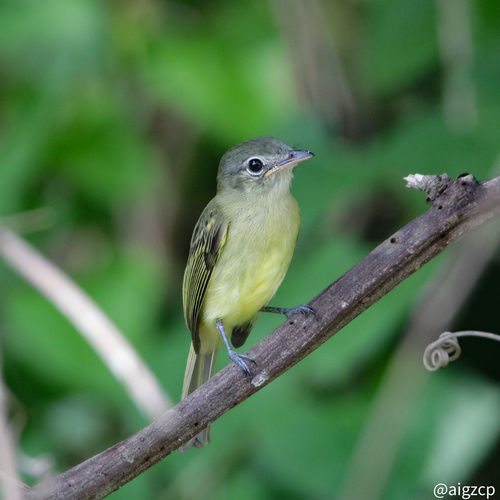
Yellow-winged Flatbill (Tolmomyias flavotectus) Yellow-winged Flatbill
Lesser Elaenia (Elaenia chiriquensis) Lesser Elaenia

Media

Loading…

In short

The most reliable field mark between Yellow-winged Flatbill and Lesser Elaenia is the wing pattern: adult Yellow-winged Flatbill shows broad yellow edges to the flight feathers, while Lesser Elaenia has two distinct white wingbars and whitish feather edges. Juvenile Yellow-winged Flatbill have duller, less distinct yellow edges, but still lack the clear double wingbars of Lesser Elaenia. Structurally, the Flatbill has a noticeably broad, flat bill and a darker, more contrasting head, while Lesser Elaenia shows a small crest and a more uniform olive-gray head. Both species share a yellowish belly, but the combination of wing pattern and bill shape is usually decisive. Beware of immature birds and poor light, which can obscure these differences.

Identification tips

  1. Wing pattern is key: Yellow-winged Flatbill (all ages) shows broad yellow edges to the wing feathers but lacks distinct wingbars; Lesser Elaenia always shows two bold white wingbars and whitish feather edges. In poor light, look for the double-barred effect on Lesser Elaenia.
  2. Juvenile confusion: Juvenile Yellow-winged Flatbill has less distinct yellow on the wings, but still lacks the sharp wingbars of Lesser Elaenia juveniles and adults. If you see clear, crisp wingbars, it's not a Flatbill.
  3. Bill shape: Flatbill has a wide, flat bill (almost paddle-shaped), black above and pale below; Lesser Elaenia's bill is narrower, black with a pinkish base to the lower mandible. Bill shape is often visible even in distant perched birds.
  4. Head pattern: Flatbill has a dark gray head with a strong white eyering, contrasting with its olive back. Lesser Elaenia's head is grayish olive, with lighter cheeks, a thin whitish eyering, and a partially hidden white crown patch (sometimes visible as a pale spot in good light).
  5. Crest: Lesser Elaenia often shows a small, squarish crest, especially when alert; Flatbill's crown is smoothly rounded with no crest.
  6. Underparts: Both have yellowish bellies, but Flatbill's throat and breast are pale gray with a yellowish wash, while Lesser Elaenia's underparts are more evenly grayish olive to pale yellow, especially in the paler albivertex subspecies. Underpart color is subtle and should not be used alone.
  7. Tail color: Flatbill has an olive-green tail matching the back; Lesser Elaenia's tail is dusky, contrasting with the upperparts.
  8. Leg color: Flatbill has gray legs and feet; Lesser Elaenia's are black. Usually not visible unless at close range.
  9. Iris color: Flatbill's iris is olive to dark brown; Lesser Elaenia's is dark brown. This is rarely useful in the field.
  10. Perched posture: Flatbill often sits horizontally with a heavy-headed look due to its broad bill; Lesser Elaenia may appear more upright, especially when raising its crest.
  11. Flight jizz: Both are small flycatchers, but Flatbill may look heavier-headed in flight; Lesser Elaenia's double wingbars can flash in flight if seen well.
  12. Habitat context: If in the interior of wet, mature forest, especially above 600 m, Flatbill is more likely. In open woodland, edge, or drier second growth, especially outside the Flatbill's range, Lesser Elaenia is expected.
  13. Foraging behavior: Flatbill is more likely in mixed-species flocks and higher in the canopy; Lesser Elaenia is more solitary and may be seen lower or at forest edge.
  14. Range: In South America east of the Andes, only Lesser Elaenia occurs; in western Colombia, Panama, and Costa Rica, both are possible, but Flatbill is more tied to wet forest interiors.
  15. Voice: Not diagnostic with current information; both are Tyrannids with varied calls, but Flatbill's voice is notably different from its former conspecifics, not Lesser Elaenia.

Size

Both species are similar in length: Yellow-winged Flatbill measures 13–13.5 cm and weighs about 15 g, while Lesser Elaenia is 13–14 cm and weighs 11.5–22 g. In the field, size is not a reliable separator, as their ranges overlap and both are small, slim flycatchers. Lesser Elaenia can appear slightly bulkier due to its higher weight range, but this is subtle and not usually diagnostic.

Plumage

Juvenile and adult Yellow-winged Flatbill both show yellow edges to the wing feathers, but juveniles have these edges less distinctly than adults. Importantly, neither age class shows strong wingbars. In contrast, Lesser Elaenia (all ages) has two bold white wingbars formed by the tips of the coverts, plus whitish edges to the flight feathers, giving a crisp, double-barred look on the closed wing. The Flatbill's head is dark gray with a white eyering and contrasts with its olive-green back, while Lesser Elaenia has a grayish olive head, lighter cheeks, a thin whitish eyering, and a partially hidden white crown patch. Both have yellowish bellies, but the Flatbill's throat and breast are pale gray with a yellowish wash, whereas Lesser Elaenia's underparts are more evenly grayish olive to pale yellow, especially in the subspecies albivertex. The Flatbill's bill is broad and flat with a black upper mandible and pale lower mandible, while Lesser Elaenia's bill is black with a pinkish base to the lower mandible.

Behaviour

Yellow-winged Flatbill forages mostly in the mid-story to canopy, often joining mixed-species flocks and sometimes descending lower at forest edges. Lesser Elaenia forages singly or in pairs, usually in the upper understory and above, rarely joining mixed flocks. Flatbill tends to be more associated with mixed-species activity, while Lesser Elaenia is more solitary in its foraging style. Both sally for insects, but Lesser Elaenia also takes berries, especially in some regions.

Habitat

Yellow-winged Flatbill is found in the interior and edges of wet forests, mature secondary forests, and plantations from southern Nicaragua through Costa Rica, Panama, western Colombia, and northern Ecuador, mostly below 1200 m elevation. Lesser Elaenia has a much broader range, occurring in open woodlands, forest edges, and secondary growth throughout Central and most of South America, including drier and more open habitats than the Flatbill. In Costa Rica and Panama, both may overlap at forest edges, but Flatbill is more restricted to wetter and less disturbed forests.

Submit a better description

Use the same sections as the comparison. Your text is published immediately.

The most reliable field mark between Yellow-winged Flatbill and Lesser Elaenia is the wing pattern: adult Yellow-winged Flatbill shows broad yellow edges to the flight feathers, while Lesser Elaenia has two distinct white wingbars and whitish feather edges. Juvenile Yellow-winged Flatbill have duller, less distinct yellow edges, but still lack the clear double wingbars of Lesser Elaenia. Structurally, the Flatbill has a noticeably broad, flat bill and a darker, more contrasting head, while Lesser Elaenia shows a small crest and a more uniform olive-gray head. Both species share a yellowish belly, but the combination of wing pattern and bill shape is usually decisive. Beware of immature birds and poor light, which can obscure these differences.

  1. Wing pattern is key: Yellow-winged Flatbill (all ages) shows broad yellow edges to the wing feathers but lacks distinct wingbars; Lesser Elaenia always shows two bold white wingbars and whitish feather edges. In poor light, look for the double-barred effect on Lesser Elaenia.
  2. Juvenile confusion: Juvenile Yellow-winged Flatbill has less distinct yellow on the wings, but still lacks the sharp wingbars of Lesser Elaenia juveniles and adults. If you see clear, crisp wingbars, it's not a Flatbill.
  3. Bill shape: Flatbill has a wide, flat bill (almost paddle-shaped), black above and pale below; Lesser Elaenia's bill is narrower, black with a pinkish base to the lower mandible. Bill shape is often visible even in distant perched birds.
  4. Head pattern: Flatbill has a dark gray head with a strong white eyering, contrasting with its olive back. Lesser Elaenia's head is grayish olive, with lighter cheeks, a thin whitish eyering, and a partially hidden white crown patch (sometimes visible as a pale spot in good light).
  5. Crest: Lesser Elaenia often shows a small, squarish crest, especially when alert; Flatbill's crown is smoothly rounded with no crest.
  6. Underparts: Both have yellowish bellies, but Flatbill's throat and breast are pale gray with a yellowish wash, while Lesser Elaenia's underparts are more evenly grayish olive to pale yellow, especially in the paler albivertex subspecies. Underpart color is subtle and should not be used alone.
  7. Tail color: Flatbill has an olive-green tail matching the back; Lesser Elaenia's tail is dusky, contrasting with the upperparts.
  8. Leg color: Flatbill has gray legs and feet; Lesser Elaenia's are black. Usually not visible unless at close range.
  9. Iris color: Flatbill's iris is olive to dark brown; Lesser Elaenia's is dark brown. This is rarely useful in the field.
  10. Perched posture: Flatbill often sits horizontally with a heavy-headed look due to its broad bill; Lesser Elaenia may appear more upright, especially when raising its crest.
  11. Flight jizz: Both are small flycatchers, but Flatbill may look heavier-headed in flight; Lesser Elaenia's double wingbars can flash in flight if seen well.
  12. Habitat context: If in the interior of wet, mature forest, especially above 600 m, Flatbill is more likely. In open woodland, edge, or drier second growth, especially outside the Flatbill's range, Lesser Elaenia is expected.
  13. Foraging behavior: Flatbill is more likely in mixed-species flocks and higher in the canopy; Lesser Elaenia is more solitary and may be seen lower or at forest edge.
  14. Range: In South America east of the Andes, only Lesser Elaenia occurs; in western Colombia, Panama, and Costa Rica, both are possible, but Flatbill is more tied to wet forest interiors.
  15. Voice: Not diagnostic with current information; both are Tyrannids with varied calls, but Flatbill's voice is notably different from its former conspecifics, not Lesser Elaenia.

Both species are similar in length: Yellow-winged Flatbill measures 13–13.5 cm and weighs about 15 g, while Lesser Elaenia is 13–14 cm and weighs 11.5–22 g. In the field, size is not a reliable separator, as their ranges overlap and both are small, slim flycatchers. Lesser Elaenia can appear slightly bulkier due to its higher weight range, but this is subtle and not usually diagnostic.

Juvenile and adult Yellow-winged Flatbill both show yellow edges to the wing feathers, but juveniles have these edges less distinctly than adults. Importantly, neither age class shows strong wingbars. In contrast, Lesser Elaenia (all ages) has two bold white wingbars formed by the tips of the coverts, plus whitish edges to the flight feathers, giving a crisp, double-barred look on the closed wing. The Flatbill's head is dark gray with a white eyering and contrasts with its olive-green back, while Lesser Elaenia has a grayish olive head, lighter cheeks, a thin whitish eyering, and a partially hidden white crown patch. Both have yellowish bellies, but the Flatbill's throat and breast are pale gray with a yellowish wash, whereas Lesser Elaenia's underparts are more evenly grayish olive to pale yellow, especially in the subspecies albivertex. The Flatbill's bill is broad and flat with a black upper mandible and pale lower mandible, while Lesser Elaenia's bill is black with a pinkish base to the lower mandible.

Yellow-winged Flatbill forages mostly in the mid-story to canopy, often joining mixed-species flocks and sometimes descending lower at forest edges. Lesser Elaenia forages singly or in pairs, usually in the upper understory and above, rarely joining mixed flocks. Flatbill tends to be more associated with mixed-species activity, while Lesser Elaenia is more solitary in its foraging style. Both sally for insects, but Lesser Elaenia also takes berries, especially in some regions.

Yellow-winged Flatbill is found in the interior and edges of wet forests, mature secondary forests, and plantations from southern Nicaragua through Costa Rica, Panama, western Colombia, and northern Ecuador, mostly below 1200 m elevation. Lesser Elaenia has a much broader range, occurring in open woodlands, forest edges, and secondary growth throughout Central and most of South America, including drier and more open habitats than the Flatbill. In Costa Rica and Panama, both may overlap at forest edges, but Flatbill is more restricted to wetter and less disturbed forests.

Discard your changes?

You have unsaved edits. If you leave now, those changes will be lost.

Yellow-winged Flatbill · Lesser Elaenia · My Tricky Birds