
Motmot

Yellow-mantled Widowbird vs Buff-shouldered Widowbird

Euplectes macroura versus Euplectes psammacromius

Play a quiz with Yellow-mantled Widowbird and Buff-shouldered Widowbird
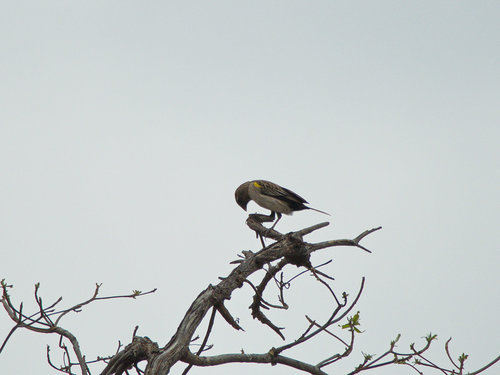
Yellow-mantled Widowbird (Euplectes macroura) Yellow-mantled Widowbird
Buff-shouldered Widowbird (Euplectes psammacromius) Buff-shouldered Widowbird

Media

Loading…

In short

The most reliable field mark between Yellow-mantled Widowbird and Buff-shouldered Widowbird is the color and extent of the shoulder patch: Yellow-mantled shows a bright golden yellow mantle or shoulder (sometimes extending onto the back), while Buff-shouldered has a more restricted yellow shoulder patch. Both species’ breeding males are mostly black with long tails, but the shape and intensity of the yellow patch, especially in flight or from the side, is key. In non-breeding or female/immature plumages, both are streaky brown and black, making separation very difficult without close views of the shoulder area. Structure and size are similar, so focus on plumage details, especially the yellow on the upperparts.

Identification tips

  1. Shoulder patch color and extent (breeding males): Yellow-mantled Widowbird males have a broad, bright golden yellow mantle or back, while Buff-shouldered males have a more limited yellow shoulder patch. Look for how far the yellow extends onto the back—if it is broad and obvious, favor Yellow-mantled.
  2. Shoulder patch (non-breeding, females, immatures): Both species retain some yellow on the shoulder in all plumages, but it is more restricted and less obvious in Buff-shouldered. In duller birds, look carefully for any yellow—if it is extensive, lean toward Yellow-mantled.
  3. Back color (breeding males): Yellow-mantled may show yellow extending onto the back (mantle), while Buff-shouldered does not. If you see yellow on the back, it is diagnostic for Yellow-mantled.
  4. Tail length and shape: Both species’ breeding males have long tails, so this is not useful for separation.
  5. Body size and structure: Both are similar in size and shape; do not use size as a field mark.
  6. Non-breeding and immature confusion: In non-breeding plumage or for females/immatures, both are streaky brown and black with some yellow on the shoulder. Separation is very difficult and may not be possible without close views of the shoulder area.
  7. Flight views: In flight, try to catch the extent of yellow on the upperparts—broad yellow favors Yellow-mantled, while a small patch favors Buff-shouldered.
  8. Geographic context: If you know your location, Buff-shouldered is more likely in eastern montane marshes, Yellow-mantled in West Africa, but range overlap and vagrancy are possible, so do not rely solely on geography.
  9. Sex and season: Only breeding males show the full black-and-yellow contrast; females and non-breeding birds are much duller and harder to separate.
  10. No known differences in juvenile/immature wing pattern: There are no described differences in upperwing pattern for young birds, so do not use this feature.
  11. No vocal differences described: Calls and songs are not described as different in available sources.
  12. When in doubt: If you cannot see the extent of yellow on the upperparts, identification may not be possible in the field, especially for non-breeding or immature birds.
  13. Photograph for later review: If possible, photograph the bird’s upperparts and shoulder area for later study, as subtle differences may be more apparent in images.
  14. Do not use tail length or body size: These are not reliable for separation between these two species.
  15. Consult local checklists: If you are in a region where only one species is expected, this may help, but always try to confirm with plumage details.

Size

Both species are similar in size and structure, with no reliable difference in the field. The only available measurement (body mass) for Yellow-mantled Widowbird is 22g [wikidata], and there is no published mass for Buff-shouldered. Both are medium-sized widowbirds with similar proportions, so size is not a useful field mark.

Plumage

In breeding season, adult males of both species are mostly black with long tails and yellow shoulder patches. Yellow-mantled Widowbird males have a bright golden yellow mantle or back (sometimes extending broadly), while Buff-shouldered males show a more discrete yellow shoulder patch. The yellow on Buff-shouldered is more restricted and does not extend onto the back. In non-breeding season and in females/immatures, both species are streaked brown and black, and both retain some yellow on the shoulder, but it is less obvious and more difficult to use for separation. There are no described differences in juvenile or immature upperwing patterns, so focus on the extent and brightness of yellow on the upperparts in all plumages.

Behaviour

Both species display typical widowbird behavior, with males performing display flights over grasslands during the breeding season. No behavioral differences are noted in the sources, so behavior is not useful for separation.

Habitat

Both species occupy similar open grassland and marshy habitats in Africa. The Buff-shouldered (Montane) Widowbird is more associated with montane and marshy areas in the eastern Afrotropics, while Yellow-mantled is found in West Africa, but habitat alone is not sufficient for field separation where their ranges overlap or in ambiguous habitat.

Submit a better description

Use the same sections as the comparison. Your text is published immediately.

The most reliable field mark between Yellow-mantled Widowbird and Buff-shouldered Widowbird is the color and extent of the shoulder patch: Yellow-mantled shows a bright golden yellow mantle or shoulder (sometimes extending onto the back), while Buff-shouldered has a more restricted yellow shoulder patch. Both species’ breeding males are mostly black with long tails, but the shape and intensity of the yellow patch, especially in flight or from the side, is key. In non-breeding or female/immature plumages, both are streaky brown and black, making separation very difficult without close views of the shoulder area. Structure and size are similar, so focus on plumage details, especially the yellow on the upperparts.

  1. Shoulder patch color and extent (breeding males): Yellow-mantled Widowbird males have a broad, bright golden yellow mantle or back, while Buff-shouldered males have a more limited yellow shoulder patch. Look for how far the yellow extends onto the back—if it is broad and obvious, favor Yellow-mantled.
  2. Shoulder patch (non-breeding, females, immatures): Both species retain some yellow on the shoulder in all plumages, but it is more restricted and less obvious in Buff-shouldered. In duller birds, look carefully for any yellow—if it is extensive, lean toward Yellow-mantled.
  3. Back color (breeding males): Yellow-mantled may show yellow extending onto the back (mantle), while Buff-shouldered does not. If you see yellow on the back, it is diagnostic for Yellow-mantled.
  4. Tail length and shape: Both species’ breeding males have long tails, so this is not useful for separation.
  5. Body size and structure: Both are similar in size and shape; do not use size as a field mark.
  6. Non-breeding and immature confusion: In non-breeding plumage or for females/immatures, both are streaky brown and black with some yellow on the shoulder. Separation is very difficult and may not be possible without close views of the shoulder area.
  7. Flight views: In flight, try to catch the extent of yellow on the upperparts—broad yellow favors Yellow-mantled, while a small patch favors Buff-shouldered.
  8. Geographic context: If you know your location, Buff-shouldered is more likely in eastern montane marshes, Yellow-mantled in West Africa, but range overlap and vagrancy are possible, so do not rely solely on geography.
  9. Sex and season: Only breeding males show the full black-and-yellow contrast; females and non-breeding birds are much duller and harder to separate.
  10. No known differences in juvenile/immature wing pattern: There are no described differences in upperwing pattern for young birds, so do not use this feature.
  11. No vocal differences described: Calls and songs are not described as different in available sources.
  12. When in doubt: If you cannot see the extent of yellow on the upperparts, identification may not be possible in the field, especially for non-breeding or immature birds.
  13. Photograph for later review: If possible, photograph the bird’s upperparts and shoulder area for later study, as subtle differences may be more apparent in images.
  14. Do not use tail length or body size: These are not reliable for separation between these two species.
  15. Consult local checklists: If you are in a region where only one species is expected, this may help, but always try to confirm with plumage details.

Both species are similar in size and structure, with no reliable difference in the field. The only available measurement (body mass) for Yellow-mantled Widowbird is 22g [wikidata], and there is no published mass for Buff-shouldered. Both are medium-sized widowbirds with similar proportions, so size is not a useful field mark.

In breeding season, adult males of both species are mostly black with long tails and yellow shoulder patches. Yellow-mantled Widowbird males have a bright golden yellow mantle or back (sometimes extending broadly), while Buff-shouldered males show a more discrete yellow shoulder patch. The yellow on Buff-shouldered is more restricted and does not extend onto the back. In non-breeding season and in females/immatures, both species are streaked brown and black, and both retain some yellow on the shoulder, but it is less obvious and more difficult to use for separation. There are no described differences in juvenile or immature upperwing patterns, so focus on the extent and brightness of yellow on the upperparts in all plumages.

Both species display typical widowbird behavior, with males performing display flights over grasslands during the breeding season. No behavioral differences are noted in the sources, so behavior is not useful for separation.

Both species occupy similar open grassland and marshy habitats in Africa. The Buff-shouldered (Montane) Widowbird is more associated with montane and marshy areas in the eastern Afrotropics, while Yellow-mantled is found in West Africa, but habitat alone is not sufficient for field separation where their ranges overlap or in ambiguous habitat.

Discard your changes?

You have unsaved edits. If you leave now, those changes will be lost.

Yellow-mantled Widowbird · Buff-shouldered Widowbird · My Tricky Birds