

Motmot

Yellow-crowned Tyrannulet vs Yellow-rumped Cacique

Tyrannulus elatus versus Cacicus cela

Play a quiz with Yellow-crowned Tyrannulet and Yellow-rumped Cacique
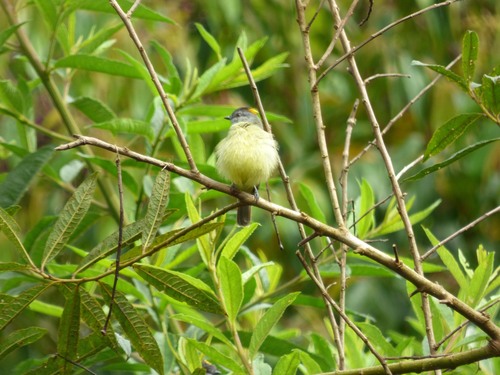
Yellow-crowned Tyrannulet (Tyrannulus elatus) Yellow-crowned Tyrannulet
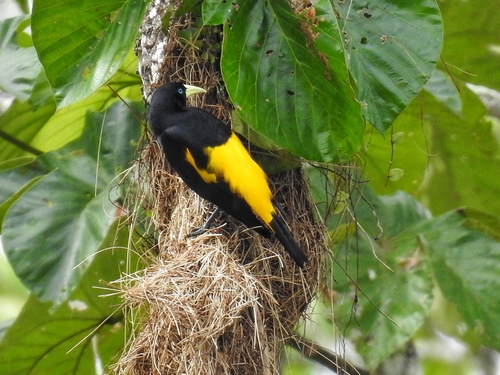
Yellow-rumped Cacique (Cacicus cela) Yellow-rumped Cacique

Media

Loading…

In short

The most reliable field mark to separate Yellow-crowned Tyrannulet from Yellow-rumped Cacique is overall size and structure: the tyrannulet is a tiny, short-billed flycatcher with subtle yellow and olive tones, while the cacique is a much larger, long-tailed blackbird with striking yellow patches on the rump, lower belly, and wing epaulets. In all plumages, the cacique’s glossy black body with sharply contrasting yellow, blue eyes, and pale pointed bill are unmistakable, especially in flight. The tyrannulet’s yellow is limited to a crown stripe and underparts, never forming large patches. Even at a distance, the cacique’s size, shape, and color blocks are diagnostic, while the tyrannulet’s delicate proportions and muted colors set it apart.

Identification tips

  1. Size is the quickest check: If the bird is large, nearly jay-sized, it is a cacique; if tiny and sparrow-sized, it is a tyrannulet. This holds for all ages and sexes.
  2. Bill shape and color: Cacique has a long, pointed, pale yellow bill; tyrannulet has a short, rounded, black bill. Bill color is especially useful at close range.
  3. Eye color: Cacique adults have striking blue eyes; tyrannulet has brown eyes. Juvenile caciques have dark eyes, so this is less reliable for immatures.
  4. Plumage blocks: Cacique shows bold yellow on rump, lower belly, and wing epaulets, contrasting with black body. Tyrannulet has only a yellowish crown stripe and pale yellow underparts, never large yellow patches.
  5. Wing pattern in flight: Cacique’s yellow epaulets and rump flash in flight; tyrannulet shows only faint wingbars and a small crown stripe, with no large yellow areas visible.
  6. Tail length and shape: Cacique has a long, straight tail; tyrannulet’s tail is short and rounded.
  7. General jizz: Cacique is slim, long, and active, often in groups; tyrannulet is small, compact, and more solitary or in pairs.
  8. Sex and age differences: Female and juvenile caciques are duller but retain the yellow rump and epaulets; tyrannulet females are slightly paler but never show bold yellow patches.
  9. Habitat context: Large, noisy groups in tall trees or colonies suggest cacique; single birds or pairs in forest edge or second growth are more likely tyrannulet.
  10. Vocalizations: Loud, varied, and musical sounds point to cacique; tyrannulet is quieter and less conspicuous vocally.
  11. Supercilium and facial pattern: Tyrannulet has a grayish supercilium and thin dark eye line; cacique’s face is mostly black with blue eyes and pale bill.
  12. Nesting behavior: If you see hanging nests in a colony, these are caciques; tyrannulet nests are small cups placed high but not in colonies.
  13. Iris color in juveniles: Juvenile caciques have dark eyes, so use other marks for immatures.
  14. Mistaken at a distance: If you see a flash of yellow in a large black bird, it is cacique; if yellow is limited to a crown stripe or underparts on a small bird, it is tyrannulet.
  15. Regional abundance: Both species can be common in their range, but caciques are often more conspicuous due to their social behavior and vocalizations.

Size

Yellow-crowned Tyrannulet is a tiny bird, weighing about 7 grams and measuring 10–11 cm in length. In contrast, the Yellow-rumped Cacique is much larger: males reach 28 cm and 104 grams, and even females are over twice the length and nearly ten times the mass of the tyrannulet. This size gap is obvious in the field—caciques look long, slim, and almost crow-like, while tyrannulets are petite, short-billed, and sparrow-sized. If both species are present, the cacique will dwarf the tyrannulet.

Plumage

There is no overlap in age-specific wing or flight patterns: the cacique, in all ages, shows large, bright yellow patches on the rump, lower belly, and wing epaulets against a black body, while the tyrannulet is olive-green above with a yellowish crown stripe and pale yellow underparts, lacking any bold color blocks. Juvenile caciques resemble duller females but retain the yellow rump and epaulets, and have dark eyes and a brownish bill base. Tyrannulets, regardless of age or sex, never show extensive yellow on the wings or rump—only subtle wingbars and a crown stripe. In flight, the cacique’s yellow rump and wing epaulets flash conspicuously, while the tyrannulet remains inconspicuous, with only faint wingbars and a small crown stripe. The cacique’s blue eyes and pale yellow pointed bill are also unique, while the tyrannulet has a brown iris and a short, rounded black bill.

Behaviour

Yellow-crowned Tyrannulet is usually seen singly or in pairs, often perched quietly in the mid to upper canopy, making short sallies for insects. Its movements are quick and delicate. In contrast, Yellow-rumped Cacique is highly social, often found in noisy colonies or flocks, especially near nesting sites. Caciques are active, conspicuous, and frequently fly between treetops, their bright yellow patches flashing. Their behavior is more reminiscent of orioles or grackles than flycatchers.

Habitat

Both species can occur in overlapping regions of Central and northern South America, but their preferred habitats differ. Yellow-crowned Tyrannulet favors forest edges, open woodlands, and second growth, often in the canopy but sometimes lower. Yellow-rumped Cacique is more closely tied to tall forests, river edges, and especially areas with large trees suitable for colonial nesting. If you see a large, noisy group in a tall tree, it is almost certainly caciques.

Voice

The cacique’s vocalizations are loud, varied, and complex—males produce a mix of fluting notes, cackles, wheezes, and mimicry, and a colony is audible from far away. The tyrannulet’s voice is not described in the provided notes, but as a small flycatcher, it is unlikely to match the cacique’s volume or complexity. If you hear a raucous, musical chorus, suspect cacique.

Submit a better description

Use the same sections as the comparison. Your text is published immediately.

The most reliable field mark to separate Yellow-crowned Tyrannulet from Yellow-rumped Cacique is overall size and structure: the tyrannulet is a tiny, short-billed flycatcher with subtle yellow and olive tones, while the cacique is a much larger, long-tailed blackbird with striking yellow patches on the rump, lower belly, and wing epaulets. In all plumages, the cacique’s glossy black body with sharply contrasting yellow, blue eyes, and pale pointed bill are unmistakable, especially in flight. The tyrannulet’s yellow is limited to a crown stripe and underparts, never forming large patches. Even at a distance, the cacique’s size, shape, and color blocks are diagnostic, while the tyrannulet’s delicate proportions and muted colors set it apart.

  1. Size is the quickest check: If the bird is large, nearly jay-sized, it is a cacique; if tiny and sparrow-sized, it is a tyrannulet. This holds for all ages and sexes.
  2. Bill shape and color: Cacique has a long, pointed, pale yellow bill; tyrannulet has a short, rounded, black bill. Bill color is especially useful at close range.
  3. Eye color: Cacique adults have striking blue eyes; tyrannulet has brown eyes. Juvenile caciques have dark eyes, so this is less reliable for immatures.
  4. Plumage blocks: Cacique shows bold yellow on rump, lower belly, and wing epaulets, contrasting with black body. Tyrannulet has only a yellowish crown stripe and pale yellow underparts, never large yellow patches.
  5. Wing pattern in flight: Cacique’s yellow epaulets and rump flash in flight; tyrannulet shows only faint wingbars and a small crown stripe, with no large yellow areas visible.
  6. Tail length and shape: Cacique has a long, straight tail; tyrannulet’s tail is short and rounded.
  7. General jizz: Cacique is slim, long, and active, often in groups; tyrannulet is small, compact, and more solitary or in pairs.
  8. Sex and age differences: Female and juvenile caciques are duller but retain the yellow rump and epaulets; tyrannulet females are slightly paler but never show bold yellow patches.
  9. Habitat context: Large, noisy groups in tall trees or colonies suggest cacique; single birds or pairs in forest edge or second growth are more likely tyrannulet.
  10. Vocalizations: Loud, varied, and musical sounds point to cacique; tyrannulet is quieter and less conspicuous vocally.
  11. Supercilium and facial pattern: Tyrannulet has a grayish supercilium and thin dark eye line; cacique’s face is mostly black with blue eyes and pale bill.
  12. Nesting behavior: If you see hanging nests in a colony, these are caciques; tyrannulet nests are small cups placed high but not in colonies.
  13. Iris color in juveniles: Juvenile caciques have dark eyes, so use other marks for immatures.
  14. Mistaken at a distance: If you see a flash of yellow in a large black bird, it is cacique; if yellow is limited to a crown stripe or underparts on a small bird, it is tyrannulet.
  15. Regional abundance: Both species can be common in their range, but caciques are often more conspicuous due to their social behavior and vocalizations.

Yellow-crowned Tyrannulet is a tiny bird, weighing about 7 grams and measuring 10–11 cm in length. In contrast, the Yellow-rumped Cacique is much larger: males reach 28 cm and 104 grams, and even females are over twice the length and nearly ten times the mass of the tyrannulet. This size gap is obvious in the field—caciques look long, slim, and almost crow-like, while tyrannulets are petite, short-billed, and sparrow-sized. If both species are present, the cacique will dwarf the tyrannulet.

There is no overlap in age-specific wing or flight patterns: the cacique, in all ages, shows large, bright yellow patches on the rump, lower belly, and wing epaulets against a black body, while the tyrannulet is olive-green above with a yellowish crown stripe and pale yellow underparts, lacking any bold color blocks. Juvenile caciques resemble duller females but retain the yellow rump and epaulets, and have dark eyes and a brownish bill base. Tyrannulets, regardless of age or sex, never show extensive yellow on the wings or rump—only subtle wingbars and a crown stripe. In flight, the cacique’s yellow rump and wing epaulets flash conspicuously, while the tyrannulet remains inconspicuous, with only faint wingbars and a small crown stripe. The cacique’s blue eyes and pale yellow pointed bill are also unique, while the tyrannulet has a brown iris and a short, rounded black bill.

Yellow-crowned Tyrannulet is usually seen singly or in pairs, often perched quietly in the mid to upper canopy, making short sallies for insects. Its movements are quick and delicate. In contrast, Yellow-rumped Cacique is highly social, often found in noisy colonies or flocks, especially near nesting sites. Caciques are active, conspicuous, and frequently fly between treetops, their bright yellow patches flashing. Their behavior is more reminiscent of orioles or grackles than flycatchers.

Both species can occur in overlapping regions of Central and northern South America, but their preferred habitats differ. Yellow-crowned Tyrannulet favors forest edges, open woodlands, and second growth, often in the canopy but sometimes lower. Yellow-rumped Cacique is more closely tied to tall forests, river edges, and especially areas with large trees suitable for colonial nesting. If you see a large, noisy group in a tall tree, it is almost certainly caciques.

The cacique’s vocalizations are loud, varied, and complex—males produce a mix of fluting notes, cackles, wheezes, and mimicry, and a colony is audible from far away. The tyrannulet’s voice is not described in the provided notes, but as a small flycatcher, it is unlikely to match the cacique’s volume or complexity. If you hear a raucous, musical chorus, suspect cacique.

Discard your changes?

You have unsaved edits. If you leave now, those changes will be lost.

Yellow-crowned Tyrannulet · Yellow-rumped Cacique · My Tricky Birds