
Yellow-crowned Tyrannulet vs Greenish Elaenia
Tyrannulus elatus versus Myiopagis viridicata
Play a quiz with Yellow-crowned Tyrannulet and Greenish Elaenia
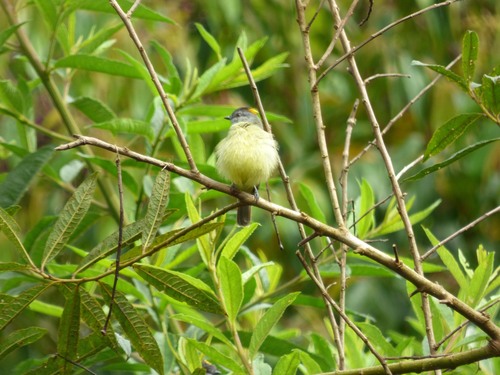 Yellow-crowned Tyrannulet
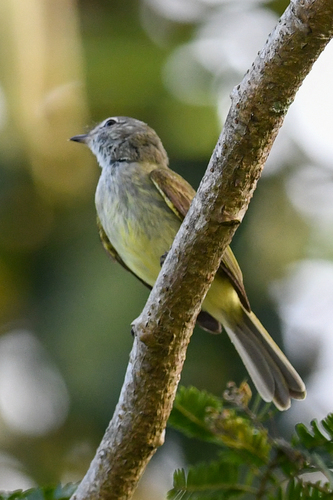 Greenish Elaenia
In short
The most reliable field mark to separate Yellow-crowned Tyrannulet from Greenish Elaenia is size: the tyrannulet is noticeably smaller and lighter, with a more delicate build. In plumage, the tyrannulet shows a sharply defined, bright yellow or orange-yellow crown stripe on a darker crown, while the elaenia has a more diffuse, partially hidden yellow crown stripe on a greenish-olive crown. Both have olive upperparts and pale yellow underparts, but the tyrannulet is brighter below and has a more contrasting head pattern. Structural differences, especially bill size and overall proportions, are also key. Immature-specific wing patterns are not described for either species, so focus on adult plumage and structure.
Identification tips
- Size is the clearest separator: If the bird is noticeably tiny and delicate, think Yellow-crowned Tyrannulet; if it is mid-sized and bulkier, think Greenish Elaenia. This is especially reliable when seen alongside other flycatchers.
- Crown stripe: Look for a sharply defined, bright yellow or orange-yellow stripe on a dark (slate-gray to blackish) crown for tyrannulet. Elaenia's crown stripe is faint, often hidden, and the crown is greenish-olive rather than dark. This mark is best seen in good light or when the bird raises its crown feathers.
- Head pattern: Tyrannulet has a clear grayish supercilium and a thin, dark eye-line, giving a crisp facial look. Elaenia's supercilium is paler, with a partial white eyering and grizzled ear coverts, making the face look less sharply marked.
- Bill shape: Tyrannulet has a short, rounded black bill; elaenia's bill is larger, stouter, and may have a lighter base to the mandible. Bill size is often visible in profile or when the bird is calling.
- Wingbars: Both species have pale wingbars, but tyrannulet's are white to yellowish white and often brighter, while elaenia's are yellowish and may blend more with the wing.
- Underparts: Tyrannulet is generally brighter yellow below, with an olive wash on the breast; elaenia is paler, with a grayish white breast (sometimes lightly streaked) and a pale yellow belly. In poor light, this difference can be subtle.
- Upperparts: Tyrannulet's nape and back are bright olive-green, while elaenia's upperparts can be duller or brighter depending on subspecies, but are always olive-green.
- Tail: Both have dusky olive tails, so do not rely on tail color for separation.
- Sex/age variation: Female tyrannulets are slightly paler and smaller, but the sharp crown stripe is always present. Elaenia males have a slightly larger yellow crown patch, but it is still faint. No distinctive juvenile/immature wing patterns are described for either species.
- Behavior: Tyrannulet may appear more active and delicate, flicking wings and tail, while elaenia is steadier and less restless.
- Habitat: Both occur in similar wooded and edge habitats; do not rely on habitat alone for separation.
- Range: Both overlap widely in Central and South America, but check local status; elaenia is absent from Chile and French Guiana, tyrannulet from southernmost South America.
- Mixed flocks: Both can join mixed-species flocks, so do not assume identity based on flock composition.
- Voice: Not described here; use with caution unless familiar with both species' calls.
- When in doubt: Prioritize size, crown stripe sharpness, and overall head pattern for the most reliable field separation.
Size
Yellow-crowned Tyrannulet is much smaller and lighter (7 g, 10–11 cm) than Greenish Elaenia (14 g, 13–14 cm) [wikidata]. The tyrannulet appears dainty and compact, with a short, rounded bill, while the elaenia is bulkier and longer overall, with a slightly larger, stouter bill. In the field, the difference is obvious if both are seen together or compared to familiar flycatchers: the tyrannulet is among the smallest tyrannids, while the elaenia is mid-sized.
Plumage
- Crown stripe: Adult Yellow-crowned Tyrannulet has a sharply defined, bright yellow to orange-yellow stripe running along the middle of a slate-gray to blackish crown, very striking and contrasting. In contrast, Greenish Elaenia's crown is greenish-olive with only a faint, partially hidden yellow stripe (more extensive in males), blending into the crown and rarely obvious unless the feathers are raised.
- Head pattern: Tyrannulet shows a grayish supercilium and a thin dark eye-line, with a pale gray lower face. Elaenia has a whitish gray supercilium, a partial white eyering, and grizzled whitish ear coverts, giving a more muted, less sharply marked face.
- Upperparts: Both are olive-green above, but the tyrannulet's nape and back are brighter, while the elaenia's upperparts can vary from dull to bright olive-green depending on subspecies.
- Wings: Both have dusky wings with pale wingbars, but the tyrannulet's bars are white to yellowish white and often stand out more. Elaenia's wingbars are yellowish, and the inner flight feathers have yellowish edges.
- Underparts: Tyrannulet is pale to medium yellow below with an olive wash on the breast; elaenia is paler, with a pale grayish white breast (sometimes lightly streaked olive) and pale yellow belly and undertail. Subtle, but the tyrannulet is generally brighter and more uniform below.
- Tail: Both have dusky olive tails, not a strong separator.
- Sex/age differences: Female tyrannulets are slightly paler and smaller, but the crown stripe is always sharper than in elaenia. No juvenile/immature-specific wing patterns are described for either species.
Behaviour
Both species are active, arboreal flycatchers, often foraging in the mid to upper canopy. The tyrannulet, being smaller, may appear more delicate and quick in its movements, often flicking its wings and tail. The elaenia, with its larger size, can seem more deliberate and less restless. Both may join mixed-species flocks, but the tyrannulet is more likely to be overlooked due to its size and subtlety.
Habitat
Ranges overlap widely in Central and South America, but the tyrannulet is absent from southernmost South America, while the elaenia is absent only from Chile and French Guiana [wikipedia]. Both use a variety of wooded and edge habitats, but local abundance may differ: Greenish Elaenia is often described as uncommon to common but easily overlooked, while the tyrannulet is widespread but less frequently reported. Both can be found in forest edges, second growth, and open woodland, so habitat is not a strong separator.
Yellow-crowned Tyrannulet · Greenish Elaenia · My Tricky Birds