

Yellow-billed Cuckoo vs Mangrove Cuckoo
Coccyzus americanus versus Coccyzus minor
Play a quiz with Yellow-billed Cuckoo and Mangrove Cuckoo
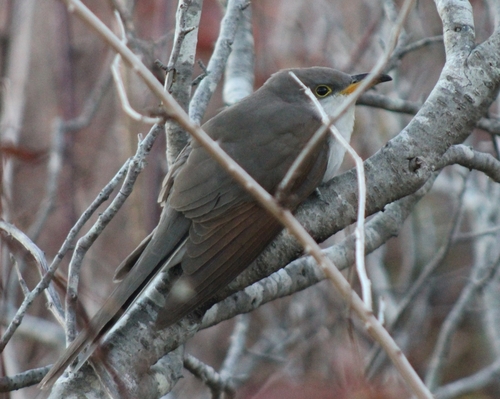 Yellow-billed Cuckoo
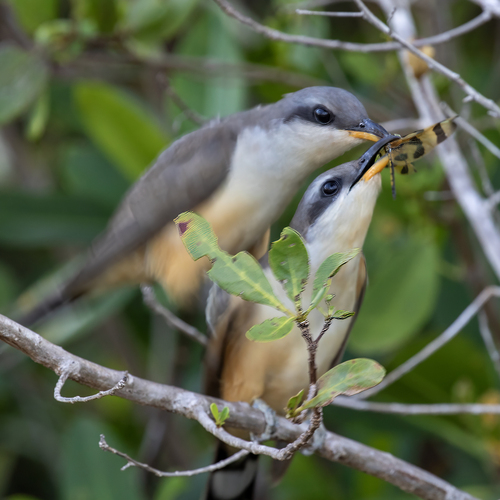 Mangrove Cuckoo
In short
The most reliable field mark to separate Yellow-billed Cuckoo from Mangrove Cuckoo is the presence of a bold black facial mask and buffy underparts on the Mangrove Cuckoo, which are absent on Yellow-billed. Both species share a long tail with black-and-white below, brown upperparts, and a black curved bill with yellow on the lower mandible, so confusion is easy, especially in quick or distant views. Juvenile Yellow-billed Cuckoos have gray (not black) undertail spots, but this is subtle and rarely diagnostic at a distance. In flight, Yellow-billed shows obvious cinnamon in the wings, a feature not mentioned for Mangrove. Structurally, Mangrove Cuckoo is slightly larger and heavier on average, but this is not a strong field mark. Habitat is often the best clue: Mangrove Cuckoo is restricted to mangroves and coastal thickets, while Yellow-billed is more widespread in woodlands and riparian areas.
Identification tips
- Black facial mask (adult Mangrove only): Look for a bold black line through the eye and cheek on Mangrove Cuckoo; Yellow-billed never shows this feature. This is the single best mark at any range.
- Underparts color: Mangrove Cuckoo has distinctly buffy underparts, while Yellow-billed Cuckoo's are clean white. Lighting can affect this, so check for a warm wash versus crisp white.
- Cinnamon in wings (Yellow-billed only): In flight, Yellow-billed Cuckoo flashes rich cinnamon in the wings, especially visible from below or in strong light. Mangrove Cuckoo does not show this.
- Juvenile undertail spots: Juvenile Yellow-billed Cuckoos have gray undertail spots instead of black. This is subtle and usually only seen at close range or in photos.
- Bill pattern: Both have a black curved bill with yellow on the lower mandible. This is not useful for separation.
- Tail pattern: Both species have a long tail with black-and-white below. Tail pattern is not diagnostic between these two.
- Eye-ring: Both show a yellow eye-ring; not a separating feature.
- Size and structure: Mangrove Cuckoo averages slightly larger and heavier, but this is not reliable in the field unless seen together.
- Habitat: If you are in mangroves or dense coastal thickets, Mangrove Cuckoo is likely. Away from mangroves, especially in inland woodlands or riparian forests, Yellow-billed is much more probable.
- Voice: Listen for the Mangrove Cuckoo's guttural 'gawk gawk' call. If you hear this, you are likely hearing Mangrove, not Yellow-billed.
- Sex and season: Both species are sexually monomorphic and do not show strong seasonal plumage changes, so these are not useful for separation.
- Behavior: Both are secretive and often perch motionless in dense foliage. Behavior is not a reliable separator.
- Range: Mangrove Cuckoo is a Neotropical and southern Florida specialty; Yellow-billed is widespread in North America. Use range as a supporting clue, but not as a sole field mark.
- Quiz pitfalls: Most confusion arises from distant or backlit views, where the facial mask and underparts color are hard to judge. Try to get a clear look at the face and belly, and note any cinnamon in the wings during flight.
- Immature birds: If you suspect a juvenile, check for gray undertail spots (Yellow-billed) but do not rely solely on this unless seen well.
Size
Both species are similar in length (Yellow-billed: 26–30 cm; Mangrove: 28–34 cm) and wingspan (38–43 cm), but Mangrove Cuckoo is on average heavier (body mass 66–102 g vs. 55–65 g for Yellow-billed) [wikidata]. In practice, this size difference is subtle and not easily judged in the field unless seen side-by-side. The impression of bulk may be slightly greater in Mangrove, but both appear slim and long-tailed.
Plumage
- Juveniles: Yellow-billed Cuckoo juveniles have gray undertail spots instead of black, but otherwise resemble adults. No distinctive juvenile marks are described for Mangrove Cuckoo, so age-related separation is limited.
- Adults: Mangrove Cuckoo is best identified by its bold black facial mask and buffy (not white) underparts. Yellow-billed Cuckoo lacks the facial mask and has clean white underparts. Both have brown upperparts, a long tail with black-and-white below, and a black curved bill with yellow on the lower mandible. Both show a yellow eye-ring. In flight, Yellow-billed Cuckoo shows obvious cinnamon coloration in the wings, which is not mentioned for Mangrove and is a useful mark if seen well.
- Sexes: Both species are sexually monomorphic—males and females look alike.
Behaviour
Both species are typically sluggish and secretive, often remaining motionless in dense foliage. They may sally out for caterpillars or other insects. Yellow-billed Cuckoo is known for calling before storms ('rain crow'), but this is not a visual cue. No major behavioral differences are noted that aid in field separation.
Habitat
Habitat is a strong clue: Mangrove Cuckoo is largely restricted to mangrove forests and dense coastal thickets in the Neotropics and southern Florida. Yellow-billed Cuckoo is much more widespread, found in deciduous woodlands, riparian corridors, and open forests across much of North America. If you are not in or adjacent to mangroves, Mangrove Cuckoo is unlikely.
Voice
Mangrove Cuckoo gives a distinctive guttural 'gawk gawk gawk gawk gauk gauk' and a single 'whit' call. Yellow-billed Cuckoo's call is not described in the notes, but it is not known for the same guttural series. Voice can be helpful if the Mangrove's unique call is heard.