

Yellow-bellied Eremomela vs Green-backed Camaroptera
Eremomela icteropygialis versus Camaroptera brachyura
Play a quiz with Yellow-bellied Eremomela and Green-backed Camaroptera
 Yellow-bellied Eremomela
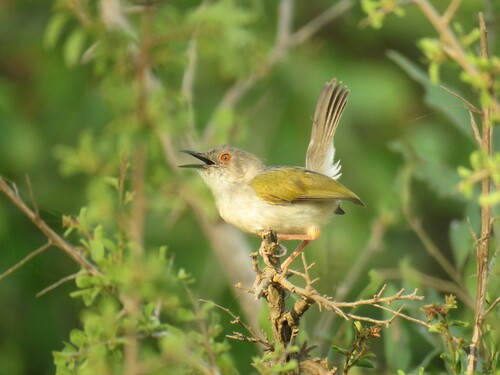 Green-backed Camaroptera
In short
The most reliable field mark to separate Yellow-bellied Eremomela from Green-backed Camaroptera is the color of the underparts: eremomela shows a distinctly yellow belly (though the tone varies by subspecies and age), while camaroptera has whitish-grey underparts. Both are small, active warblers in the Cisticolidae family, but eremomela is greyer above with a pale supercilium, whereas camaroptera is green-backed and lacks a strong facial pattern. Juveniles of both are duller below, but the eremomela retains some yellow. Both species are similar in size, but camaroptera is slightly heavier and longer-tailed. In the field, look for eremomela’s brighter lemon belly and contrasting grey head, versus camaroptera’s overall green and white appearance and preference for dense, low cover.
Identification tips
- Underparts color: The single best field mark is the belly color—Yellow-bellied Eremomela shows a distinctly yellow (lemon) belly in adults, while Green-backed Camaroptera is whitish-grey below. This holds for most subspecies and ages, though juvenile eremomelas are duller yellow.
- Upperparts: Eremomela is grey above, becoming more olive on the wings and tail; camaroptera is green-backed and olive-winged throughout. Look for the overall green tone in camaroptera versus the greyer, more contrasting look of eremomela.
- Facial pattern: Eremomela has a thin pale grey supercilium and a blackish stripe through the eye, giving it a more marked face. Camaroptera lacks a strong supercilium or eye-stripe and looks plainer in the face.
- Throat and breast: Some eremomela subspecies (especially in western southern Africa) have a whitish throat and breast, which can reduce the yellow impression, but the yellow belly is usually still visible. Camaroptera is consistently whitish-grey below, sometimes with a faint yellowish wash in juveniles.
- Bill color: Eremomela has a blackish bill; camaroptera’s bill color is not described, so this is not a reliable separator.
- Tail: Camaroptera is described as short-tailed, but this is subtle and not always obvious in the field.
- Size: Both are tiny, but camaroptera is slightly heavier and longer (11.5 cm vs. 10 cm), though this is rarely useful without direct comparison.
- Behavior: Camaroptera is much more skulking, staying low in dense cover and rarely coming into the open. Eremomela is more likely to be seen actively foraging in more open situations or higher in bushes.
- Habitat: If the bird is deep in tangled undergrowth, camaroptera is more likely; if it is in open woodland or shrub, eremomela is more likely, but there is overlap.
- Juvenile confusion: Both species are duller as juveniles, but eremomela juveniles retain some yellow on the underparts, while camaroptera juveniles are paler yellow on the breast but mostly whitish-grey below.
- Flight/wing pattern: No distinctive wing or flight marks are described for either species, so do not rely on upperwing pattern in flight.
- Voice: Eremomela gives a high-pitched, repeated "tchee-tchee-tchuut"; camaroptera’s call is not described here, so use voice with caution unless you know camaroptera’s bleating call.
- Sexes: Both species are sexually monomorphic—males and females look alike.
- Pitfalls: Beware of eremomela subspecies with paler throats and breasts, which can look less yellow below, and of camaroptera juveniles with a faint yellowish tinge on the breast. Always check for the overall yellow vs. whitish-grey impression on the underparts.
- Context: Use a combination of underparts color, face pattern, and behavior for the most reliable identification, especially when plumage is dull or the view is brief.
Size
Both species are very small warblers, but Green-backed Camaroptera is marginally heavier (10 g vs. about 9 g for eremomela) and slightly longer (11.5 cm for camaroptera, 10 cm for eremomela). The camaroptera is also described as short-tailed, but the difference is subtle in the field. Size alone is not a reliable separator, but camaroptera may look a bit more compact and heavier-bodied, especially when seen side-by-side.
Plumage
- Juvenile/immature plumage: Both species have duller underparts as juveniles, but Yellow-bellied Eremomela juveniles still show some yellow below, while camaroptera juveniles are paler yellow on the breast but generally much less saturated, tending toward whitish-grey.
- Adults: Eremomela adults have grey upperparts (darker and more olive on wings and tail), a thin pale grey supercilium, a blackish eye-stripe, and a lemon yellow belly. The throat and breast can be whitish in some subspecies, especially in western southern Africa. Camaroptera adults have green upperparts, olive wings, and whitish-grey underparts, with no strong facial markings. The sexes are similar in both species.
- Flight/wing pattern: No distinctive age-specific upperwing or flight marks are described for either species; separation relies on overall coloration and face pattern.
Behaviour
Green-backed Camaroptera is typically very skulking, staying low in dense cover and rarely venturing into the open. It often binds leaves together to build its nest low in bushes. Yellow-bellied Eremomela, while also active and warbler-like, is not described as particularly skulking and may be seen more readily in open situations or higher in bushes. Both are insectivorous and active, but camaroptera’s tendency to stay hidden is a behavioral clue.
Habitat
Both species inhabit a range of bushy and wooded habitats in sub-Saharan Africa, but Green-backed Camaroptera is especially associated with dense, low cover, often in thickets or tangled vegetation. Yellow-bellied Eremomela is less strictly tied to dense undergrowth and may be found in more open woodland or shrubland. Habitat alone is not diagnostic but can provide supporting context.
Voice
Yellow-bellied Eremomela gives a high-pitched, repeated "tchee-tchee-tchuut" call. No specific vocal description is provided for Green-backed Camaroptera in the notes, but it is known as the "bleating camaroptera," suggesting a different, possibly more nasal or bleating call. If you hear a high, repeated tchee-tchee-tchuut, eremomela is more likely; camaroptera’s call is not described here, so use caution.
Yellow-bellied Eremomela · Green-backed Camaroptera · My Tricky Birds