

Motmot

Xantus's Hummingbird vs Berylline Hummingbird

Basilinna xantusii versus Saucerottia beryllina

Play a quiz with Xantus's Hummingbird and Berylline Hummingbird
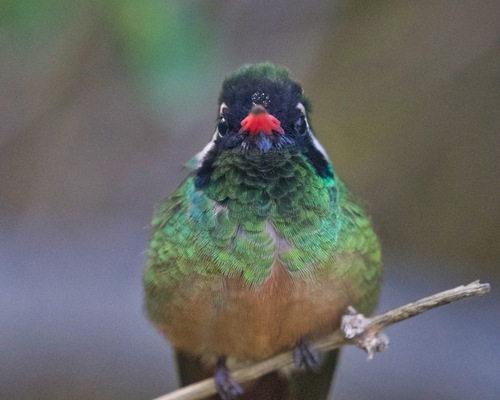
Xantus's Hummingbird (Basilinna xantusii) Xantus's Hummingbird
Berylline Hummingbird (Saucerottia beryllina) Berylline Hummingbird

Media

Loading…

In short

The most reliable field mark to separate Xantus's Hummingbird from Berylline Hummingbird is the striking facial pattern: Xantus's shows a bold white stripe behind the eye set against a mostly black face and chin, while Berylline lacks this contrast and has a more uniform green or bronze-green head. In flight or perched, Xantus's also stands out with its cinnamon underparts and rufous tail, compared to the Berylline's glittering green underparts and coppery tail. Bill color is another key: Xantus's has a mostly red bill with a black tip (male), while Berylline's is black with a pinkish base on the mandible. Juvenile and female plumages can be tricky, but the facial pattern and underpart color remain the best clues. Both are similar in size, but Berylline is slightly heavier and longer on average.

Identification tips

  1. Facial pattern (all ages/sexes): Xantus's Hummingbird always shows a bold white or buffy stripe behind the eye on a dark face, giving a strong contrast. Berylline lacks this mark, with a more uniform green or bronze-green head and face.
  2. Underpart color: Xantus's has cinnamon to pale cinnamon underparts in both sexes and all ages, sometimes with green mottling on the flanks. Berylline's underparts are glittering golden green in adult males, paler and more grayish in females, and only juveniles show a grayish cinnamon belly (never as rich as Xantus's).
  3. Bill color: Male Xantus's has a straight, mostly red bill with a black tip; female's bill is blackish with a pinkish base and pinkish red mandible with black tip. Berylline's bill is black with a pinkish base to the mandible (male) or entirely black (female). Bill color is best seen at close range.
  4. Tail pattern: Xantus's tail is rufous chestnut with green edges (male) or golden green central feathers and rufous outer feathers with a black/bronzy band and white tips (female). Berylline's tail is coppery to rufous but lacks the green edges and complex pattern; it is more uniformly colored.
  5. Crown and forehead: Xantus's male has a golden green to emerald green crown with a black forehead and chin, while Berylline's is bronze-green to coppery throughout, without the black forehead.
  6. Throat: Xantus's male has an iridescent emerald green throat sharply set off from the black chin and cinnamon belly; Berylline's throat is glittering green but blends smoothly into the rest of the underparts.
  7. Wing patch (Berylline only): Berylline shows a chestnut patch at the base of the primaries and secondaries on the closed wing, which can be visible in good light and is absent in Xantus's.
  8. Sex differences: Female Xantus's is duller but still shows the facial stripe and cinnamon underparts. Female Berylline is similar to the male but with a paler, more grayish throat and belly, and an all-black bill.
  9. Juvenile confusion: Juvenile Berylline has a grayish cinnamon belly, but still lacks the bold facial stripe and has a more uniform face; juvenile Xantus's keeps the facial stripe and cinnamon underparts.
  10. Size: Berylline is slightly heavier and longer, but this is rarely obvious unless both species are seen together.
  11. Range/habitat: In Baja California, Xantus's is expected; elsewhere, Berylline is more likely. Always confirm with plumage marks, as vagrancy can occur.
  12. Perched vs. in flight: The facial stripe and underpart color are visible both perched and in flight; tail pattern is best seen when the bird fans its tail.
  13. Uppertail coverts: Xantus's shows rufous edging on uppertail coverts (male) or golden green with rufous shaft (female); Berylline's uppertail coverts are coppery to rufous but less patterned.
  14. No strong behavioral or vocal differences: Both species behave similarly and are best separated by plumage and structure.
  15. Beware of lighting: Iridescent colors can shift with angle and light; rely on the facial stripe and underpart color as the most consistent marks.

Size

Both species are similar in length, with Xantus's Hummingbird at 8.5–9.5 cm and Berylline Hummingbird at 8–10 cm. However, Berylline is noticeably heavier (males ~4.4 g, females ~4.0 g) compared to Xantus's (males ~3.5 g, females ~3.4 g) [wikipedia][avonet]. In the field, this weight difference is subtle and rarely diagnostic, but Berylline may appear a bit bulkier, especially when seen side-by-side.

Plumage

Juvenile and female Xantus's Hummingbirds have a distinctive pale buffy or white stripe behind the eye on a dark face, which is lacking in Berylline of any age or sex. Xantus's underparts are cinnamon to pale cinnamon (all ages/sexes), while Berylline's are glittering golden green in adult males, paler and more grayish in females, and grayish cinnamon only in juveniles. Xantus's tail is rufous chestnut with green edges (male) or golden green central feathers and rufous outer feathers with black/bronzy bands and white tips (female), while Berylline's tail is coppery to rufous but lacks the complex pattern and green edges. Berylline also shows a chestnut patch at the base of the primaries/secondaries on the closed wing, which can be a subtle but useful mark in good light. Adult male Xantus's has a black forehead and chin, contrasting with its green throat, while Berylline's head and throat are more uniformly bronze-green to coppery.

Behaviour

Both species are active, fast-moving hummingbirds, often hovering at flowers or perching briefly. There are no strong behavioral differences noted in the sources that would reliably separate them in the field. Xantus's may move locally after breeding, but this is not a useful field mark for identification.

Habitat

Xantus's Hummingbird is endemic to the Baja California Peninsula, typically found in montane forests but can move down to sea level after breeding [wikipedia]. Berylline Hummingbird is found from Mexico to the southern United States and Central America, occupying a wider range of habitats including forests and edges. If seen outside Baja California, Berylline is far more likely, but within Baja, Xantus's is the default. However, habitat alone is not diagnostic where ranges overlap.

Submit a better description

Use the same sections as the comparison. Your text is published immediately.

The most reliable field mark to separate Xantus's Hummingbird from Berylline Hummingbird is the striking facial pattern: Xantus's shows a bold white stripe behind the eye set against a mostly black face and chin, while Berylline lacks this contrast and has a more uniform green or bronze-green head. In flight or perched, Xantus's also stands out with its cinnamon underparts and rufous tail, compared to the Berylline's glittering green underparts and coppery tail. Bill color is another key: Xantus's has a mostly red bill with a black tip (male), while Berylline's is black with a pinkish base on the mandible. Juvenile and female plumages can be tricky, but the facial pattern and underpart color remain the best clues. Both are similar in size, but Berylline is slightly heavier and longer on average.

  1. Facial pattern (all ages/sexes): Xantus's Hummingbird always shows a bold white or buffy stripe behind the eye on a dark face, giving a strong contrast. Berylline lacks this mark, with a more uniform green or bronze-green head and face.
  2. Underpart color: Xantus's has cinnamon to pale cinnamon underparts in both sexes and all ages, sometimes with green mottling on the flanks. Berylline's underparts are glittering golden green in adult males, paler and more grayish in females, and only juveniles show a grayish cinnamon belly (never as rich as Xantus's).
  3. Bill color: Male Xantus's has a straight, mostly red bill with a black tip; female's bill is blackish with a pinkish base and pinkish red mandible with black tip. Berylline's bill is black with a pinkish base to the mandible (male) or entirely black (female). Bill color is best seen at close range.
  4. Tail pattern: Xantus's tail is rufous chestnut with green edges (male) or golden green central feathers and rufous outer feathers with a black/bronzy band and white tips (female). Berylline's tail is coppery to rufous but lacks the green edges and complex pattern; it is more uniformly colored.
  5. Crown and forehead: Xantus's male has a golden green to emerald green crown with a black forehead and chin, while Berylline's is bronze-green to coppery throughout, without the black forehead.
  6. Throat: Xantus's male has an iridescent emerald green throat sharply set off from the black chin and cinnamon belly; Berylline's throat is glittering green but blends smoothly into the rest of the underparts.
  7. Wing patch (Berylline only): Berylline shows a chestnut patch at the base of the primaries and secondaries on the closed wing, which can be visible in good light and is absent in Xantus's.
  8. Sex differences: Female Xantus's is duller but still shows the facial stripe and cinnamon underparts. Female Berylline is similar to the male but with a paler, more grayish throat and belly, and an all-black bill.
  9. Juvenile confusion: Juvenile Berylline has a grayish cinnamon belly, but still lacks the bold facial stripe and has a more uniform face; juvenile Xantus's keeps the facial stripe and cinnamon underparts.
  10. Size: Berylline is slightly heavier and longer, but this is rarely obvious unless both species are seen together.
  11. Range/habitat: In Baja California, Xantus's is expected; elsewhere, Berylline is more likely. Always confirm with plumage marks, as vagrancy can occur.
  12. Perched vs. in flight: The facial stripe and underpart color are visible both perched and in flight; tail pattern is best seen when the bird fans its tail.
  13. Uppertail coverts: Xantus's shows rufous edging on uppertail coverts (male) or golden green with rufous shaft (female); Berylline's uppertail coverts are coppery to rufous but less patterned.
  14. No strong behavioral or vocal differences: Both species behave similarly and are best separated by plumage and structure.
  15. Beware of lighting: Iridescent colors can shift with angle and light; rely on the facial stripe and underpart color as the most consistent marks.

Both species are similar in length, with Xantus's Hummingbird at 8.5–9.5 cm and Berylline Hummingbird at 8–10 cm. However, Berylline is noticeably heavier (males ~4.4 g, females ~4.0 g) compared to Xantus's (males ~3.5 g, females ~3.4 g) [wikipedia][avonet]. In the field, this weight difference is subtle and rarely diagnostic, but Berylline may appear a bit bulkier, especially when seen side-by-side.

Juvenile and female Xantus's Hummingbirds have a distinctive pale buffy or white stripe behind the eye on a dark face, which is lacking in Berylline of any age or sex. Xantus's underparts are cinnamon to pale cinnamon (all ages/sexes), while Berylline's are glittering golden green in adult males, paler and more grayish in females, and grayish cinnamon only in juveniles. Xantus's tail is rufous chestnut with green edges (male) or golden green central feathers and rufous outer feathers with black/bronzy bands and white tips (female), while Berylline's tail is coppery to rufous but lacks the complex pattern and green edges. Berylline also shows a chestnut patch at the base of the primaries/secondaries on the closed wing, which can be a subtle but useful mark in good light. Adult male Xantus's has a black forehead and chin, contrasting with its green throat, while Berylline's head and throat are more uniformly bronze-green to coppery.

Both species are active, fast-moving hummingbirds, often hovering at flowers or perching briefly. There are no strong behavioral differences noted in the sources that would reliably separate them in the field. Xantus's may move locally after breeding, but this is not a useful field mark for identification.

Xantus's Hummingbird is endemic to the Baja California Peninsula, typically found in montane forests but can move down to sea level after breeding [wikipedia]. Berylline Hummingbird is found from Mexico to the southern United States and Central America, occupying a wider range of habitats including forests and edges. If seen outside Baja California, Berylline is far more likely, but within Baja, Xantus's is the default. However, habitat alone is not diagnostic where ranges overlap.

Discard your changes?

You have unsaved edits. If you leave now, those changes will be lost.

Xantus's Hummingbird · Berylline Hummingbird · My Tricky Birds