

Motmot

Wood Warbler vs Eastern Bonelli's Warbler

Phylloscopus sibilatrix versus Phylloscopus orientalis

Play a quiz with Wood Warbler and Eastern Bonelli's Warbler
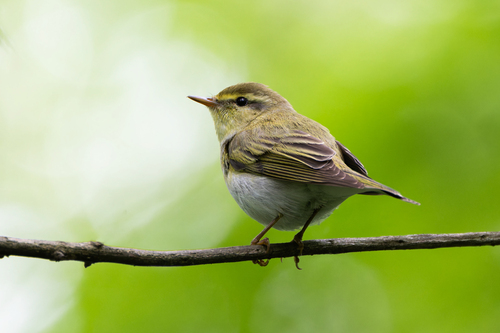
Wood Warbler (Phylloscopus sibilatrix) Wood Warbler
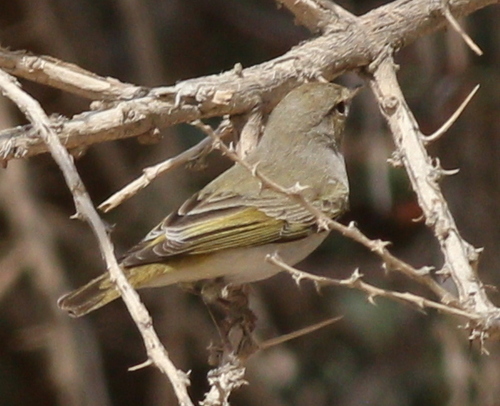
Eastern Bonelli's Warbler (Phylloscopus orientalis) Eastern Bonelli's Warbler

Media

Loading…

In short

Wood Warbler and Eastern Bonelli's Warbler can look similar at a glance, but Wood Warbler stands out with its bright lemon-yellow throat and breast, bold yellow supercilium, and longer primary projection. Eastern Bonelli's is plainer, with a grey-green back and only a faint greenish tinge, lacking any strong yellow on the underparts or face. In the field, Wood Warbler appears brighter and more contrasting, while Eastern Bonelli's is more subdued and uniform. Vocalizations are also very different: Wood Warbler's song is a fluid metallic trill, while Eastern Bonelli's gives a hard 'chup' call. Pay close attention to the face and underpart color, as well as the overall brightness and structure, to separate these two warblers.

Identification tips

  1. Yellow on Throat and Supercilium (Adults): Wood Warbler shows a bright lemon-yellow throat, upper breast, and a bold yellow supercilium. Eastern Bonelli's lacks any yellow on the underparts or face; its supercilium is faint and not yellow. This is the most reliable mark in all adult plumages.
  2. Underpart Color: Wood Warbler is white below with a clear yellow wash on the upper breast; Eastern Bonelli's is plain whitish below with no yellow at all.
  3. Upperparts Tone: Wood Warbler is green above, while Eastern Bonelli's is grey-green, sometimes with a faint greenish tinge but never as bright or saturated as Wood Warbler.
  4. Primary Projection: Wood Warbler has a noticeably longer primary projection (the length of the primaries beyond the tertials) and a shorter, broader tail. This gives it a more elongated, pointed-wing look when perched or in flight. Eastern Bonelli's has a shorter projection and a more compact appearance.
  5. Face Pattern: Wood Warbler's face is brighter and more contrasting due to the yellow supercilium and throat. Eastern Bonelli's face is plain, with a small, pointed bill and brown legs, but lacks any strong facial markings.
  6. Tertial Edges: Wood Warbler shows pale edges to the tertials, which can be a subtle but useful mark in good light. Eastern Bonelli's tertials are not described as having contrasting edges.
  7. Tail Structure: Wood Warbler's tail is shorter and broader compared to Eastern Bonelli's, which may appear slightly longer and narrower.
  8. Song: Wood Warbler's song is a fluid, metallic trill that speeds up, often alternating with descending piping notes. Eastern Bonelli's song is a fast, monotone trill, less musical and more even. Song alone can be confusing, but combined with other marks is helpful.
  9. Call: The call is a key separator: Wood Warbler gives a soft 'piü', while Eastern Bonelli's gives a hard 'chup' (like a crossbill or house sparrow). If you hear the call, identification is straightforward.
  10. Habitat and Range: In northern and temperate Europe, Wood Warbler is expected; Eastern Bonelli's is a rare vagrant. In southeast Europe and Asia Minor, Eastern Bonelli's is the breeder. Always consider location and season.
  11. Jizz and Movement: Wood Warbler may appear more restless and flicks its wings and tail frequently. Eastern Bonelli's is also active but moves more methodically.
  12. Age and Season: No detailed notes on juvenile or first-winter plumage differences, so rely on adult marks throughout the year. If in doubt, focus on the presence or absence of yellow on the face and throat.
  13. Confusion with Other Phylloscopus: Both can be confused with Willow Warbler or Chiffchaff, but those species show different combinations of supercilium, leg color, and underpart tone; always check for yellow and the strength of the supercilium.
  14. Structural Impression: Wood Warbler's longer wings and broader tail can give it a sleeker, more pointed look, especially when seen side-by-side with Eastern Bonelli's.
  15. Pitfalls: In poor light, Wood Warbler's yellow may look duller, and Eastern Bonelli's can appear greener than it is. Always try to see the throat and face in good light, and listen for calls if possible.

Size

Wood Warbler is slightly larger and heavier (body mass around 10g [wikidata]), with a longer primary projection and a somewhat broader tail. Eastern Bonelli's Warbler is a small warbler as well, but the notes do not provide a direct mass comparison; in the field, size difference is subtle and not reliable for separation. Both are typical leaf warbler size, but Wood Warbler may look a touch bulkier due to its structure.

Plumage

Juvenile and immature plumages are not described in detail for either species in the notes, but adults show clear differences. Wood Warbler is green above and white below, with a striking lemon-yellow throat, upper breast, and supercilium, and pale tertial edges. The yellow is most intense in fresh spring adults but remains a strong field mark. Eastern Bonelli's Warbler is plainer, with a grey-green back, green-toned rump and wings, and whitish underparts; it lacks any yellow wash on the throat or supercilium. Its face is plain, and the supercilium is much less obvious. Both species have pale underparts, but only Wood Warbler shows the bright yellow contrast. In flight, Wood Warbler's longer primary projection may be visible, while Bonelli's appears more compact and less contrasting overall.

Behaviour

Both species forage actively in woodland and forest, gleaning insects from foliage. Wood Warbler may appear more restless and is often seen flicking its wings and tail, sometimes sallying out for insects. Eastern Bonelli's Warbler is also active but tends to move more methodically through the canopy. Both nest on or near the ground. Behavioral differences are subtle and not usually diagnostic in the field.

Habitat

Wood Warbler breeds in northern and temperate Europe, favoring mature deciduous or mixed woodland with a well-developed canopy. Eastern Bonelli's Warbler breeds in southeast Europe and Asia Minor, also in forest and woodland, but is a rare vagrant in northern Europe. Both winter in sub-Saharan Africa. If found in central or northern Europe, Wood Warbler is the expected species; Eastern Bonelli's would be exceptional. Habitat overlap is possible in migration, but breeding ranges are largely separate.

Voice

Wood Warbler has two distinctive song types: a high-pitched, fluid metallic trill that accelerates, and a series of 3–5 descending piping notes ('piüü-piüü-piüü'). Its contact call is a soft, single piping note ('piü'). Eastern Bonelli's Warbler's song is a fast monotone trill, similar to Wood Warbler's but less musical and more even. Critically, the call is a hard 'chup', reminiscent of a crossbill or house sparrow, and completely different from Wood Warbler's softer notes. Calls are the most reliable vocal separator.

Submit a better description

Use the same sections as the comparison. Your text is published immediately.

Wood Warbler and Eastern Bonelli's Warbler can look similar at a glance, but Wood Warbler stands out with its bright lemon-yellow throat and breast, bold yellow supercilium, and longer primary projection. Eastern Bonelli's is plainer, with a grey-green back and only a faint greenish tinge, lacking any strong yellow on the underparts or face. In the field, Wood Warbler appears brighter and more contrasting, while Eastern Bonelli's is more subdued and uniform. Vocalizations are also very different: Wood Warbler's song is a fluid metallic trill, while Eastern Bonelli's gives a hard 'chup' call. Pay close attention to the face and underpart color, as well as the overall brightness and structure, to separate these two warblers.

  1. Yellow on Throat and Supercilium (Adults): Wood Warbler shows a bright lemon-yellow throat, upper breast, and a bold yellow supercilium. Eastern Bonelli's lacks any yellow on the underparts or face; its supercilium is faint and not yellow. This is the most reliable mark in all adult plumages.
  2. Underpart Color: Wood Warbler is white below with a clear yellow wash on the upper breast; Eastern Bonelli's is plain whitish below with no yellow at all.
  3. Upperparts Tone: Wood Warbler is green above, while Eastern Bonelli's is grey-green, sometimes with a faint greenish tinge but never as bright or saturated as Wood Warbler.
  4. Primary Projection: Wood Warbler has a noticeably longer primary projection (the length of the primaries beyond the tertials) and a shorter, broader tail. This gives it a more elongated, pointed-wing look when perched or in flight. Eastern Bonelli's has a shorter projection and a more compact appearance.
  5. Face Pattern: Wood Warbler's face is brighter and more contrasting due to the yellow supercilium and throat. Eastern Bonelli's face is plain, with a small, pointed bill and brown legs, but lacks any strong facial markings.
  6. Tertial Edges: Wood Warbler shows pale edges to the tertials, which can be a subtle but useful mark in good light. Eastern Bonelli's tertials are not described as having contrasting edges.
  7. Tail Structure: Wood Warbler's tail is shorter and broader compared to Eastern Bonelli's, which may appear slightly longer and narrower.
  8. Song: Wood Warbler's song is a fluid, metallic trill that speeds up, often alternating with descending piping notes. Eastern Bonelli's song is a fast, monotone trill, less musical and more even. Song alone can be confusing, but combined with other marks is helpful.
  9. Call: The call is a key separator: Wood Warbler gives a soft 'piü', while Eastern Bonelli's gives a hard 'chup' (like a crossbill or house sparrow). If you hear the call, identification is straightforward.
  10. Habitat and Range: In northern and temperate Europe, Wood Warbler is expected; Eastern Bonelli's is a rare vagrant. In southeast Europe and Asia Minor, Eastern Bonelli's is the breeder. Always consider location and season.
  11. Jizz and Movement: Wood Warbler may appear more restless and flicks its wings and tail frequently. Eastern Bonelli's is also active but moves more methodically.
  12. Age and Season: No detailed notes on juvenile or first-winter plumage differences, so rely on adult marks throughout the year. If in doubt, focus on the presence or absence of yellow on the face and throat.
  13. Confusion with Other Phylloscopus: Both can be confused with Willow Warbler or Chiffchaff, but those species show different combinations of supercilium, leg color, and underpart tone; always check for yellow and the strength of the supercilium.
  14. Structural Impression: Wood Warbler's longer wings and broader tail can give it a sleeker, more pointed look, especially when seen side-by-side with Eastern Bonelli's.
  15. Pitfalls: In poor light, Wood Warbler's yellow may look duller, and Eastern Bonelli's can appear greener than it is. Always try to see the throat and face in good light, and listen for calls if possible.

Wood Warbler is slightly larger and heavier (body mass around 10g [wikidata]), with a longer primary projection and a somewhat broader tail. Eastern Bonelli's Warbler is a small warbler as well, but the notes do not provide a direct mass comparison; in the field, size difference is subtle and not reliable for separation. Both are typical leaf warbler size, but Wood Warbler may look a touch bulkier due to its structure.

Juvenile and immature plumages are not described in detail for either species in the notes, but adults show clear differences. Wood Warbler is green above and white below, with a striking lemon-yellow throat, upper breast, and supercilium, and pale tertial edges. The yellow is most intense in fresh spring adults but remains a strong field mark. Eastern Bonelli's Warbler is plainer, with a grey-green back, green-toned rump and wings, and whitish underparts; it lacks any yellow wash on the throat or supercilium. Its face is plain, and the supercilium is much less obvious. Both species have pale underparts, but only Wood Warbler shows the bright yellow contrast. In flight, Wood Warbler's longer primary projection may be visible, while Bonelli's appears more compact and less contrasting overall.

Both species forage actively in woodland and forest, gleaning insects from foliage. Wood Warbler may appear more restless and is often seen flicking its wings and tail, sometimes sallying out for insects. Eastern Bonelli's Warbler is also active but tends to move more methodically through the canopy. Both nest on or near the ground. Behavioral differences are subtle and not usually diagnostic in the field.

Wood Warbler breeds in northern and temperate Europe, favoring mature deciduous or mixed woodland with a well-developed canopy. Eastern Bonelli's Warbler breeds in southeast Europe and Asia Minor, also in forest and woodland, but is a rare vagrant in northern Europe. Both winter in sub-Saharan Africa. If found in central or northern Europe, Wood Warbler is the expected species; Eastern Bonelli's would be exceptional. Habitat overlap is possible in migration, but breeding ranges are largely separate.

Wood Warbler has two distinctive song types: a high-pitched, fluid metallic trill that accelerates, and a series of 3–5 descending piping notes ('piüü-piüü-piüü'). Its contact call is a soft, single piping note ('piü'). Eastern Bonelli's Warbler's song is a fast monotone trill, similar to Wood Warbler's but less musical and more even. Critically, the call is a hard 'chup', reminiscent of a crossbill or house sparrow, and completely different from Wood Warbler's softer notes. Calls are the most reliable vocal separator.

Discard your changes?

You have unsaved edits. If you leave now, those changes will be lost.

Wood Warbler · Eastern Bonelli's Warbler · My Tricky Birds