

Wood Snipe vs Pin-tailed Snipe
Gallinago nemoricola versus Gallinago stenura
Play a quiz with Wood Snipe and Pin-tailed Snipe
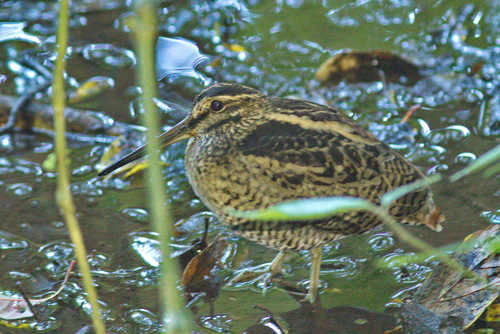 Wood Snipe
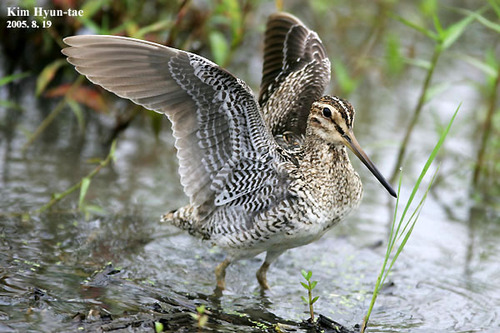 Pin-tailed Snipe
In short
The most reliable way to separate Wood Snipe from Pin-tailed Snipe is by overall structure and bulk: Wood Snipe is significantly larger and heavier-bodied, with a noticeably shorter, thicker bill and a darker, more uniform appearance. Pin-tailed Snipe is smaller, slimmer, and has a longer, finer bill, with a more patterned upperpart and distinctive tail shape in flight. If you see the bird in flight, look for the shorter, pin-like tail feathers of Pin-tailed Snipe, which can produce a whistling sound in display. Habitat can also help: Wood Snipe is a high-altitude Himalayan specialist, while Pin-tailed Snipe is more widespread and less tied to alpine meadows.
Identification tips
- Size and Bulk: Wood Snipe is much larger and heavier-bodied than Pin-tailed Snipe; look for a robust, broad-chested bird (all ages, all seasons).
- Bill Structure: Wood Snipe has a shorter, thicker bill; Pin-tailed Snipe’s bill is longer and finer (all ages, all seasons).
- Tail Shape in Flight: Pin-tailed Snipe has pin-like outer tail feathers that can be seen in flight or display; Wood Snipe’s tail is short and broad, lacking this feature (best in adult males, but can be seen in flushed birds of both sexes).
- Overall Plumage Tone: Wood Snipe is darker and more uniform above, with less contrast and fewer pale lines; Pin-tailed Snipe is more patterned, with cream lines down the back and a pale belly (all ages, but especially adults).
- Facial Pattern: Pin-tailed Snipe has a dark eye-stripe with pale lines above and below; Wood Snipe’s face is less strongly marked (all ages).
- Underparts: Pin-tailed Snipe has a streaked buff breast and white belly; Wood Snipe is duskier and less cleanly marked below (all ages).
- Wing Shape: Pin-tailed Snipe’s wings are less pointed than Common Snipe, but this is not a strong contrast with Wood Snipe; focus on other marks (all ages).
- Flight Style: Pin-tailed Snipe flushes with a flatter, more direct flight path; Wood Snipe may appear heavier and less agile in flight (all ages).
- Display Behavior: Pin-tailed Snipe males display in groups, producing a whistling sound from the tail; Wood Snipe does not display in this way (breeding season, males).
- Habitat: Wood Snipe is a high-altitude Himalayan specialist; Pin-tailed Snipe is widespread in lowland and wetland habitats (all ages, all seasons).
- Geographic Range: If you are in the Himalayas above 3,000 m, Wood Snipe is possible; elsewhere, especially in lowlands, Pin-tailed Snipe is far more likely (all ages).
- Abundance: Wood Snipe is rare and local; Pin-tailed Snipe is common and widespread (all ages).
- Vocalizations: If you hear a whistling or buzzing display, it is Pin-tailed Snipe; Wood Snipe is not known for such vocal or mechanical sounds (breeding season).
- Feeding Behavior: Wood Snipe may be seen foraging among boulders or in drier alpine meadows; Pin-tailed Snipe prefers wetter, marshy ground (all ages).
- Pitfalls: In poor light or distant views, both can appear dark and snipe-like; rely on size, bill structure, and habitat as primary clues, and look for the pin-tail in flight for Pin-tailed Snipe.
Size
Wood Snipe is much heavier (170 g vs. 116.5 g) and longer (28–32 cm vs. 25–27 cm) than Pin-tailed Snipe. In the field, Wood Snipe appears bulkier and more robust, with a broad-chested look. Pin-tailed Snipe is noticeably slimmer and more delicate, with a lighter, more agile jizz. Bill structure also differs: Wood Snipe has a shorter, thicker bill, while Pin-tailed Snipe’s is longer and finer.
Plumage
- Juvenile/Immature/Non-breeding (when most confusion occurs): No detailed juvenile upperwing pattern is described for either species in the sources, but Pin-tailed Snipe is noted for a more patterned upperpart with cream lines down the back and a pale, streaked buff breast. Wood Snipe is described as overall darker and more uniform, lacking the strong pale lines and with a heavier, duskier look.
- Adults: Wood Snipe is dark brown above with less contrast and a generally duskier, more uniform appearance. Pin-tailed Snipe shows more contrast, with cream lines on the back, a dark eye-stripe bordered by pale lines, and a white belly. Pin-tailed Snipe’s wings are less pointed than Common Snipe and lack a white trailing edge, but this is not a direct contrast with Wood Snipe.
- Tail: Pin-tailed Snipe’s tail is shorter and features pin-like outer feathers, which are diagnostic in display and flight. Wood Snipe’s tail is relatively short and broad but lacks the pin-like effect.
Behaviour
Pin-tailed Snipe often flushes with a flatter, more direct flight path and can display in groups, with males producing a whistling sound from their tail feathers during display flights. Wood Snipe is less likely to be seen in such group displays and is more secretive, often foraging alone or in pairs. Wood Snipe is also more likely to be seen walking among boulders or foraging in high-altitude meadows, while Pin-tailed Snipe is more typical of lower, wetter habitats.
Habitat
Wood Snipe breeds in alpine meadows above 3,000 m in the Himalayas, often near rhododendron shrubs and boulders, and winters at lower elevations but still prefers upland or montane areas. It is a rare and local species, often found in remote, high-altitude locations. Pin-tailed Snipe is much more widespread, found in a variety of wetland habitats at lower elevations, and is not restricted to the Himalayas. If you are birding in true alpine meadows or rocky slopes above treeline, Wood Snipe is far more likely; in lowland or typical marshy areas, Pin-tailed Snipe is the default.
Voice
Pin-tailed Snipe males display with a loud, repetitive 'tcheka' song, a crescendo of fizzing and buzzing, and a distinctive whistling noise produced by the pin-like tail feathers in flight. The normal call is a weak 'squik.' No distinctive vocalizations are described for Wood Snipe in these sources, so vocal cues are most useful for confirming Pin-tailed Snipe, especially in display.