

Wood Sandpiper vs Common Greenshank
Tringa glareola versus Tringa nebularia
Play a quiz with Wood Sandpiper and Common Greenshank
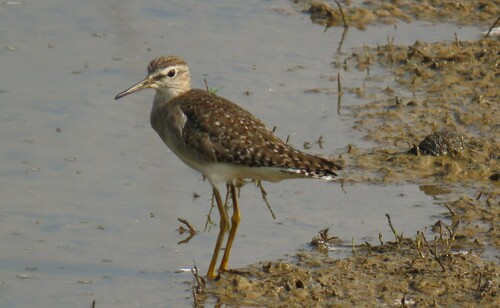 Wood Sandpiper
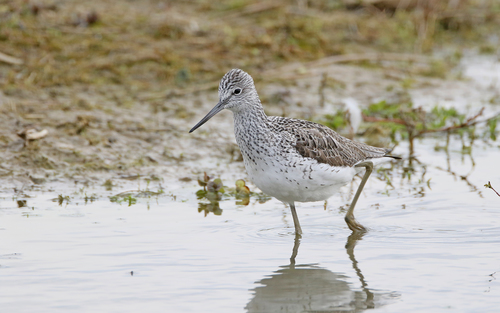 Common Greenshank
In short
The most reliable way to separate Wood Sandpiper from Common Greenshank is by size and structure: Wood Sandpiper is much smaller and more delicate, with a shorter, finer bill and longer yellowish legs, while Greenshank is bulkier, with a long, slightly upturned bill and greenish legs. In flight, look for the rump and back pattern: Wood Sandpiper shows a small, less-contrasting white rump patch, whereas Greenshank displays a prominent white wedge up the back. Both species can appear similar in dull light or at a distance, but careful attention to bill shape, leg color, and flight pattern will usually clinch the ID, especially for immatures. Habitat overlap is common, so do not rely on location alone.
Identification tips
- Size: Greenshank is much larger and heavier than Wood Sandpiper. Use this when both species are present or with familiar species for scale.
- Bill shape: Wood Sandpiper has a short, fine, straight bill; Greenshank's bill is long, thick-based, and slightly upturned, with a grey base. This is reliable at moderate range.
- Leg color: Wood Sandpiper's legs are yellowish; Greenshank's are greenish. Beware muddy legs or poor light.
- Flight rump/back pattern: In all ages, Wood Sandpiper shows a small, less-contrasting white rump patch; Greenshank has a bold white wedge up the back. This is the best mark in flight.
- Breast and neck spotting (immatures): Juvenile/immature Wood Sandpiper shows diffuse brownish spots on the breast and neck; Greenshank is plainer or has a coarser, darker breast pattern in breeding plumage.
- Upperpart pattern: Wood Sandpiper is light brown above with darker mottling and some spotting; Greenshank is brown (breeding) or grey-brown (non-breeding), with less spotting and more uniform color.
- Leg length and structure: Wood Sandpiper appears long-legged for its size, dainty, and delicate; Greenshank is robust, with proportionally shorter legs for its bulk.
- Jizz in flight: Wood Sandpiper is fluttery and light; Greenshank is strong and direct.
- Foraging behavior: Wood Sandpiper picks delicately at the water's edge; Greenshank wades deeper and moves more steadily.
- Bill base color: Greenshank's bill has a grey base, especially obvious at close range; Wood Sandpiper's is all dark.
- Voice: If you hear a fluty teu-teu-teu, it's Greenshank. Wood Sandpiper's call is not described here.
- Habitat: Both are freshwater specialists, but Greenshank can occur in a wider range of wetlands, including brackish areas. Do not rely on this alone.
- Pitfall—distance and light: At long range or in poor light, size and bill shape may be hard to judge; rely on flight rump/back pattern if possible.
- Pitfall—muddy legs: Leg color can be obscured by mud; always check multiple features.
- No strong sexual dimorphism: Both sexes look similar in both species; age and season are more important for ID.
Size
Wood Sandpiper is significantly smaller, with an average body mass of 67.5g compared to the Greenshank's 173g. This size gap is obvious in mixed flocks or side-by-side: Wood Sandpiper appears daintier, with a finer build and proportionally longer legs for its size. Greenshank is robust, taller, and heavier-bodied, with a noticeably longer bill and neck.
Plumage
For all ages, the most telling flight mark is the rump and back: Wood Sandpiper (adult and immature) shows a small, less-contrasting white rump patch, while Common Greenshank of any age has a bold white wedge running up the back, visible in flight. Juvenile and immature Wood Sandpipers have diffuse brownish spots on the breast and neck and a subdued, light-brown upperpart with darker mottling, lacking the crisp, dark patterning of Greenshank. Greenshank in breeding plumage is brown above with a coarsely marked, dark breast and much black on the shoulders and back; in winter, it is plainer grey-brown above. Both species have pale underparts, but Greenshank's upperparts are always plainer and less spotted than Wood Sandpiper's. Leg color is also useful: Wood Sandpiper has yellowish legs, while Greenshank's are greenish. Bill color and shape differ: Wood Sandpiper's bill is short and fine, Greenshank's is long, thick-based, and slightly upturned with a grey base.
Behaviour
Both species forage by probing in shallow water or mud for invertebrates, but Greenshank may also take small fish and amphibians. Wood Sandpiper often appears more active and dainty, picking delicately along the water's edge, while Greenshank moves with a steadier, more purposeful gait, often wading deeper. In flight, Wood Sandpiper is lighter and more fluttery, while Greenshank is strong and direct.
Habitat
Both species are found in freshwater and wetland environments, often together. Wood Sandpiper prefers shallow lakeshores, marshes, and riverbanks, and is less likely on saltwater or coastal habitats than some other shanks. Greenshank is also a freshwater specialist but can be found in a wider range of wet habitats, including brackish marshes and estuaries. Habitat alone is not diagnostic where their ranges overlap.
Voice
Greenshank has a distinctive call: a rapid series of three short, fluty notes (teu-teu-teu), which is loud and carries far. Wood Sandpiper's call is not described in the notes, so vocalization is only diagnostic for Greenshank when heard.