

Wood Duck vs Long-tailed Duck
Aix sponsa versus Clangula hyemalis
Play a quiz with Wood Duck and Long-tailed Duck
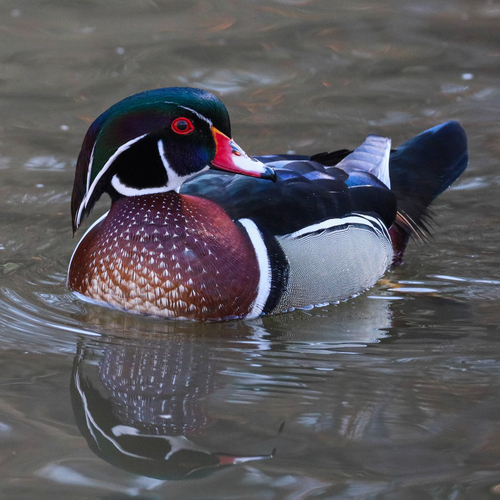 Wood Duck
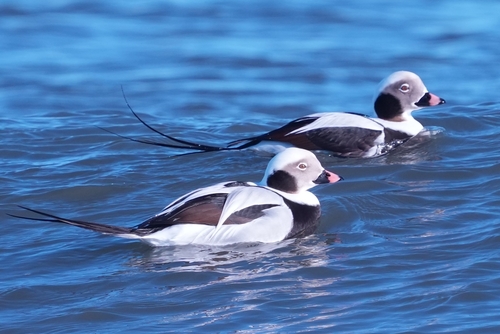 Long-tailed Duck
In short
The most reliable field mark between Wood Duck and Long-tailed Duck is the presence of a long, pointed tail in adult male Long-tailed Ducks, especially obvious in flight or on water, while Wood Ducks have a short, squared tail and a crested head. In all plumages, Wood Ducks show a crested head profile and, in both sexes, a bold white trailing edge to the speculum in flight. Long-tailed Ducks, by contrast, lack a crest and have a more compact, rounded head. Female and immature Long-tailed Ducks can be confused with female Wood Ducks at a distance, but the Wood Duck’s white eye-ring and unique face pattern, plus its preference for wooded freshwater habitats, help separate them. Habitat is often a strong clue: Wood Ducks are found in wooded ponds and swamps, Long-tailed Ducks on open, often coastal, water.
Identification tips
- Long tail streamers (adult male Long-tailed Duck): If you see a duck with very long, pointed tail feathers (up to 15 cm), especially in flight or on water, it is a male Long-tailed Duck. Wood Ducks never show this feature.
- Crested head (Wood Duck): Both male and female Wood Ducks have a crested head, giving a peaked or angular profile, visible both perched and in flight. Long-tailed Ducks have a smoothly rounded head with no crest.
- White eye-ring (female/immature Wood Duck): Female and juvenile Wood Ducks have a bold white eye-ring and a white throat patch, lacking in Long-tailed Ducks of any age or sex.
- Speculum pattern (Wood Duck): In all ages and sexes, Wood Ducks show an iridescent blue-green speculum with a white trailing edge in flight. Long-tailed Ducks have a less colorful, less sharply bordered wing pattern.
- Face pattern (female/immature Long-tailed Duck): Female and immature Long-tailed Ducks show a white face with a dark crown in winter, and a less distinct cheek patch in juveniles. Wood Duck females have a more uniform brown face with a white eye-ring, not a dark crown.
- Bill shape and color: Wood Ducks have a relatively short, broad bill (males show red and white coloration), while Long-tailed Ducks have a smaller, dark bill with a pink band in adult males.
- Body shape: Wood Ducks are bulkier with a larger head and shorter neck; Long-tailed Ducks are more compact, especially females, and males appear longer due to the tail.
- Habitat: Wood Ducks are almost always found in wooded freshwater habitats, often near overhanging branches. Long-tailed Ducks are found on open water, especially coastal or large lakes, rarely near trees.
- Flight profile: Wood Ducks show a crested head and short tail in flight; Long-tailed Duck males show trailing tail streamers, females a pointed but shorter tail.
- Vocalizations: Listen for the Wood Duck’s rising whistle or squeal in wooded wetlands; Long-tailed Duck males give a distinctive yodeling call, often in large flocks on open water.
- Seasonal context: Wood Ducks are resident or migratory in wooded parts of North America; Long-tailed Ducks are strictly migratory, appearing in winter on northern coasts and large lakes.
- Plumage pitfalls: Female and immature Long-tailed Ducks can look superficially like female Wood Ducks at a distance, but always lack the crest and white eye-ring.
- Group behavior: Long-tailed Ducks are gregarious, often in large flocks; Wood Ducks are more often seen in pairs or small groups.
- Perching: Wood Ducks may be seen perched in trees or on branches; Long-tailed Ducks are never seen perching in trees.
- Diving vs dabbling: Long-tailed Ducks dive frequently and deeply for food; Wood Ducks are dabblers, rarely diving.
Size
Wood Duck is a medium-sized duck, typically 47–54 cm in length with a 66–73 cm wingspan and weighing 454–862 grams [wikipedia]. Long-tailed Duck is also medium-sized, but the adult male’s tail streamers add up to 15 cm to its length, making it appear longer and more slender, especially in flight or on the water [wikipedia]. Without the tail, overall body size is similar, but Wood Duck is bulkier and has a proportionally larger head and shorter neck. Female Long-tailed Ducks lack the long tail and appear more compact than Wood Ducks.
Plumage
- Juvenile and immature birds: Juvenile Long-tailed Ducks resemble adult females in autumn, with a brown back and white head/neck, but with a lighter, less distinct cheek patch. Wood Duck juveniles are similar to adult females but always show a white eye-ring and throat, and lack the sharp contrast of Long-tailed Duck’s head pattern.
- Adult males (breeding): Male Wood Duck is unmistakable with iridescent multicolored plumage, red eyes, and a bold white neck flare. Male Long-tailed Duck in breeding plumage is mostly dark with a white cheek patch and very long tail streamers.
- Adult males (winter): Long-tailed Duck males are mostly white with a dark cheek patch and breast, and retain the long tail. Wood Duck males remain colorful but less so than in breeding, with a crested head and white neck lines.
- Adult females: Wood Duck females are brownish with a white eye-ring and throat, crested head, and blue-green speculum with a white trailing edge. Female Long-tailed Ducks are brown-backed with white head/neck and a dark crown in winter, lacking the crest and eye-ring. In flight, the Wood Duck’s speculum is more colorful and bordered with white, while Long-tailed Duck’s wing pattern is less distinctive.
- In flight: Wood Ducks show a crested head and white trailing edge to the speculum in all ages/sexes. Long-tailed Ducks (especially males) show long tail streamers; females have a shorter, pointed tail and less contrast in the wing.
Behaviour
Wood Ducks perch in trees and are agile in wooded wetlands, often seen dabbling or perching on branches near water. Long-tailed Ducks are highly aquatic, diving frequently (sometimes to great depths) and forming large flocks on open water, rarely perching in trees. In flight, Wood Ducks have a swift, direct flight with rapid wingbeats and a crested head profile; Long-tailed Ducks have a more compact, rounded head and, in males, trailing tail streamers are obvious.
Habitat
Wood Ducks are strongly associated with wooded ponds, swamps, and slow-moving rivers, often in areas with overhanging trees or abundant vegetation. They are rarely found on open sea or large lakes. Long-tailed Ducks breed in Arctic tundra pools and winter on large lakes and coastal waters, often far from shore, and are rarely found in wooded or sheltered freshwater habitats. If you see a duck in a forested pond, it is almost certainly a Wood Duck; on open, often saltwater, it is likely a Long-tailed Duck.
Voice
Wood Duck males give a rising whistle (jeeeeee), and females a drawn-out squeal (do weep do weep) or sharp alarm call (cr-r-ek, cr-e-ek). Long-tailed Duck males are notably vocal, with a musical yodelling call (ow, ow, owal-ow). The calls are quite different, with Long-tailed Duck’s yodeling being distinctive in large flocks, while Wood Duck’s calls are more likely heard in wooded wetlands.