

Wonga Pigeon vs Bar-shouldered Dove
Leucosarcia melanoleuca versus Geopelia humeralis
Play a quiz with Wonga Pigeon and Bar-shouldered Dove
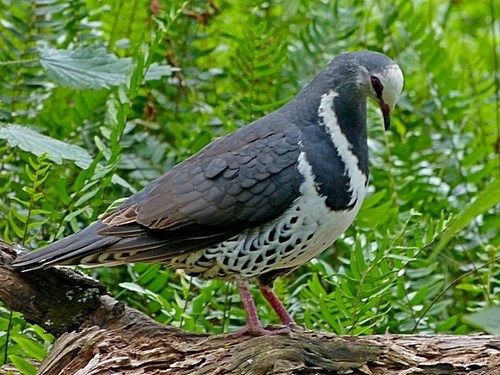 Wonga Pigeon
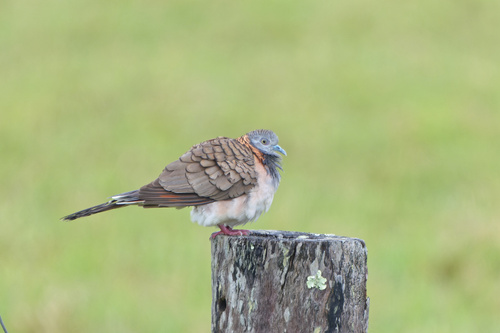 Bar-shouldered Dove
In short
The most reliable field mark to separate Wonga Pigeon from Bar-shouldered Dove is overall size and build: Wonga Pigeon is much larger and bulkier, with a broad body and long tail, while Bar-shouldered Dove is noticeably slimmer and smaller. Immature Wonga Pigeons can be browner and less crisply marked, but still appear far more massive than any Bar-shouldered Dove. In flight or on the ground, look for the Wonga Pigeon's white underparts with a dark-spotted 'V' on the chest, contrasting with the Bar-shouldered Dove's blue-grey breast and copper-barred nape. Both species forage on the ground, but their structure, plumage, and voice are quite distinct with careful observation.
Identification tips
- Size and Build: Wonga Pigeon is much larger and bulkier than Bar-shouldered Dove. If the bird looks pigeon-sized or larger, it's Wonga; if it looks like a typical dove, it's Bar-shouldered.
- Chest Pattern: Look for the white underparts with a dark grey-spotted 'V' on the chest in Wonga Pigeon (all ages, though less distinct in juveniles). Bar-shouldered Dove never shows this pattern.
- Back and Head Color: Wonga Pigeon has a pastel blue-grey back and creamy-white head, fading from the body. Bar-shouldered Dove has a blue-grey breast, chequered brown-bronze wings, and a copper-barred, striated nape.
- Nape and Neck: Bar-shouldered Dove shows copper-colored, striated nape feathers (not present in Wonga Pigeon). This is a key mark at close range or in good light.
- Eye-ring Color: Wonga Pigeon has a pink eye-ring around dark red-brown eyes. Bar-shouldered Dove's eye-ring is usually grey, turning red-brown only in breeding adults.
- Leg Color: Wonga Pigeon has red legs; Bar-shouldered Dove's leg color is not distinctive for separation.
- Tail Shape and Length: Wonga Pigeon has a long, broad tail; Bar-shouldered Dove's tail is also long but the bird is much slimmer overall.
- Flight Style: Wonga Pigeon flushes explosively with loud wing claps and appears heavy in flight. Bar-shouldered Dove is swift, direct, and produces a whistling sound with its wings.
- Juvenile Plumage: Juvenile Wonga Pigeons are browner and less sharply marked but still larger and with more white below than any Bar-shouldered Dove. Juvenile Bar-shouldered Doves are simply duller versions of adults.
- Habitat: Dense wet forest or rainforest strongly favors Wonga Pigeon. Open woodland, edges, or urban parks are more typical for Bar-shouldered Dove.
- Group Size: Wonga Pigeon is usually solitary or in pairs; Bar-shouldered Dove is often seen in pairs or loose flocks.
- Voice: Persistent, high-pitched 'coo' for Wonga Pigeon; melodious 'cook-a-wook' or 'coolicoo' for Bar-shouldered Dove.
- Behavior: Wonga Pigeon is shy and elusive, often heard but not seen. Bar-shouldered Dove is more approachable and visible.
- Geographic Range: Both species overlap in eastern Australia, but Bar-shouldered Dove also occurs further north and into southern New Guinea.
- Confusion Species: Bar-shouldered Dove is sometimes confused with Spotted Turtle Dove, but not with Wonga Pigeon by experienced observers due to the large size gap.
Size
Wonga Pigeon is a true heavyweight among Australian pigeons, with an average body mass of 429 g and a length of 38–40 cm. In contrast, Bar-shouldered Dove is much smaller and lighter, measuring only 26–30 cm in length (no mass data, but typical for small doves). Even at a distance, Wonga Pigeon appears broad-bodied, thick-necked, and long-tailed, while Bar-shouldered Dove is slender, small-headed, and more delicate overall. Size alone can often separate these two, especially when seen together or with familiar species for scale.
Plumage
Juvenile Wonga Pigeons are browner overall with a less distinct white 'V' on the chest, but still show the species' characteristic white underparts and pastel blue-grey back. Adults are strikingly white below with dark grey spots forming a clear 'V' on the chest, and a creamy-white head. Bar-shouldered Dove, both adult and juvenile, lacks any white 'V' or extensive white underparts. Instead, it shows a blue-grey breast, chequered brown-bronze wings, and a distinctive copper-barred nape. The nape feathers are striated copper, and the eye-ring is grey (turning red-brown in breeding adults). Juvenile Bar-shouldered Doves are duller but still show the same structural and pattern differences. Neither species shows strong age-specific upperwing patterns in flight, but the Wonga Pigeon's broad wings and white belly are distinctive, while Bar-shouldered Dove's wings are more pointed and the flight is swift with a whistling sound.
Behaviour
Both species are ground foragers, but Wonga Pigeon is much more elusive and shy, often flushing explosively with loud wing claps when disturbed. Bar-shouldered Dove is more likely to be seen in pairs or loose flocks, feeding openly on seeds. In flight, Wonga Pigeon appears heavy and direct, while Bar-shouldered Dove is swifter and more agile, with a characteristic wing whistle. Wonga Pigeon is more often heard than seen, especially in dense forest, whereas Bar-shouldered Dove is more tolerant of open spaces and human presence.
Habitat
Wonga Pigeon is restricted to eastern Australia, from central Queensland to eastern Victoria, and prefers dense rainforests, wet eucalypt forests, and occasionally coastal forests or well-vegetated parks and gardens. Bar-shouldered Dove is native to Australia and southern New Guinea, and is found in a wider range of open habitats, including woodland edges, open forests, and even urban areas. If you are in dense, wet forest, Wonga Pigeon is more likely; in open woodland or suburban parks, Bar-shouldered Dove is the default.
Voice
Wonga Pigeon's call is a loud, high-pitched 'coo' repeated for several seconds, often heard from deep cover. During display, males give a soft, trilling coo while bowing. Bar-shouldered Dove has a distinctive, melodious 'cook-a-wook' or 'coolicoo' call, which is quite different in rhythm and tone from Wonga Pigeon's persistent cooing. Voice is a strong clue if the bird is not seen clearly.