

Motmot

Wilson's Storm-Petrel vs European Storm-Petrel

Oceanites oceanicus versus Hydrobates pelagicus

Play a quiz with Wilson's Storm-Petrel and European Storm-Petrel
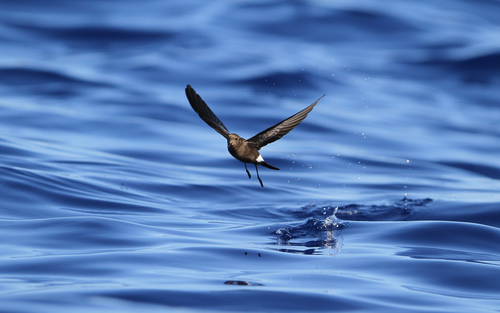
Wilson's Storm-Petrel (Oceanites oceanicus) Wilson's Storm-Petrel
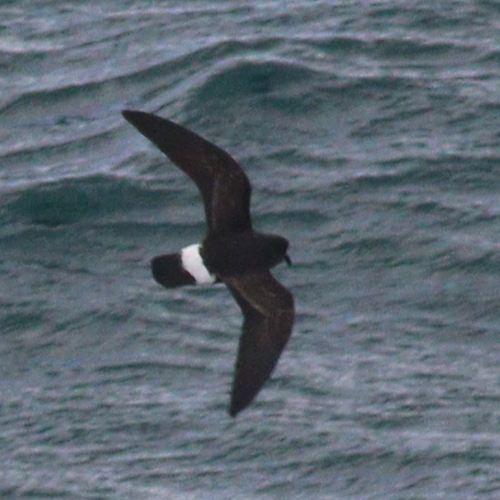
European Storm-Petrel (Hydrobates pelagicus) European Storm-Petrel

Media

Loading…

In short

The most reliable field mark between Wilson's Storm-Petrel and European Storm-Petrel is the presence or absence of a white bar on the underwing: European Storm-Petrel always shows a broad white underwing bar (all ages), while Wilson's Storm-Petrel lacks this, instead showing a more uniform dark underwing. Both species have a white rump, but Wilson's has slightly longer legs with feet projecting beyond the tail in flight, and a diffuse pale upperwing covert band, while European Storm-Petrel is more compact and entirely dark above except for the rump and sometimes a narrow white upperwing bar in juveniles. Flight style and leg projection are also helpful: Wilson's often appears to 'walk' on water with feet visible, while European Storm-Petrel's feet are hidden and its flight is more fluttery and bat-like. Size is similar but Wilson's is slightly heavier and longer-winged.

Identification tips

  1. Underwing bar: European Storm-Petrel always shows a broad white bar on the underwing (all ages, all plumages); Wilson's Storm-Petrel never does. This is the single most reliable field mark in flight.
  2. Upperwing pattern: Wilson's Storm-Petrel has a diffuse pale band along the upperwing coverts (all ages), while European Storm-Petrel is nearly all dark above except that fresh juveniles may show a narrow white upperwing bar. If you see a pale upperwing band but no underwing bar, think Wilson's.
  3. Feet projection: In flight, Wilson's Storm-Petrel's legs are long enough that the feet project just beyond the square tail; in European Storm-Petrel, the feet are not visible beyond the tail. This is best seen in good light and close views.
  4. Flight style: Wilson's Storm-Petrel has a more direct, gliding flight and often 'walks' on water with wings held high. European Storm-Petrel has a weaker, fluttering, bat-like flight with short glides and does not walk on water.
  5. Rump patch: Both have a white rump, but in European Storm-Petrel it is broader and wraps around the sides of the tail base. Wilson's has a whiter rump and flanks, but this is subtle and variable.
  6. Plumage tone: Wilson's Storm-Petrel is dark brown in all plumages, while European Storm-Petrel is blacker when fresh, becoming browner with wear. This is a minor point and not always reliable at sea.
  7. Flank color: Wilson's Storm-Petrel shows some white on the flanks, especially in flight; European Storm-Petrel does not.
  8. Tail shape: Both have square-ended tails, but Wilson's may appear slightly longer-tailed due to leg projection.
  9. Leg color: Wilson's pre-breeding birds have yellow webbing with black spots, but this is not visible at sea and not useful for field ID.
  10. Size and structure: Wilson's is slightly larger and bulkier, with a longer wingspan and heavier body mass, but this is only apparent in direct comparison or with experience.
  11. Behavior at sea: If you see a storm-petrel pattering or 'walking' on the water, with feet visible, it is almost certainly Wilson's. European Storm-Petrel does not show this behavior.
  12. Habitat and context: In the North Atlantic, both species can occur together, but European Storm-Petrel is more closely tied to the northeast Atlantic, while Wilson's is more widespread and abundant.
  13. Voice: Calls are not useful for separation at sea; both are mostly silent away from colonies.
  14. Sex and age: No reliable sex differences are visible at sea for either species. Juvenile European Storm-Petrel may show a narrow white upperwing bar, but this does not overlap with Wilson's more diffuse pale upperwing band.
  15. Pitfalls: Beware of wear and molt effects—European Storm-Petrel can look browner and less contrasting as plumage wears, but the underwing bar remains diagnostic. Wilson's can look darker in poor light, but never shows a white underwing bar.

Size

Wilson's Storm-Petrel is marginally larger, with a body mass around 34 g [wikidata], length 16–18.5 cm, and wingspan 38–42 cm [wikipedia]. European Storm-Petrel averages about 28 g, with a length of 14–18 cm and wingspan of 36–39 cm [wikipedia]. In the field, this size difference is subtle and usually only apparent in direct comparison, but Wilson's can look slightly longer-winged and bulkier. Both are small, dark seabirds, but Wilson's is the more robust of the two.

Plumage

The most diagnostic plumage difference is on the underwing: European Storm-Petrel (all ages) shows a broad, obvious white bar on the underwing, which is never present on Wilson's Storm-Petrel. On the upperwing, Wilson's has a diffuse pale band along the upperwing coverts, while European Storm-Petrel is nearly all dark above, though fresh juveniles may show a narrow white bar on the upperwing. Both have a white rump, but in European Storm-Petrel it is broader and extends to the sides of the tail base. Wilson's has a square-ended tail and dark brown overall plumage with a white rump and flanks, while European Storm-Petrel is blacker (becoming browner with wear) and lacks any pale on the flanks. Wilson's pre-breeding birds have yellow webbing with black spots on the feet, but this is not visible at sea. No obvious sex differences are apparent in the field for either species.

Behaviour

Wilson's Storm-Petrel often feeds by pattering or 'walking' on the water surface, using its longer legs and visible feet to stabilize itself, sometimes appearing to hover with wings held high. Its flight is more direct and gliding compared to the European Storm-Petrel. European Storm-Petrel has a weaker, fluttering, bat-like flight with short glides and does not appear to walk on water; its feet are not visible in flight. Both species feed by picking at planktonic food on the surface, but Wilson's is more likely to follow ships and show the characteristic water-walking behavior.

Habitat

Both species are pelagic and seen at sea, but their core breeding and abundance zones differ: Wilson's Storm-Petrel is much more abundant globally, with a circumpolar southern distribution but regular movement into northern oceans in boreal summer. European Storm-Petrel breeds mainly on islands off northern Europe and is less numerous overall. In the North Atlantic, both may occur together, especially in late spring and summer, but European Storm-Petrel is more closely tied to the northeast Atlantic and adjacent seas.

Voice

Wilson's Storm-Petrel gives a soft peeping noise while feeding, but neither species is especially vocal at sea and their calls are not reliable for field separation in most circumstances. European Storm-Petrel has distinctive nocturnal display calls at colonies, but these are rarely heard at sea.

Submit a better description

Use the same sections as the comparison. Your text is published immediately.

The most reliable field mark between Wilson's Storm-Petrel and European Storm-Petrel is the presence or absence of a white bar on the underwing: European Storm-Petrel always shows a broad white underwing bar (all ages), while Wilson's Storm-Petrel lacks this, instead showing a more uniform dark underwing. Both species have a white rump, but Wilson's has slightly longer legs with feet projecting beyond the tail in flight, and a diffuse pale upperwing covert band, while European Storm-Petrel is more compact and entirely dark above except for the rump and sometimes a narrow white upperwing bar in juveniles. Flight style and leg projection are also helpful: Wilson's often appears to 'walk' on water with feet visible, while European Storm-Petrel's feet are hidden and its flight is more fluttery and bat-like. Size is similar but Wilson's is slightly heavier and longer-winged.

  1. Underwing bar: European Storm-Petrel always shows a broad white bar on the underwing (all ages, all plumages); Wilson's Storm-Petrel never does. This is the single most reliable field mark in flight.
  2. Upperwing pattern: Wilson's Storm-Petrel has a diffuse pale band along the upperwing coverts (all ages), while European Storm-Petrel is nearly all dark above except that fresh juveniles may show a narrow white upperwing bar. If you see a pale upperwing band but no underwing bar, think Wilson's.
  3. Feet projection: In flight, Wilson's Storm-Petrel's legs are long enough that the feet project just beyond the square tail; in European Storm-Petrel, the feet are not visible beyond the tail. This is best seen in good light and close views.
  4. Flight style: Wilson's Storm-Petrel has a more direct, gliding flight and often 'walks' on water with wings held high. European Storm-Petrel has a weaker, fluttering, bat-like flight with short glides and does not walk on water.
  5. Rump patch: Both have a white rump, but in European Storm-Petrel it is broader and wraps around the sides of the tail base. Wilson's has a whiter rump and flanks, but this is subtle and variable.
  6. Plumage tone: Wilson's Storm-Petrel is dark brown in all plumages, while European Storm-Petrel is blacker when fresh, becoming browner with wear. This is a minor point and not always reliable at sea.
  7. Flank color: Wilson's Storm-Petrel shows some white on the flanks, especially in flight; European Storm-Petrel does not.
  8. Tail shape: Both have square-ended tails, but Wilson's may appear slightly longer-tailed due to leg projection.
  9. Leg color: Wilson's pre-breeding birds have yellow webbing with black spots, but this is not visible at sea and not useful for field ID.
  10. Size and structure: Wilson's is slightly larger and bulkier, with a longer wingspan and heavier body mass, but this is only apparent in direct comparison or with experience.
  11. Behavior at sea: If you see a storm-petrel pattering or 'walking' on the water, with feet visible, it is almost certainly Wilson's. European Storm-Petrel does not show this behavior.
  12. Habitat and context: In the North Atlantic, both species can occur together, but European Storm-Petrel is more closely tied to the northeast Atlantic, while Wilson's is more widespread and abundant.
  13. Voice: Calls are not useful for separation at sea; both are mostly silent away from colonies.
  14. Sex and age: No reliable sex differences are visible at sea for either species. Juvenile European Storm-Petrel may show a narrow white upperwing bar, but this does not overlap with Wilson's more diffuse pale upperwing band.
  15. Pitfalls: Beware of wear and molt effects—European Storm-Petrel can look browner and less contrasting as plumage wears, but the underwing bar remains diagnostic. Wilson's can look darker in poor light, but never shows a white underwing bar.

Wilson's Storm-Petrel is marginally larger, with a body mass around 34 g [wikidata], length 16–18.5 cm, and wingspan 38–42 cm [wikipedia]. European Storm-Petrel averages about 28 g, with a length of 14–18 cm and wingspan of 36–39 cm [wikipedia]. In the field, this size difference is subtle and usually only apparent in direct comparison, but Wilson's can look slightly longer-winged and bulkier. Both are small, dark seabirds, but Wilson's is the more robust of the two.

The most diagnostic plumage difference is on the underwing: European Storm-Petrel (all ages) shows a broad, obvious white bar on the underwing, which is never present on Wilson's Storm-Petrel. On the upperwing, Wilson's has a diffuse pale band along the upperwing coverts, while European Storm-Petrel is nearly all dark above, though fresh juveniles may show a narrow white bar on the upperwing. Both have a white rump, but in European Storm-Petrel it is broader and extends to the sides of the tail base. Wilson's has a square-ended tail and dark brown overall plumage with a white rump and flanks, while European Storm-Petrel is blacker (becoming browner with wear) and lacks any pale on the flanks. Wilson's pre-breeding birds have yellow webbing with black spots on the feet, but this is not visible at sea. No obvious sex differences are apparent in the field for either species.

Wilson's Storm-Petrel often feeds by pattering or 'walking' on the water surface, using its longer legs and visible feet to stabilize itself, sometimes appearing to hover with wings held high. Its flight is more direct and gliding compared to the European Storm-Petrel. European Storm-Petrel has a weaker, fluttering, bat-like flight with short glides and does not appear to walk on water; its feet are not visible in flight. Both species feed by picking at planktonic food on the surface, but Wilson's is more likely to follow ships and show the characteristic water-walking behavior.

Both species are pelagic and seen at sea, but their core breeding and abundance zones differ: Wilson's Storm-Petrel is much more abundant globally, with a circumpolar southern distribution but regular movement into northern oceans in boreal summer. European Storm-Petrel breeds mainly on islands off northern Europe and is less numerous overall. In the North Atlantic, both may occur together, especially in late spring and summer, but European Storm-Petrel is more closely tied to the northeast Atlantic and adjacent seas.

Wilson's Storm-Petrel gives a soft peeping noise while feeding, but neither species is especially vocal at sea and their calls are not reliable for field separation in most circumstances. European Storm-Petrel has distinctive nocturnal display calls at colonies, but these are rarely heard at sea.

Discard your changes?

You have unsaved edits. If you leave now, those changes will be lost.

Wilson's Storm-Petrel · European Storm-Petrel · My Tricky Birds