

Motmot

Wilson's Storm-Petrel vs Band-rumped Storm-Petrel

Oceanites oceanicus versus Hydrobates castro

Play a quiz with Wilson's Storm-Petrel and Band-rumped Storm-Petrel
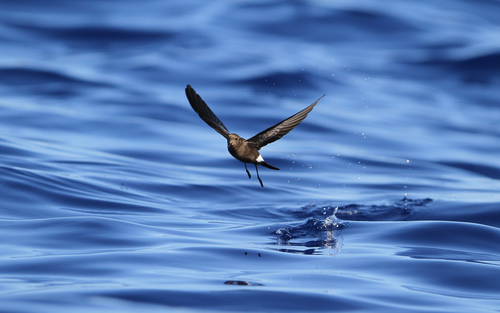
Wilson's Storm-Petrel (Oceanites oceanicus) Wilson's Storm-Petrel
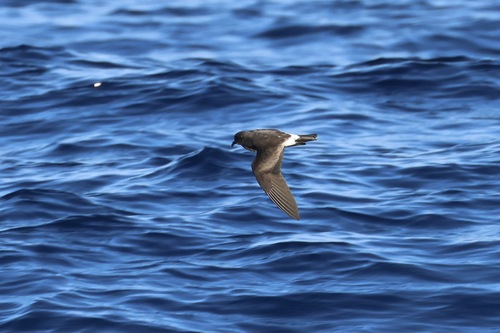
Band-rumped Storm-Petrel (Hydrobates castro) Band-rumped Storm-Petrel

Media

Loading…

In short

The most reliable field mark to separate Wilson's Storm-Petrel from Band-rumped Storm-Petrel is the upperwing pattern: Wilson's shows a diffuse pale band along the upperwing coverts (all ages), while Band-rumped's upperwing is uniformly dark. Wilson's also has feet that project just past the tail in flight, a square tail, and a fluttering, pattering flight style, whereas Band-rumped is larger, with a longer wingspan, a slightly forked tail, and steadier, more shearwater-like flight. Both species have a white rump, but Band-rumped's is more extensive. Structural and flight differences are often as important as plumage, especially at sea.

Identification tips

  1. Upperwing pattern: Look for a diffuse pale band along the upperwing coverts in Wilson's Storm-Petrel (all ages); Band-rumped's upperwing is uniformly dark. This is the single most reliable field mark in flight.
  2. Tail shape: Wilson's has a square-ended tail; Band-rumped's tail is slightly forked, though not as deeply as Leach's Storm-Petrel. The fork can be subtle and is best seen when the tail is spread.
  3. Feet projection: In Wilson's, the feet extend just beyond the tail in flight, often visible as tiny projections; in Band-rumped, the feet do not project beyond the tail. This is a subtle but useful mark in good views.
  4. Flight style: Wilson's shows a fluttering, hovering flight with frequent pattering on the water; Band-rumped flies more steadily, with a gliding, shearwater-like action, rarely pattering.
  5. White rump: Both have a white rump, but Band-rumped's is more extensive. However, rump extent is variable and overlaps, so use with caution.
  6. Flank color: Wilson's shows white on the flanks as well as the rump; Band-rumped's white is confined to the rump.
  7. Size: Band-rumped is larger and bulkier, with a longer wingspan and heavier build. This is most useful when both species are seen together.
  8. Underwing: Neither species has a strong white underwing panel; Wilson's lacks the white underwing lining of European Storm-Petrel, and Band-rumped's underwing is uniformly dark.
  9. Toe webbing: Wilson's pre-breeding birds have yellow and black-spotted toe webbing, but this is not a field mark except at extreme close range.
  10. Breeding context: If seen near islands in the North Atlantic or Pacific, Band-rumped is more likely to be a breeder; Wilson's breeds in the Southern Hemisphere but disperses widely.
  11. Nocturnal habits: Band-rumped is strictly nocturnal at colonies; Wilson's is not as strictly nocturnal, but this is rarely relevant at sea.
  12. Voice: Wilson's gives soft peeping calls while feeding, but voice is rarely diagnostic at sea for either species.
  13. Ship-following: Wilson's is more likely to follow ships and gather in large flocks; Band-rumped is less frequently described in this context.
  14. Confusion with other storm-petrels: Be cautious not to confuse Band-rumped with Leach's Storm-Petrel, which has a more deeply forked tail and different rump shape; Wilson's is more easily separated by its upperwing band and pattering flight.
  15. Pitfalls: In poor light or distant views, size and tail shape can be misleading; rely on upperwing pattern and flight style as primary marks.

Size

Band-rumped Storm-Petrel is noticeably larger than Wilson's Storm-Petrel in both length and wingspan. Wilson's measures 16–18.5 cm in length with a 38–42 cm wingspan and weighs about 34 g [wikidata], while Band-rumped is 19–21 cm long, with a 43–46 cm wingspan and a mass of 44–49 g [wikipedia]. This size difference is often apparent when seen together, but can be subtle at a distance or in isolation. Band-rumped appears bulkier and longer-winged, while Wilson's is more compact.

Plumage

For all ages, Wilson's Storm-Petrel shows a diffuse pale band along the upperwing coverts, which is absent in Band-rumped Storm-Petrel, whose upperwing is uniformly dark [wikipedia]. Both species have a white rump, but Band-rumped's is more extensive. Wilson's has a square-ended tail, while Band-rumped's tail is slightly forked. Wilson's also shows white on the flanks, not just the rump. The underwing of Wilson's lacks the distinct white lining found in European Storm-Petrel, but Band-rumped's underwing is not described as having any pale lining or panels. In pre-breeding Wilson's, the webbing between the toes is yellow with black spots, but this is not visible in the field except at extremely close range. There are no age-specific upperwing or underwing patterns described for Band-rumped, so the upperwing band of Wilson's is the most consistent mark across all ages.

Behaviour

Wilson's Storm-Petrel is famous for its fluttering, hovering flight with wings held high and its habit of pattering on the water surface with its feet as it feeds. This creates a distinctive, almost bat-like jizz, especially when compared to the steadier, more direct, and gliding flight of Band-rumped Storm-Petrel, which is described as more 'shearwater-like.' Wilson's often follows ships and is highly gregarious, while Band-rumped is less described in this context. On land, both are awkward, but Band-rumped is strictly nocturnal at breeding sites, rarely seen on land by day.

Habitat

Both species are pelagic and can be seen far from land, but their breeding distributions differ: Wilson's is mainly a Southern Hemisphere breeder but disperses widely, while Band-rumped breeds on Atlantic and Pacific islands in warmer regions. At sea, their habitats overlap, especially in the North Atlantic. Band-rumped is strictly nocturnal at colonies, while Wilson's is more flexible in its activity.

Voice

Wilson's Storm-Petrel gives a soft peeping noise while feeding, but neither species is likely to be identified by voice at sea. Band-rumped has distinct vocalizations at colonies, but these are not typically heard at sea or during migration.

Submit a better description

Use the same sections as the comparison. Your text is published immediately.

The most reliable field mark to separate Wilson's Storm-Petrel from Band-rumped Storm-Petrel is the upperwing pattern: Wilson's shows a diffuse pale band along the upperwing coverts (all ages), while Band-rumped's upperwing is uniformly dark. Wilson's also has feet that project just past the tail in flight, a square tail, and a fluttering, pattering flight style, whereas Band-rumped is larger, with a longer wingspan, a slightly forked tail, and steadier, more shearwater-like flight. Both species have a white rump, but Band-rumped's is more extensive. Structural and flight differences are often as important as plumage, especially at sea.

  1. Upperwing pattern: Look for a diffuse pale band along the upperwing coverts in Wilson's Storm-Petrel (all ages); Band-rumped's upperwing is uniformly dark. This is the single most reliable field mark in flight.
  2. Tail shape: Wilson's has a square-ended tail; Band-rumped's tail is slightly forked, though not as deeply as Leach's Storm-Petrel. The fork can be subtle and is best seen when the tail is spread.
  3. Feet projection: In Wilson's, the feet extend just beyond the tail in flight, often visible as tiny projections; in Band-rumped, the feet do not project beyond the tail. This is a subtle but useful mark in good views.
  4. Flight style: Wilson's shows a fluttering, hovering flight with frequent pattering on the water; Band-rumped flies more steadily, with a gliding, shearwater-like action, rarely pattering.
  5. White rump: Both have a white rump, but Band-rumped's is more extensive. However, rump extent is variable and overlaps, so use with caution.
  6. Flank color: Wilson's shows white on the flanks as well as the rump; Band-rumped's white is confined to the rump.
  7. Size: Band-rumped is larger and bulkier, with a longer wingspan and heavier build. This is most useful when both species are seen together.
  8. Underwing: Neither species has a strong white underwing panel; Wilson's lacks the white underwing lining of European Storm-Petrel, and Band-rumped's underwing is uniformly dark.
  9. Toe webbing: Wilson's pre-breeding birds have yellow and black-spotted toe webbing, but this is not a field mark except at extreme close range.
  10. Breeding context: If seen near islands in the North Atlantic or Pacific, Band-rumped is more likely to be a breeder; Wilson's breeds in the Southern Hemisphere but disperses widely.
  11. Nocturnal habits: Band-rumped is strictly nocturnal at colonies; Wilson's is not as strictly nocturnal, but this is rarely relevant at sea.
  12. Voice: Wilson's gives soft peeping calls while feeding, but voice is rarely diagnostic at sea for either species.
  13. Ship-following: Wilson's is more likely to follow ships and gather in large flocks; Band-rumped is less frequently described in this context.
  14. Confusion with other storm-petrels: Be cautious not to confuse Band-rumped with Leach's Storm-Petrel, which has a more deeply forked tail and different rump shape; Wilson's is more easily separated by its upperwing band and pattering flight.
  15. Pitfalls: In poor light or distant views, size and tail shape can be misleading; rely on upperwing pattern and flight style as primary marks.

Band-rumped Storm-Petrel is noticeably larger than Wilson's Storm-Petrel in both length and wingspan. Wilson's measures 16–18.5 cm in length with a 38–42 cm wingspan and weighs about 34 g [wikidata], while Band-rumped is 19–21 cm long, with a 43–46 cm wingspan and a mass of 44–49 g [wikipedia]. This size difference is often apparent when seen together, but can be subtle at a distance or in isolation. Band-rumped appears bulkier and longer-winged, while Wilson's is more compact.

For all ages, Wilson's Storm-Petrel shows a diffuse pale band along the upperwing coverts, which is absent in Band-rumped Storm-Petrel, whose upperwing is uniformly dark [wikipedia]. Both species have a white rump, but Band-rumped's is more extensive. Wilson's has a square-ended tail, while Band-rumped's tail is slightly forked. Wilson's also shows white on the flanks, not just the rump. The underwing of Wilson's lacks the distinct white lining found in European Storm-Petrel, but Band-rumped's underwing is not described as having any pale lining or panels. In pre-breeding Wilson's, the webbing between the toes is yellow with black spots, but this is not visible in the field except at extremely close range. There are no age-specific upperwing or underwing patterns described for Band-rumped, so the upperwing band of Wilson's is the most consistent mark across all ages.

Wilson's Storm-Petrel is famous for its fluttering, hovering flight with wings held high and its habit of pattering on the water surface with its feet as it feeds. This creates a distinctive, almost bat-like jizz, especially when compared to the steadier, more direct, and gliding flight of Band-rumped Storm-Petrel, which is described as more 'shearwater-like.' Wilson's often follows ships and is highly gregarious, while Band-rumped is less described in this context. On land, both are awkward, but Band-rumped is strictly nocturnal at breeding sites, rarely seen on land by day.

Both species are pelagic and can be seen far from land, but their breeding distributions differ: Wilson's is mainly a Southern Hemisphere breeder but disperses widely, while Band-rumped breeds on Atlantic and Pacific islands in warmer regions. At sea, their habitats overlap, especially in the North Atlantic. Band-rumped is strictly nocturnal at colonies, while Wilson's is more flexible in its activity.

Wilson's Storm-Petrel gives a soft peeping noise while feeding, but neither species is likely to be identified by voice at sea. Band-rumped has distinct vocalizations at colonies, but these are not typically heard at sea or during migration.

Discard your changes?

You have unsaved edits. If you leave now, those changes will be lost.

Wilson's Storm-Petrel · Band-rumped Storm-Petrel · My Tricky Birds