

Motmot

White's Thrush vs Varied Thrush

Zoothera aurea versus Ixoreus naevius

Play a quiz with White's Thrush and Varied Thrush
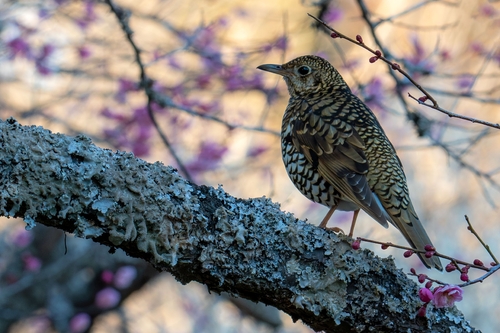
White's Thrush (Zoothera aurea) White's Thrush
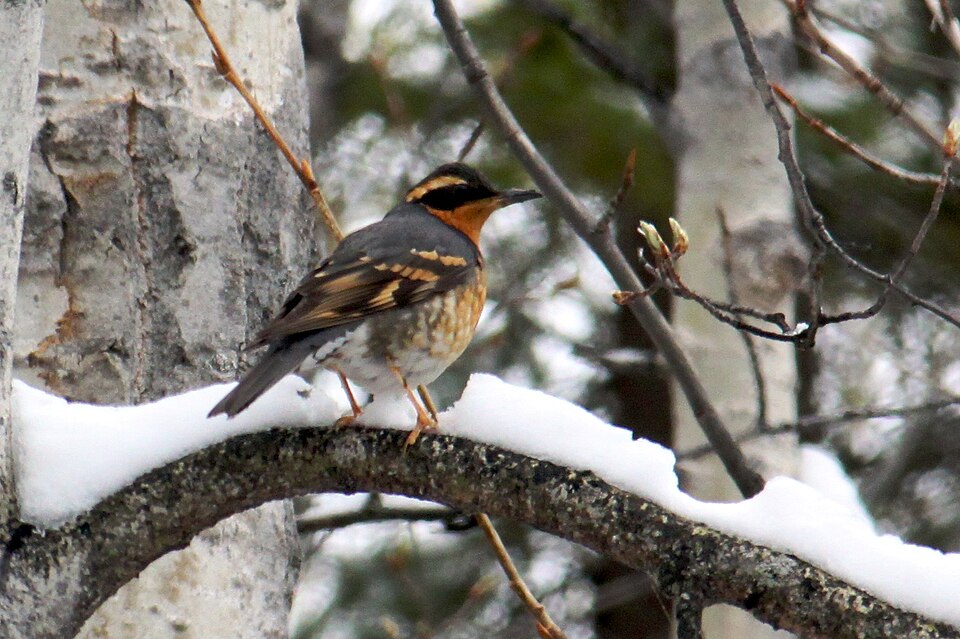
Varied Thrush (Ixoreus naevius) Varied Thrush

Media

Loading…

In short

The most reliable field mark to separate White's Thrush from Varied Thrush is the bold black band on the white underwing, visible in flight on White's Thrush of all ages—a feature Varied Thrush lacks. On perched birds, White's Thrush shows heavy black scaling over a pale background, while Varied Thrush (especially adult males) is strikingly orange and black with a bold breast band and facial stripes. Juvenile Varied Thrushes are brownish with white bellies and orange covert stripes, but never show the strong underwing pattern of White's. Both are large thrushes, but White's is longer and slimmer, while Varied Thrush is stockier and more robust. Habitat and range rarely overlap, but confusion can occur with vagrants or in photos.

Identification tips

  1. Underwing pattern in flight: White's Thrush (all ages) shows a bold black band on the white underwing, visible when the bird is flying—Varied Thrush never shows this feature.
  2. Upperparts and scaling: Perched White's Thrush has heavy black scaling on a pale white or yellowish background, giving a scaly appearance; Varied Thrush is never scaled, instead showing smooth, intense orange and black (male) or duller olive-brown and gray (female).
  3. Breast band: Adult male Varied Thrush has a curved, dark breast band across a bright orange breast; White's Thrush lacks any breast band, instead showing uniform scaling.
  4. Facial pattern: Varied Thrush (both sexes, but especially males) has a bold orange supercilium (eyebrow) and dark facial stripes; White's Thrush has a more subdued face, blending into the scaly pattern.
  5. Juvenile confusion: Juvenile Varied Thrushes are brown above with white bellies and two orange covert stripes, but lack the scaling and underwing band of White's. Juvenile White's Thrushes resemble adults in scaling and underwing pattern.
  6. Bill and structure: Varied Thrush has a shorter, heavier bill and a robust, stocky build; White's Thrush is longer, slimmer, and more elongated in profile.
  7. Leg color: Varied Thrush legs are tawny or dark brown; leg color is not diagnostic for White's Thrush in the notes.
  8. Size impression: White's Thrush is longer and slimmer, Varied Thrush is shorter but heavier and more compact—useful when birds are side by side or with familiar species.
  9. Habitat context: Varied Thrush is expected in western North American forests, towns, and orchards in winter; White's Thrush is an Old World species of dense forests. Out-of-range sightings require extra caution.
  10. Song: If heard, White's Thrush gives a mechanical, far-carrying whistle with long pauses; Varied Thrush song is not detailed, so this is only a positive for White's.
  11. Sex differences: Female Varied Thrushes are duller, with olive-brown and gray replacing the male's bright orange and black, but still show the facial stripes and breast band. White's Thrush sexes are similar.
  12. Vagrant confusion: Rare Varied Thrushes in Europe or White's Thrushes in unusual locations may cause confusion—always look for the underwing band and overall scaling.
  13. Pitfalls: Photos of perched birds can be misleading if the underwing is hidden; always try for a flight view if uncertain.
  14. Flock behavior: Varied Thrush may be seen in flocks, especially in winter; White's Thrush is more solitary.
  15. Rare color morphs: Extremely rare Varied Thrushes may lack orange (white morph), but these are exceptional and still lack the underwing band and scaling of White's.

Size

White's Thrush is larger overall, measuring 27–31 cm in length [wikipedia], while Varied Thrush is 20–26 cm long [wikipedia]. Varied Thrush has a wingspan of 34–42 cm and a heavier, more robust build, whereas White's is longer and slimmer. In the field, White's Thrush may appear lankier and more elongated, while Varied Thrush looks compact and stocky, similar to an American Robin but shorter and heavier-bodied.

Plumage

Juvenile and adult White's Thrushes of both sexes show bold black scaling on a pale white or yellowish background, with the most diagnostic mark being the black band on the white underwing, visible in flight. This underwing pattern is unique among these two species. Varied Thrush adults (especially males) are intense orange and black, with a curved dark breast band, orange supercilium, and blue-gray upperparts. Females are duller, with more olive-brown and gray tones, and less distinct breast bands. Juvenile Varied Thrushes are mostly brown above, with white bellies and two orange covert stripes, lacking the bold scaling or underwing band of White's. In all ages and sexes, Varied Thrush never shows the black-and-white underwing pattern of White's Thrush.

Behaviour

Both species forage on the ground, but Varied Thrush is often seen in flocks in winter and may be more conspicuous in open areas or towns during the non-breeding season. White's Thrush is typically solitary or in pairs, and more secretive, often found in dense forest undergrowth. Flight style is not described in detail for either species, but White's Thrush may appear more elongated and buoyant, while Varied Thrush is likely to look more robust and direct.

Habitat

White's Thrush inhabits dense forests in its native range, while Varied Thrush breeds in moist coniferous forests of western North America, especially in high elevations, and winters in lower elevations, towns, orchards, and thickets. Varied Thrush is a rare vagrant to Europe, so confusion is most likely with out-of-range individuals. White's Thrush is not expected in North America. If seen in typical habitat, context can help, but vagrants require careful scrutiny.

Voice

White's Thrush has a loud, far-carrying mechanical whistle, with 5–10 second pauses between each 1-second phrase ("twee...tuuu....tuuu....tuuu"). Varied Thrush song is not described in the notes, so voice is not a reliable separator here.

Submit a better description

Use the same sections as the comparison. Your text is published immediately.

The most reliable field mark to separate White's Thrush from Varied Thrush is the bold black band on the white underwing, visible in flight on White's Thrush of all ages—a feature Varied Thrush lacks. On perched birds, White's Thrush shows heavy black scaling over a pale background, while Varied Thrush (especially adult males) is strikingly orange and black with a bold breast band and facial stripes. Juvenile Varied Thrushes are brownish with white bellies and orange covert stripes, but never show the strong underwing pattern of White's. Both are large thrushes, but White's is longer and slimmer, while Varied Thrush is stockier and more robust. Habitat and range rarely overlap, but confusion can occur with vagrants or in photos.

  1. Underwing pattern in flight: White's Thrush (all ages) shows a bold black band on the white underwing, visible when the bird is flying—Varied Thrush never shows this feature.
  2. Upperparts and scaling: Perched White's Thrush has heavy black scaling on a pale white or yellowish background, giving a scaly appearance; Varied Thrush is never scaled, instead showing smooth, intense orange and black (male) or duller olive-brown and gray (female).
  3. Breast band: Adult male Varied Thrush has a curved, dark breast band across a bright orange breast; White's Thrush lacks any breast band, instead showing uniform scaling.
  4. Facial pattern: Varied Thrush (both sexes, but especially males) has a bold orange supercilium (eyebrow) and dark facial stripes; White's Thrush has a more subdued face, blending into the scaly pattern.
  5. Juvenile confusion: Juvenile Varied Thrushes are brown above with white bellies and two orange covert stripes, but lack the scaling and underwing band of White's. Juvenile White's Thrushes resemble adults in scaling and underwing pattern.
  6. Bill and structure: Varied Thrush has a shorter, heavier bill and a robust, stocky build; White's Thrush is longer, slimmer, and more elongated in profile.
  7. Leg color: Varied Thrush legs are tawny or dark brown; leg color is not diagnostic for White's Thrush in the notes.
  8. Size impression: White's Thrush is longer and slimmer, Varied Thrush is shorter but heavier and more compact—useful when birds are side by side or with familiar species.
  9. Habitat context: Varied Thrush is expected in western North American forests, towns, and orchards in winter; White's Thrush is an Old World species of dense forests. Out-of-range sightings require extra caution.
  10. Song: If heard, White's Thrush gives a mechanical, far-carrying whistle with long pauses; Varied Thrush song is not detailed, so this is only a positive for White's.
  11. Sex differences: Female Varied Thrushes are duller, with olive-brown and gray replacing the male's bright orange and black, but still show the facial stripes and breast band. White's Thrush sexes are similar.
  12. Vagrant confusion: Rare Varied Thrushes in Europe or White's Thrushes in unusual locations may cause confusion—always look for the underwing band and overall scaling.
  13. Pitfalls: Photos of perched birds can be misleading if the underwing is hidden; always try for a flight view if uncertain.
  14. Flock behavior: Varied Thrush may be seen in flocks, especially in winter; White's Thrush is more solitary.
  15. Rare color morphs: Extremely rare Varied Thrushes may lack orange (white morph), but these are exceptional and still lack the underwing band and scaling of White's.

White's Thrush is larger overall, measuring 27–31 cm in length [wikipedia], while Varied Thrush is 20–26 cm long [wikipedia]. Varied Thrush has a wingspan of 34–42 cm and a heavier, more robust build, whereas White's is longer and slimmer. In the field, White's Thrush may appear lankier and more elongated, while Varied Thrush looks compact and stocky, similar to an American Robin but shorter and heavier-bodied.

Juvenile and adult White's Thrushes of both sexes show bold black scaling on a pale white or yellowish background, with the most diagnostic mark being the black band on the white underwing, visible in flight. This underwing pattern is unique among these two species. Varied Thrush adults (especially males) are intense orange and black, with a curved dark breast band, orange supercilium, and blue-gray upperparts. Females are duller, with more olive-brown and gray tones, and less distinct breast bands. Juvenile Varied Thrushes are mostly brown above, with white bellies and two orange covert stripes, lacking the bold scaling or underwing band of White's. In all ages and sexes, Varied Thrush never shows the black-and-white underwing pattern of White's Thrush.

Both species forage on the ground, but Varied Thrush is often seen in flocks in winter and may be more conspicuous in open areas or towns during the non-breeding season. White's Thrush is typically solitary or in pairs, and more secretive, often found in dense forest undergrowth. Flight style is not described in detail for either species, but White's Thrush may appear more elongated and buoyant, while Varied Thrush is likely to look more robust and direct.

White's Thrush inhabits dense forests in its native range, while Varied Thrush breeds in moist coniferous forests of western North America, especially in high elevations, and winters in lower elevations, towns, orchards, and thickets. Varied Thrush is a rare vagrant to Europe, so confusion is most likely with out-of-range individuals. White's Thrush is not expected in North America. If seen in typical habitat, context can help, but vagrants require careful scrutiny.

White's Thrush has a loud, far-carrying mechanical whistle, with 5–10 second pauses between each 1-second phrase ("twee...tuuu....tuuu....tuuu"). Varied Thrush song is not described in the notes, so voice is not a reliable separator here.

Discard your changes?

You have unsaved edits. If you leave now, those changes will be lost.

White's Thrush · Varied Thrush · My Tricky Birds