

White's Thrush vs Siberian Thrush
Zoothera aurea versus Geokichla sibirica
Play a quiz with White's Thrush and Siberian Thrush
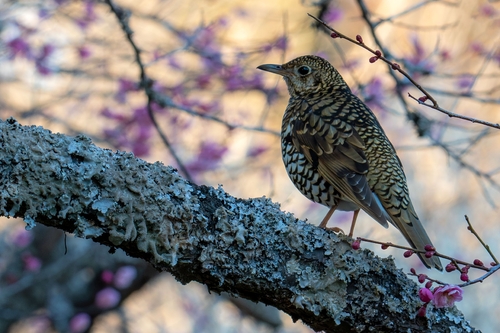 White's Thrush
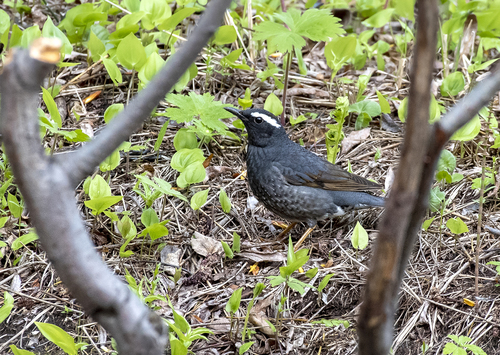 Siberian Thrush
In short
The most reliable field mark for separating White's Thrush and Siberian Thrush in flight is the bold black band on the white underwing, which is shared by both species and therefore not diagnostic between them. Instead, focus on plumage when perched: White's Thrush shows heavy black scaling on a pale white or yellowish background, while Siberian Thrush lacks this scaly appearance. Both are similar in size, but White's Thrush tends to appear larger and more robust. Vocalizations are only helpful if you hear the song, as only White's Thrush is described as having a loud, mechanical whistle. Habitat and structure offer little help in the field, so rely on plumage patterns for separation.
Identification tips
- In flight, both species show a bold black band on the white underwing—this is not a separator, as both share it. Do not rely on this feature for identification between these two.
- Perched birds are best separated by body plumage: White's Thrush of all ages and sexes shows heavy black scaling on a pale white or yellowish background, creating a scaly effect over the entire body. Look for this distinctive pattern, especially on the back and underparts.
- Siberian Thrush lacks the all-over scaling: Males are dark blue-black above and below, while females are brownish and more uniform, sometimes with faint scaling but never as bold or extensive as White's Thrush.
- Size and structure: White's Thrush is generally larger and bulkier than Siberian Thrush, with a longer tail. However, this can be subtle and is not always reliable without direct comparison.
- Sex differences in Siberian Thrush: Males are much darker (blue-black), while females are brownish. White's Thrush shows little sexual dimorphism, with both sexes similar in appearance.
- No age-specific upperwing or immature flight marks are described for either species, so do not look for differences in juvenile wing panels or patterns.
- Voice: If you hear a loud, mechanical, far-carrying whistle with long pauses, you are likely hearing White's Thrush. Siberian Thrush vocalizations are not described in the provided notes.
- Habitat and context: Both species can occur in similar forested habitats during migration or winter, so do not rely on location alone for separation.
- Feeding behavior: Both forage on the ground and may flush in a similar manner; behavior is not a reliable separator.
- In poor light or at a distance, focus on the overall impression: White's Thrush will often appear paler and more patterned, while Siberian Thrush (especially males) will look much darker and more uniform.
- If you see a bird with a scaly pattern across the body, especially on the underparts, it is White's Thrush. If the bird is dark and lacks this scaling, consider Siberian Thrush, especially if it is blue-black (male) or plain brown (female).
- Do not be misled by the underwing pattern in flight—both species share the black-and-white underwing, so this feature alone cannot be used for separation.
- If you only see the bird in flight and cannot assess body plumage, identification may not be possible between these two species.
- When in doubt, try to observe the bird when perched to check for the scaly pattern of White's Thrush.
- Remember that both species are rare or local in many areas; check local abundance on eBird if unsure, but do not rely solely on expected status.
Size
Both species are similar in size, with Siberian Thrush listed at about 65 g in body mass [wikidata]. White's Thrush is described as 27–31 cm long, and is generally bulkier and longer than Siberian Thrush, which is closer in size to a Song Thrush. In the field, White's Thrush may appear more robust and longer-tailed, but this difference is subtle and not always reliable at a distance or in poor light.
Plumage
In flight, both species show a striking black band on the white underwing, which is not useful for separation as it is shared by both. When perched, White's Thrush (all ages and sexes) is characterized by extensive black scaling on a pale white or yellowish ground color, giving a distinctly 'scaly' look across the body. Siberian Thrush lacks this all-over scaling; instead, males are dark blue-black above and below, while females are brownish with less distinct scaling and a more uniform appearance. No age-specific upperwing or immature flight marks are described for either species, so the main separation is in the body plumage when perched.
Behaviour
Both species are ground-foraging thrushes and may behave similarly when feeding or flushed. No distinctive behavioral differences are noted in the sources provided.
Habitat
No diagnostic habitat differences are described in the notes. Both species are forest thrushes and may overlap in migration or wintering grounds.
Voice
Only White's Thrush is described as having a song: a loud, far-carrying mechanical whistle with 5–10 second pauses between each one-second phrase ("twee...tuuu....tuuu....tuuu"). No vocal description is given for Siberian Thrush in the provided notes, so song is only useful if you hear the distinctive call of White's Thrush.