

White's Thrush vs Mistle Thrush
Zoothera aurea versus Turdus viscivorus
Play a quiz with White's Thrush and Mistle Thrush
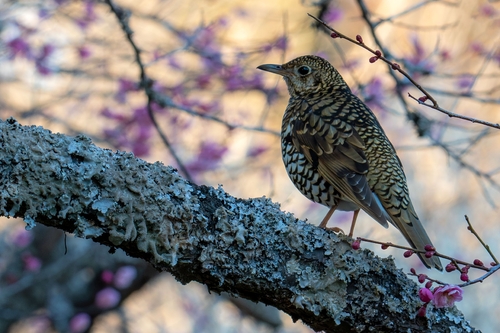 White's Thrush
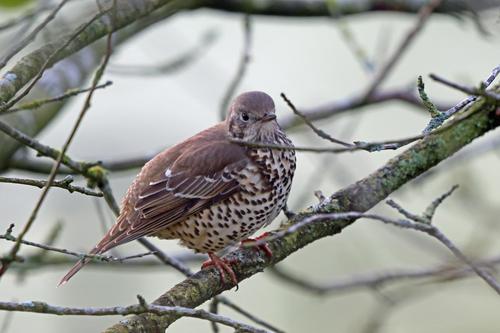 Mistle Thrush
In short
The most reliable way to separate White's Thrush from Mistle Thrush is by their underwing pattern in flight: White's Thrush shows a bold black band across the white underwing coverts, while Mistle Thrush has plain white underwings without any dark band. On perched birds, White's Thrush is heavily scalloped below with black-edged golden or yellowish feathers, whereas Mistle Thrush is paler, with round black spots on a buff or off-white background. Juvenile Mistle Thrushes can look confusingly patterned, but lack the golden tones and distinctive underwing of White's. Structure and behavior also help: White's is more compact and secretive, while Mistle is larger, paler, and often stands upright in open areas.
Identification tips
- Underwing pattern in flight (all ages): White's Thrush shows a bold black band across the white underwing coverts—unique among thrushes in the region. Mistle Thrush underwings are plain white. Always prioritize this mark if the bird is seen in flight.
- Underpart pattern (perched, all ages): White's Thrush has heavy black scalloping or scaling on a golden or yellowish background. Mistle Thrush is paler, with round black spots on a buff or off-white belly and breast.
- Juvenile confusion: Juvenile Mistle Thrushes have smaller, rounder spots and creamy teardrop marks on the upperparts, but lack the golden tones and strong black scalloping of White's. Juvenile White's Thrushes already show the diagnostic underwing band.
- Tail pattern: Mistle Thrush has white tips to the outer tail feathers, visible when the tail is spread. White's Thrush lacks these white tips.
- Overall coloration: White's Thrush appears golden or yellowish below, especially in good light; Mistle Thrush is more grey-brown above and buffy or off-white below.
- Structure: Mistle Thrush is larger, bulkier, and has a longer tail, often held upright. White's Thrush is more compact and rounded, with a shorter tail.
- Behavior: Mistle Thrush is often seen in the open, upright and alert, sometimes in flocks. White's Thrush is shy, secretive, and prefers dense cover.
- Habitat: Mistle Thrush frequents open woodlands, parks, and fields; White's Thrush sticks to dense, damp forests and is rarely seen far from cover.
- Flight style: Mistle Thrush has an undulating, bounding flight with glides; White's Thrush is more direct and steady when flushed.
- Vocalization: If heard, White's Thrush gives a mechanical, whistled 'tuuu...tuuu...tuuu' with long pauses. Mistle Thrush's song is a loud, fluty warble (not detailed in notes).
- Seasonal context: Both species can be found in overlapping ranges in some areas, but White's Thrush is more likely to be a migrant or winter visitor, while Mistle Thrush is often resident or forms flocks in autumn/winter.
- No sexual dimorphism: Both species have similar plumage in males and females, so do not rely on sex for identification.
- Spot shape: Mistle Thrush spots are round and irregularly placed; White's Thrush has more regular, scalloped scaling.
- Upperpart color: Mistle Thrush is pale grey-brown above; White's Thrush has a warmer, golden-brown tone.
- Contextual clues: If the bird is in a city park or open field, Mistle Thrush is more likely; if deep in a damp forest, suspect White's Thrush.
Size
Mistle Thrush is generally larger and heavier than White's Thrush. Mistle Thrush measures 27–30 cm in length (depending on subspecies), with a wingspan around 45 cm and an average weight of about 130 g, reaching up to 167 g in some individuals [wikipedia]. White's Thrush is similar in length (27–31 cm) but is typically slimmer and less bulky [wikipedia]. Mistle Thrush appears especially long-tailed and stocky, while White's Thrush is more compact and rounded.
Plumage
Juvenile and adult White's Thrushes of all ages show bold black scaling or scalloping on a pale golden or yellowish ground color, especially on the underparts. In flight, all ages reveal a striking black band across the otherwise white underwing coverts—a key diagnostic feature not found in Mistle Thrush. Mistle Thrush adults and juveniles are paler, with grey-brown upperparts and round black spots on the yellowish-buff to off-white underparts. Juvenile Mistle Thrushes have smaller spots and creamy teardrop centers to upperpart feathers, but never the golden tones or strong scalloping of White's. Mistle Thrush underwings are plain white, lacking any black band. Tail pattern also differs: Mistle Thrush has white tips to the outer tail feathers, while White's Thrush does not show this feature. Both species lack sexual dimorphism in plumage.
Behaviour
Mistle Thrushes are often seen upright and alert in open areas, hopping with their heads held high and sometimes flicking their wings and tails. They are more likely to be seen in flocks, especially outside the breeding season, and are generally bolder and more terrestrial. White's Thrush is secretive, preferring dense cover and moving quietly on the ground or low in trees. In flight, Mistle Thrush has an undulating, bounding flight interspersed with glides, while White's Thrush is less often seen in the open but shows a more direct, steady flight when flushed.
Habitat
Mistle Thrush is widespread across Europe, temperate Asia, and North Africa, commonly found in open woodlands, parks, and even urban green spaces. It is often seen in the open, especially on lawns or fields. White's Thrush prefers dense, damp woodlands and forest edges, rarely venturing far from cover. If seen in open habitat, it is usually only briefly when flushed.
Voice
White's Thrush has a loud, far-carrying mechanical whistle, with each phrase lasting about a second and separated by long pauses (5–10 seconds): a repeated 'tuuu...tuuu...tuuu.' Mistle Thrush's song is not described in the provided notes, but it is generally known to be a loud, fluty, and somewhat harsh warble, often delivered from a treetop. Calls are not diagnostic with the given information.