

White-winged Scoter vs Kauai Amakihi
Melanitta deglandi versus Chlorodrepanis stejnegeri
Play a quiz with White-winged Scoter and Kauai Amakihi
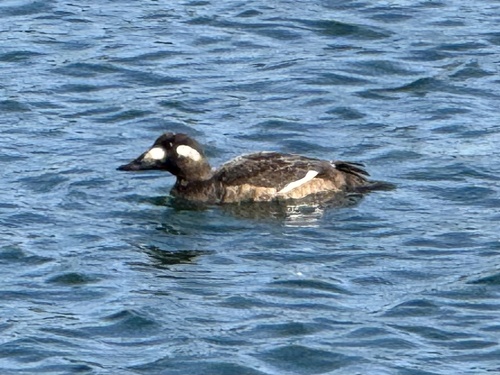 White-winged Scoter
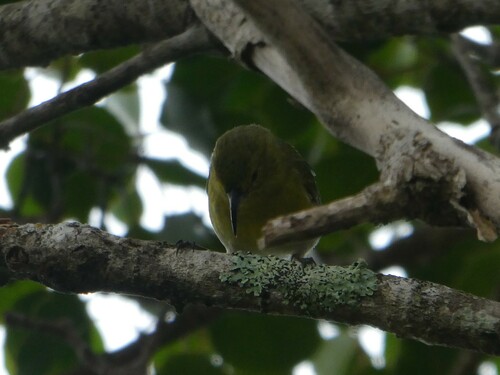 Kauai Amakihi
In short
The most reliable field mark to separate White-winged Scoter from Kauai Amakihi is the presence of a bold white secondary patch (speculum) on the wing of the scoter, visible in flight and sometimes at rest, especially in juveniles and adult males. White-winged Scoter is a large, heavy sea duck with a bulky body and a thick, feathered-based bill, while Kauai Amakihi is a small, slender honeycreeper with a distinctly curved, thin bill. Female and immature scoters can be confusing due to variable facial markings, but their overall size, shape, and aquatic habits are unlike the arboreal, nectar-feeding Amakihi. In the field, context (open water vs. forest) and structure are as important as plumage for a confident separation.
Identification tips
- White wing patch in flight: White-winged Scoter of all ages shows a bold white secondary patch (speculum) in the wing, especially obvious in flight. Kauai Amakihi never shows white in the wing.
- Size: White-winged Scoter is a massive duck, much larger than any songbird. Even at a distance, the bulk and length are obvious.
- Bill shape: Scoter has a thick, heavy bill with a feathered base and, in males, a large black knob. Amakihi has a thin, curved bill suited for nectar feeding.
- Facial markings (immature/female scoter): Juvenile and female scoters may show white spots in front of and behind the eye, but this is variable and can fade with age. Amakihi does not show such facial patches.
- Body shape: Scoter is bulky, with a long body and short tail. Amakihi is slender, with a proportionally longer tail for its size.
- Plumage color: Scoter males are all black with white highlights; females and juveniles are brownish with variable white. Amakihi is generally greenish or yellowish (not detailed in the notes, but never black or brown with white patches).
- Habitat: Scoter is always on or near water; Amakihi is always in forest or woodland, never on open water.
- Behavior: Scoter swims and dives; Amakihi flits among branches and feeds at flowers.
- Head profile (female/immature scoter): Female scoter has a 'two-stepped' profile between bill and head, with feathering forming a right angle at the base of the upper mandible. Amakihi has a smoothly curved bill-to-head profile.
- Bill color (male scoter): Male scoter has an orange and red bill with a black knob; Amakihi has a plain, dark bill.
- Wing pattern at rest: The scoter's white speculum may be partly visible even when perched or swimming; Amakihi's wing is plain.
- Flight style: Scoter flies powerfully and directly over water; Amakihi's flight is weak, undulating, and usually short-range between trees.
- Vocalization: Amakihi may give a high-pitched 'tweet' when active; scoter is generally silent.
- Sex/age confusion: Female and immature scoters can lose their white facial patches with age, but will always be much larger and bulkier than Amakihi.
- Context: If you see a large, dark bird with white in the wing on water, it's a scoter; if you see a small, greenish bird in a tree, it's an Amakihi.
Size
White-winged Scoter is vastly larger: males average 1,380 g and 55 cm in length, females about 1,180 g and 52.3 cm [wikipedia]. Kauai Amakihi is a small songbird (no direct measurements in the notes, but as a honeycreeper, it is much smaller and lighter than any duck). The scoter is one of the largest North American ducks, while the Amakihi is a typical small forest bird. There is no overlap in size; even a juvenile scoter dwarfs the Amakihi.
Plumage
Juvenile and female White-winged Scoters show variable white facial patches and a white speculum (secondary patch) on the wing, especially in flight. Juvenile males have more extensive white on the greater secondary coverts than juvenile females, but both sexes may show some white. Adult males are all black with a white eye crescent and white speculum, while adult females are brownish with less distinct facial markings as they age. In contrast, Kauai Amakihi lacks any white in the wing and does not show bold facial patches; its plumage is generally greenish or yellowish (not detailed in the notes, but as a honeycreeper, it lacks the scoter's strong contrast and white markings). The Amakihi's bill is thin and curved, matching its nectar-feeding habits, while the scoter's bill is thick, with a feathered base and, in males, a prominent knob. The scoter's white wing patch is diagnostic in flight at all ages, while the Amakihi never shows such a mark.
Behaviour
White-winged Scoter is an aquatic duck, usually seen swimming or diving on open water, rarely perching except on the ground near water. Its flight is powerful and direct, with strong wingbeats. Kauai Amakihi is arboreal, foraging among foliage and flowers, often seen flitting between branches or hovering briefly to feed. It does not swim or dive. The scoter's behavior is typical of sea ducks, while the Amakihi behaves like a small, active songbird.
Habitat
White-winged Scoter is found on large bodies of water—seas, lakes, or rivers—especially in open or tundra environments. It nests on the ground near water. Kauai Amakihi is endemic to forests on Kauai, Hawaii, and is never found on open water. If the bird is seen in a forest, especially in the Hawaiian Islands, it is the Amakihi; if on open water in North America, it is the scoter.
Voice
The notes only mention that Kauai Amakihi gives a distinguishing 'tweet' when flying or feeding. No vocalization information is provided for White-winged Scoter. In practice, scoters are generally quiet, while Amakihi may be heard giving short, high-pitched calls in the canopy.