

White-tipped Sicklebill vs Bronzy Hermit
Eutoxeres aquila versus Glaucis aeneus
Play a quiz with White-tipped Sicklebill and Bronzy Hermit
 White-tipped Sicklebill
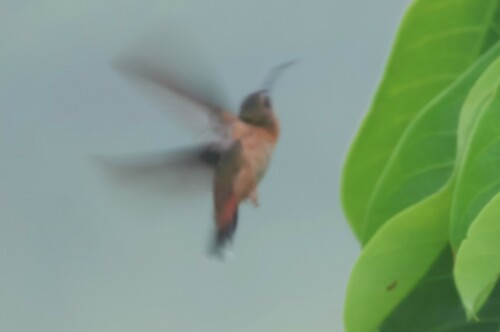 Bronzy Hermit
In short
The most reliable field mark separating White-tipped Sicklebill from Bronzy Hermit is the extreme, sickle-shaped curve of the sicklebill's bill, which forms a dramatic arc unlike the more modestly decurved bill of the hermit. Both species have green upperparts and white-tipped tails, but the sicklebill shows bold green-and-white striping on the underparts, while the hermit has a deep buff throat and belly with a distinctive white moustache. Juvenile sicklebills appear scaly, but there are no age-specific upperwing patterns noted for either species. In flight or perched, focus on bill shape and underpart pattern for the quickest separation.
Identification tips
- Bill shape is the single most diagnostic feature: White-tipped Sicklebill has an extremely decurved, sickle-shaped bill that forms a dramatic arc, while Bronzy Hermit's bill is only moderately decurved (more so in females, but never as extreme as the sicklebill).
- Underpart pattern: Sicklebill shows bold green-and-white striping on the underparts, with a blackish throat and chest. Bronzy Hermit has a deep buff throat and breast with a pale buff belly and lacks striping.
- Facial markings: Bronzy Hermit has a clear white moustache and a dusky face, which is absent in the sicklebill.
- Tail pattern: Both have white-tipped tails, but Bronzy Hermit's tail is gray-green above and reddish/blackish below, while the sicklebill's is mostly green with white tips on the outer feathers.
- Juvenile appearance: Juvenile White-tipped Sicklebills appear scaly, which may cause confusion with other species but not with the hermit, whose juveniles are not described as such.
- Size: Sicklebill is significantly larger and bulkier than Bronzy Hermit, but this is best used in direct comparison or with experience.
- Sex differences: Both species are similar in plumage between sexes; however, Bronzy Hermit females have a more curved bill (still less than sicklebill) and lack serrations present in the male's maxilla.
- Feeding behavior: Sicklebill is often seen clinging to curved flowers (Heliconia, Centropogon) due to its bill adaptation, while Bronzy Hermit may feed in a more typical hovering manner.
- Habitat: Sicklebill is more likely in dense, mid-elevation montane forest understory, especially where Heliconia is abundant. Bronzy Hermit can occur in similar areas but is not as specialized.
- Vocalizations: If heard, the sicklebill's high, thin squeaks and tseeps are distinctive; lack of vocalization detail for Bronzy Hermit means this is only useful if the sicklebill is singing.
- Flight jizz: No specific flight or upperwing pattern differences are described, so rely on structure and coloration.
- Perched posture: Sicklebill's long, dramatically curved bill is obvious even at rest; Bronzy Hermit appears shorter-billed and more compact.
- Trap-lining: Sicklebill is a classic trap-line feeder, rarely defending a territory, which may help in behavioral context if observed over time.
- Mistaken identity pitfalls: The white-tipped tail is shared, but do not rely on this alone; always check bill shape and underpart pattern.
- Geographic overlap: Both species can occur together in parts of Central and northern South America, so do not use range as a primary separator within their shared areas.
Size
White-tipped Sicklebill is notably larger, measuring 11.5–13.5 cm and weighing 8.6–14.5 g, while Bronzy Hermit is smaller at 9–10 cm and 3–6.5 g (males) or 3–6 g (females) [wikipedia][avonet]. This size difference is often apparent in direct comparison, with the sicklebill appearing bulkier and longer-billed. However, size alone can be misleading if seen singly or at a distance.
Plumage
No distinctive juvenile or immature upperwing patterns are described for either species. For all ages, White-tipped Sicklebill has green upperparts, a blackish throat and chest, and boldly striped green-and-white underparts. Its tail is mostly green with white tips on the outer feathers; juveniles look scaly overall. Bronzy Hermit, by contrast, has bronzy or coppery green upperparts, a deep buff throat and breast, and a pale buff belly. Its face is marked by a white moustache and dusky mask. The tail is gray-green above with white tips, and underneath it is reddish at the base, blackish in the middle, and white-tipped. Both species have white-tipped tails, but the underpart coloration and facial pattern are key.
Behaviour
White-tipped Sicklebill is a trap-line feeder, moving between flowers and rarely defending a territory. It often clings to flowers while feeding, especially those with curved corollas. Bronzy Hermit also feeds on nectar and is likely to be seen in similar foraging behavior, but the notes do not specify territoriality or trap-lining for this species. Both may glean insects, but the sicklebill is noted for taking them from spiderwebs or bark.
Habitat
Both species overlap in range in Central and northern South America, but White-tipped Sicklebill is more closely tied to the understory of montane evergreen forests, often at mid-elevations (300–2,100 m depending on locality). Bronzy Hermit shares much of the same geographic range but the notes do not specify its elevation or habitat preferences in detail. In Costa Rica and Panama, both could be found in the same general areas, but sicklebill is more specialized for dense forest understory.
Voice
White-tipped Sicklebill's song is a complex series of thin, whiny squeaks followed by strident, high tseep notes; its call is described as high, thin, sharp, and piercing ("tsitting"). Bronzy Hermit's vocalizations are not described in the provided notes, so voice is not a reliable separator unless the sicklebill's distinctive squeaks and tseeps are heard.