
White Tern vs Black Noddy
Gygis alba versus Anous minutus
Play a quiz with White Tern and Black Noddy
 White Tern
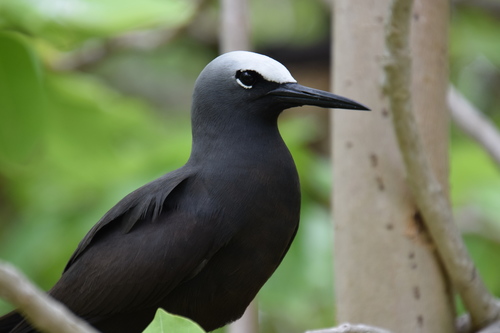 Black Noddy
In short
The most reliable way to separate White Tern from Black Noddy is by overall plumage: White Tern is entirely white (adults), while Black Noddy is dark sooty-brown to black with a contrasting white cap. Even at a distance or in flight, the White Tern's pure white body and wings stand out, whereas Black Noddy always shows a dark body with a pale crown. Juvenile White Terns are white with some grey mottling, but never approach the overall dark look of a noddy. Bill color and shape, as well as tail and wing structure, add further clues if plumage is obscured. These species may overlap on tropical islands, but their appearance is strikingly different in all plumages.
Identification tips
- Overall color: White Tern is entirely white in all plumages except juveniles, which are white with some grey mottling; Black Noddy is always dark sooty-brown to black with a white cap. This is the quickest and most reliable field mark.
- Crown and cap: Black Noddy has a sharply defined white cap that contrasts with the dark face and body; White Tern lacks any cap or contrasting crown, remaining white throughout.
- Bill: Both have black bills, but White Tern's is longer, more slender, and sometimes bluish at the base; Black Noddy's bill is shorter and stouter.
- Eye and lores: White Tern has a black eye with a narrow black feather ring; Black Noddy has dark lores (the area between the eye and bill), which further accentuates the white cap.
- Tail shape: White Tern's tail is shallowly forked, with the longest feathers being the second-from-outermost; Black Noddy's tail is more squared-off or slightly notched, never deeply forked.
- Wing shape and flight: White Tern has long, pointed wings and a buoyant, elastic flight style; Black Noddy's wings are also long and pointed, but its flight is steadier and more direct.
- Juvenile confusion: Juvenile White Tern is white with greyish mottling, never dark overall; juvenile Black Noddy is dark with a white cap, just like the adult.
- Perching behavior: White Tern often perches in exposed locations on thin branches or wires; Black Noddy prefers ledges or denser perches in colonies.
- Habitat context: Both species occur on tropical islands, but White Tern is more likely to be seen singly or in pairs, while Black Noddy is often in larger groups or colonies.
- Leg color: White Tern has dark grey to pale grey legs depending on subspecies; Black Noddy's legs are black (except orange in some subspecies, not relevant for most field encounters).
- Facial pattern: Black Noddy shows a small white crescent under the eye and a white spot above, adding to the capped look; White Tern's face is plain white except for the eye-ring.
- Nest placement: White Tern is famous for laying eggs directly on bare branches without a nest; Black Noddy builds a nest on ledges or trees.
- Size impression: Black Noddy is longer-bodied and may appear larger, but White Tern has a longer wingspan and appears more delicate.
- No seasonal or sex differences: There are no significant seasonal or sexual differences in plumage for either species that would affect identification.
- No voice cues: Vocalizations are not distinctive or described in the sources for field separation between these two species.
Size
White Tern is slightly smaller and lighter-bodied: it measures 23–30 cm in length with a wingspan of 76–87 cm and a body mass around 138 g. Black Noddy is longer (35–37 cm), but with a slightly shorter wingspan (66–72 cm) and a similar mass (98–144 g). In the field, Black Noddy may look more elongated due to its longer body and tail, but White Tern's larger wingspan and all-white plumage can make it appear more buoyant and delicate in flight.
Plumage
-
Adults: White Tern is pure white overall, with only a narrow dark streak along the shafts of the outer primaries in some subspecies (G. a. candida), and a black eye with a thin black eye-ring. Black Noddy is dark sooty-brown to black over most of the body, with a sharply defined white cap and a small white crescent below each eye and a white spot above. The lores are dark, not pale. The bill is black in both, but White Tern's is longer and more slender, sometimes bluish at the base.
-
Juveniles: Juvenile White Tern is white, mottled with grey or grey-brown, but never dark overall. Juvenile Black Noddy resembles the adult, remaining dark with the white cap. There are no age-related upperwing patterns in either species that would cause confusion: both lack contrasting panels, triangles, or trailing edges typical of other terns.
-
In flight: White Tern always shows a gleaming white appearance, while Black Noddy is dark with a white cap visible from above and in side view. The tail of White Tern is shallowly forked, with the longest feathers being the second-from-outermost, while Black Noddy's tail is more truncated.
Behaviour
White Tern often perches on thin branches, wires, or even bare twigs, sometimes in exposed positions, and is famous for nesting on open branches without a nest. Black Noddy tends to perch on ledges or in dense colonies, often on rocky substrates or in trees, but usually not as exposed as White Tern. In flight, White Tern is buoyant and graceful, with deep, elastic wingbeats, while Black Noddy flies with steadier, more direct wingbeats and often forages in flocks.
Habitat
Both species are tropical seabirds found on coral islands and atolls. White Tern is more likely to be seen nesting on small branches, wires, or even man-made structures, while Black Noddy prefers nesting in colonies on rocky ledges or in trees, sometimes in denser aggregations. Their ranges may overlap on some islands, but White Tern is more likely to be seen alone or in pairs, while Black Noddy is often in larger groups.