

Motmot

White-tailed Tropicbird vs Reunion Stonechat

Phaethon lepturus versus Saxicola tectes

Play a quiz with White-tailed Tropicbird and Reunion Stonechat
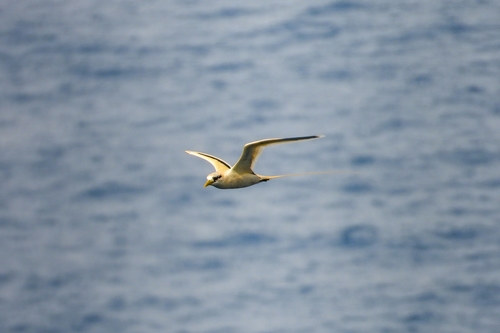
White-tailed Tropicbird (Phaethon lepturus) White-tailed Tropicbird
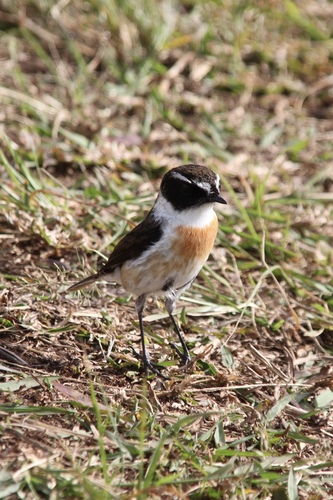
Reunion Stonechat (Saxicola tectes) Reunion Stonechat

Media

Loading…

In short

The most reliable field mark is overall structure and tail: White-tailed Tropicbird is a large, slender, oceanic bird with extremely long, ribbon-like central tail feathers (especially in adults), while Reunion Stonechat is a small, upright perching songbird with a short, square tail. In flight, the tropicbird shows strikingly white plumage with a bold black inner wing bar and a long, streaming tail, whereas the stonechat is compact, with no tail streamers and lacks any black wing bar. Juvenile tropicbirds lack tail streamers but still show the black wing bar and a green-yellow bill, while stonechats never show these features at any age. If seen perched, the tropicbird is rarely on land except at remote breeding sites, while the stonechat is common in terrestrial habitats and perches on shrubs or posts.

Identification tips

  1. Tail structure: Adult White-tailed Tropicbird has extremely long, ribbon-like central tail feathers, often twice the body length; stonechat never has tail streamers at any age.
  2. Wing pattern in flight: Tropicbird (all ages) shows a bold black inner wing bar; stonechat never has a black wing bar—its wings are uniformly dark or patterned with pale edges.
  3. Bill color: Adult tropicbird has an orange-yellow to orange-red bill; juveniles have a green-yellow bill. Stonechat always has a short, dark bill typical of insectivorous songbirds.
  4. Overall size and shape: Tropicbird is a large, slender seabird with long wings and tail; stonechat is a small, compact, upright perching bird.
  5. Plumage: Tropicbird is almost entirely white with a black eye-mask and black wing bar; stonechat is darker above, paler below, sometimes with orange on the breast and a white collar, but never pure white overall.
  6. Juvenile marks: Juvenile tropicbirds lack tail streamers but still show the black wing bar and a barred back; juvenile stonechats are streaky and brownish, never white or black-marked.
  7. Perched posture: Tropicbirds rarely perch except at remote colonies, where they sit on the ground or cliff ledges; stonechats perch upright on shrubs, rocks, or wires.
  8. Flight style: Tropicbird glides and soars with long, slow wingbeats and trailing tail; stonechat flies in short, bounding bursts with no tail streamers.
  9. Habitat: Tropicbird is oceanic, seen over open water or at remote breeding cliffs; stonechat is terrestrial, in open bushland, gardens, or plantations.
  10. Vocalization: Tropicbird’s call is a high, screamed series; stonechat gives sharp, ticking notes ('tec-tec').
  11. Context: If seen inland or in a garden, it is almost certainly a stonechat; if seen over the open ocean with long tail streamers, it is a tropicbird.
  12. Sex and age: Both species are sexually similar; male tropicbirds have slightly longer tails, but this is subtle. Juvenile tropicbirds can be confused only if tail streamers are missing, but the black wing bar and white plumage still separate them from stonechats.
  13. Pitfalls: A juvenile tropicbird without tail streamers could be mistaken for another white seabird, but never for a stonechat if size and wing pattern are checked. Stonechats are never white, never oceanic, and never have a black wing bar.
  14. Bill shape: Tropicbird’s bill is long, pointed, and slightly decurved; stonechat’s bill is short, straight, and conical.
  15. Abundance: On Réunion, stonechat is common and widespread; tropicbird is rare except at sea or at breeding cliffs.

Size

White-tailed Tropicbird is dramatically larger: adults are 71–80 cm long including the tail streamers, with a wingspan of 89–96 cm. Even without the tail streamers, the body is much larger than the Reunion Stonechat, which is a typical small passerine (exact measurements not provided, but stonechats are usually about 13–14 cm long). The tropicbird is slender and elongated, while the stonechat is compact and stubby by comparison. There is no overlap in size or impression.

Plumage

Juvenile and adult White-tailed Tropicbirds both show a distinctive black band on the inner wing in flight, which is never present on Reunion Stonechat. Juvenile tropicbirds lack the long tail streamers but have a finely barred back and a green-yellow bill, while adults have pure white backs, very long central tail feathers, and an orange-yellow to orange-red bill. The black eye-mask and white plumage are present at all ages. Reunion Stonechat, in contrast, never shows a black wing bar, tail streamers, or all-white plumage. Its plumage is typical of stonechats: darker above, paler below, often with a white collar and some orange on the breast, but never the clean white and black pattern of the tropicbird. In all ages and seasons, the stonechat’s upperparts are much darker and the underparts are never pure white.

Behaviour

White-tailed Tropicbird is almost always seen flying over open ocean, rarely perching except at remote breeding colonies, and feeds by plunge-diving for fish and squid. Its flight is buoyant and graceful, with long, gliding arcs and obvious tail streamers trailing behind. Reunion Stonechat is terrestrial, perching upright on shrubs, rocks, or posts, and feeds by sallying out to catch insects. Its flight is short, bounding, and direct, lacking any trailing tail streamers. The two species never overlap in typical behavior or jizz.

Habitat

White-tailed Tropicbird is strictly oceanic, found over tropical seas and only coming to land to breed on remote islands or cliffs. It is never found in forests, shrublands, gardens, or plantations. Reunion Stonechat is endemic to the island of Réunion, where it is common in open bushland, clearings, gardens, and plantations, up to 2600 meters elevation. It is never found at sea. If you see the bird inland, especially perched in a bush or garden, it is almost certainly a stonechat.

Voice

White-tailed Tropicbird gives a high, screamed 'keee-keee-krrrt-krrt-krrt', usually heard at breeding colonies or when flying overhead. Reunion Stonechat’s name is onomatopoeic ('tec-tec'), and its call is a sharp, clicking or ticking note, typical of stonechats. The two vocalizations are completely different in tone, rhythm, and context.

Submit a better description

Use the same sections as the comparison. Your text is published immediately.

The most reliable field mark is overall structure and tail: White-tailed Tropicbird is a large, slender, oceanic bird with extremely long, ribbon-like central tail feathers (especially in adults), while Reunion Stonechat is a small, upright perching songbird with a short, square tail. In flight, the tropicbird shows strikingly white plumage with a bold black inner wing bar and a long, streaming tail, whereas the stonechat is compact, with no tail streamers and lacks any black wing bar. Juvenile tropicbirds lack tail streamers but still show the black wing bar and a green-yellow bill, while stonechats never show these features at any age. If seen perched, the tropicbird is rarely on land except at remote breeding sites, while the stonechat is common in terrestrial habitats and perches on shrubs or posts.

  1. Tail structure: Adult White-tailed Tropicbird has extremely long, ribbon-like central tail feathers, often twice the body length; stonechat never has tail streamers at any age.
  2. Wing pattern in flight: Tropicbird (all ages) shows a bold black inner wing bar; stonechat never has a black wing bar—its wings are uniformly dark or patterned with pale edges.
  3. Bill color: Adult tropicbird has an orange-yellow to orange-red bill; juveniles have a green-yellow bill. Stonechat always has a short, dark bill typical of insectivorous songbirds.
  4. Overall size and shape: Tropicbird is a large, slender seabird with long wings and tail; stonechat is a small, compact, upright perching bird.
  5. Plumage: Tropicbird is almost entirely white with a black eye-mask and black wing bar; stonechat is darker above, paler below, sometimes with orange on the breast and a white collar, but never pure white overall.
  6. Juvenile marks: Juvenile tropicbirds lack tail streamers but still show the black wing bar and a barred back; juvenile stonechats are streaky and brownish, never white or black-marked.
  7. Perched posture: Tropicbirds rarely perch except at remote colonies, where they sit on the ground or cliff ledges; stonechats perch upright on shrubs, rocks, or wires.
  8. Flight style: Tropicbird glides and soars with long, slow wingbeats and trailing tail; stonechat flies in short, bounding bursts with no tail streamers.
  9. Habitat: Tropicbird is oceanic, seen over open water or at remote breeding cliffs; stonechat is terrestrial, in open bushland, gardens, or plantations.
  10. Vocalization: Tropicbird’s call is a high, screamed series; stonechat gives sharp, ticking notes ('tec-tec').
  11. Context: If seen inland or in a garden, it is almost certainly a stonechat; if seen over the open ocean with long tail streamers, it is a tropicbird.
  12. Sex and age: Both species are sexually similar; male tropicbirds have slightly longer tails, but this is subtle. Juvenile tropicbirds can be confused only if tail streamers are missing, but the black wing bar and white plumage still separate them from stonechats.
  13. Pitfalls: A juvenile tropicbird without tail streamers could be mistaken for another white seabird, but never for a stonechat if size and wing pattern are checked. Stonechats are never white, never oceanic, and never have a black wing bar.
  14. Bill shape: Tropicbird’s bill is long, pointed, and slightly decurved; stonechat’s bill is short, straight, and conical.
  15. Abundance: On Réunion, stonechat is common and widespread; tropicbird is rare except at sea or at breeding cliffs.

White-tailed Tropicbird is dramatically larger: adults are 71–80 cm long including the tail streamers, with a wingspan of 89–96 cm. Even without the tail streamers, the body is much larger than the Reunion Stonechat, which is a typical small passerine (exact measurements not provided, but stonechats are usually about 13–14 cm long). The tropicbird is slender and elongated, while the stonechat is compact and stubby by comparison. There is no overlap in size or impression.

Juvenile and adult White-tailed Tropicbirds both show a distinctive black band on the inner wing in flight, which is never present on Reunion Stonechat. Juvenile tropicbirds lack the long tail streamers but have a finely barred back and a green-yellow bill, while adults have pure white backs, very long central tail feathers, and an orange-yellow to orange-red bill. The black eye-mask and white plumage are present at all ages. Reunion Stonechat, in contrast, never shows a black wing bar, tail streamers, or all-white plumage. Its plumage is typical of stonechats: darker above, paler below, often with a white collar and some orange on the breast, but never the clean white and black pattern of the tropicbird. In all ages and seasons, the stonechat’s upperparts are much darker and the underparts are never pure white.

White-tailed Tropicbird is almost always seen flying over open ocean, rarely perching except at remote breeding colonies, and feeds by plunge-diving for fish and squid. Its flight is buoyant and graceful, with long, gliding arcs and obvious tail streamers trailing behind. Reunion Stonechat is terrestrial, perching upright on shrubs, rocks, or posts, and feeds by sallying out to catch insects. Its flight is short, bounding, and direct, lacking any trailing tail streamers. The two species never overlap in typical behavior or jizz.

White-tailed Tropicbird is strictly oceanic, found over tropical seas and only coming to land to breed on remote islands or cliffs. It is never found in forests, shrublands, gardens, or plantations. Reunion Stonechat is endemic to the island of Réunion, where it is common in open bushland, clearings, gardens, and plantations, up to 2600 meters elevation. It is never found at sea. If you see the bird inland, especially perched in a bush or garden, it is almost certainly a stonechat.

White-tailed Tropicbird gives a high, screamed 'keee-keee-krrrt-krrt-krrt', usually heard at breeding colonies or when flying overhead. Reunion Stonechat’s name is onomatopoeic ('tec-tec'), and its call is a sharp, clicking or ticking note, typical of stonechats. The two vocalizations are completely different in tone, rhythm, and context.

Discard your changes?

You have unsaved edits. If you leave now, those changes will be lost.

White-tailed Tropicbird · Reunion Stonechat · My Tricky Birds