

Motmot

White-tailed Lark vs Brimstone Canary

Mirafra albicauda versus Crithagra sulphurata

Play a quiz with White-tailed Lark and Brimstone Canary

White-tailed Lark (Mirafra albicauda) White-tailed Lark
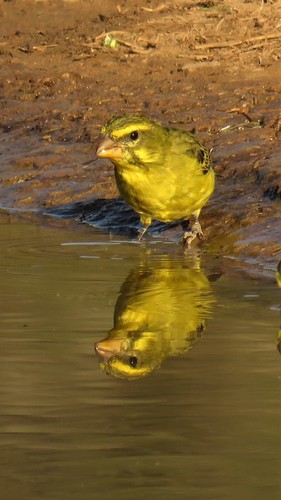
Brimstone Canary (Crithagra sulphurata) Brimstone Canary

Media

Loading…

In short

The most reliable way to separate White-tailed Lark from Brimstone Canary is by overall structure and bill shape: the lark is a typical ground-dwelling bird with a slender bill, while the canary is a chunky finch with a heavy, conical bill. Brimstone Canary shows bright yellow and green tones with two yellow wing bars and a stout, pale bill, whereas White-tailed Lark is a more uniformly brownish grassland bird with no yellow or wing bars. Habitat is also a strong clue: larks are found in open, seasonally wet grasslands, while canaries prefer lightly wooded areas, forest edge, or gardens. Immature Brimstone Canaries are duller but still show yellow tones and a finch-like bill, never resembling the cryptic, earth-toned lark.

Identification tips

  1. Bill shape is key: Brimstone Canary always has a thick, conical, seed-cracking bill, pale brownish with a pinkish or yellowish base; White-tailed Lark has a slender, pointed bill suited for insectivory. This is diagnostic at all ages.
  2. Plumage color: Brimstone Canary shows yellow-green upperparts, yellow underparts, and two yellow wing bars (adults and immatures, though immatures are duller and greyer). White-tailed Lark is uniformly brownish with no yellow or wing bars.
  3. Wing bars: Only Brimstone Canary has two yellow wing bars; White-tailed Lark never shows wing bars at any age.
  4. Facial pattern: Brimstone Canary has a yellow-green malar stripe and ear coverts, with a better defined face pattern in males. White-tailed Lark has a plain face with no strong markings.
  5. Tail and rump: Brimstone Canary males may show a greenish rump, but never a white tail. White-tailed Lark's tail is not described as white in field marks, but its name suggests some pale in the tail, which could help in flight if visible.
  6. Body structure: Brimstone Canary is compact, short-tailed, and heavy-billed; White-tailed Lark is longer-tailed, more upright, and slender-billed.
  7. Behavior: Larks are ground-dwelling, running or walking on open grass, rarely perching high. Canaries perch on bushes, trees, or wires and are more arboreal.
  8. Habitat: Open, seasonally wet grassland (lark) vs. lightly wooded areas, forest edge, or gardens (canary). If you see a yellowish bird in a bush, it's almost certainly a canary.
  9. Juvenile confusion: Young Brimstone Canaries are duller but still show yellow tones and a finch bill; they never look like a cryptic brown lark. Juvenile larks remain earth-toned and structurally different.
  10. Song and calls: Only Brimstone Canary has a described song and call; if you hear a deep, trilled, or warbling song, it's the canary.
  11. Sex differences: Male Brimstone Canaries are brighter with a larger bill and more defined face pattern, but both sexes share the yellow and green tones. Lark sexes are not described as differing in field marks.
  12. Regional variation: Brimstone Canary varies from greener in the south to more yellowish-green in the north, but always keeps the finch structure and yellow tones.
  13. Feeding: Canaries may be seen cracking seeds or eating fruit/flowers; larks feed on the ground, often on insects.
  14. Group size: Both species can be solitary or in pairs, but canaries may form small groups, especially at food sources.
  15. When in doubt: If the bird is cryptic brown, ground-dwelling, and lacks yellow or wing bars, it's a lark. If it is yellowish, heavy-billed, and perching, it's a canary.

Size

Brimstone Canary is a small, chunky finch weighing about 18.2 g [wikidata], with a compact build and large head relative to body. White-tailed Lark's mass is not given, but as a Mirafra lark, it is likely similar or slightly larger in length but slimmer and more elongated in profile, with a longer tail and legs. In the field, the canary appears stockier and shorter-tailed, while the lark looks more streamlined and upright when on the ground.

Plumage

Brimstone Canary of all ages shows yellow-green upperparts with dark green streaking, two yellow wing bars, and yellow underparts (duller and greyer in juveniles). The bill is always thick and conical, pale brownish with a pinkish or yellowish base. Adults are brighter, especially males, with more vivid yellow and a greenish rump; immatures are less yellow but retain the overall finch pattern. White-tailed Lark, by contrast, lacks any yellow, green, or wing bars, and is instead a cryptic brownish bird suited to grassland camouflage. The lark's plumage is more uniform and earth-toned, with no strong facial or wing markings, and a slender bill. No age-specific wing pattern is noted for either species, so separation relies on overall color and structure at all ages.

Behaviour

White-tailed Lark is typically seen walking or running on the ground in open grasslands, often alone or in loose pairs, and rarely perches in trees or bushes. Its movements are more horizontal and it may flush with a fluttering, low flight. Brimstone Canary is less gregarious than other canaries but is usually seen singly, in pairs, or small groups, often perching conspicuously on bushes, trees, or wires. It frequently visits gardens and cracks seeds with its strong bill, sometimes feeding on fruit or flowers. The canary's behavior is more arboreal and less terrestrial than the lark.

Habitat

White-tailed Lark is restricted to tropical and subtropical seasonally wet or flooded lowland grasslands, especially near lakes (Lake Chad, Lake Victoria) in parts of Chad, Sudan, South Sudan, Ethiopia, Uganda, Kenya, and Tanzania [wikipedia]. Brimstone Canary is found in central and southern Africa, favoring open, lightly wooded habitats, hillsides with trees or scrub, forest edges, and gardens. Thus, a bird in open, wet grassland is likely a lark, while one in a bushy, wooded, or garden setting is likely a canary.

Voice

Brimstone Canary has a distinctive, deep-pitched trilled call ('swirriwirrit' or 'chirrup') and a song that is a jumble of chirps, whistles, warbles, and trills, with southern birds sounding deeper and northern birds faster and more tuneful. No vocal description is provided for White-tailed Lark, so voice is only useful for confirming Brimstone Canary, not for positively identifying the lark.

Submit a better description

Use the same sections as the comparison. Your text is published immediately.

The most reliable way to separate White-tailed Lark from Brimstone Canary is by overall structure and bill shape: the lark is a typical ground-dwelling bird with a slender bill, while the canary is a chunky finch with a heavy, conical bill. Brimstone Canary shows bright yellow and green tones with two yellow wing bars and a stout, pale bill, whereas White-tailed Lark is a more uniformly brownish grassland bird with no yellow or wing bars. Habitat is also a strong clue: larks are found in open, seasonally wet grasslands, while canaries prefer lightly wooded areas, forest edge, or gardens. Immature Brimstone Canaries are duller but still show yellow tones and a finch-like bill, never resembling the cryptic, earth-toned lark.

  1. Bill shape is key: Brimstone Canary always has a thick, conical, seed-cracking bill, pale brownish with a pinkish or yellowish base; White-tailed Lark has a slender, pointed bill suited for insectivory. This is diagnostic at all ages.
  2. Plumage color: Brimstone Canary shows yellow-green upperparts, yellow underparts, and two yellow wing bars (adults and immatures, though immatures are duller and greyer). White-tailed Lark is uniformly brownish with no yellow or wing bars.
  3. Wing bars: Only Brimstone Canary has two yellow wing bars; White-tailed Lark never shows wing bars at any age.
  4. Facial pattern: Brimstone Canary has a yellow-green malar stripe and ear coverts, with a better defined face pattern in males. White-tailed Lark has a plain face with no strong markings.
  5. Tail and rump: Brimstone Canary males may show a greenish rump, but never a white tail. White-tailed Lark's tail is not described as white in field marks, but its name suggests some pale in the tail, which could help in flight if visible.
  6. Body structure: Brimstone Canary is compact, short-tailed, and heavy-billed; White-tailed Lark is longer-tailed, more upright, and slender-billed.
  7. Behavior: Larks are ground-dwelling, running or walking on open grass, rarely perching high. Canaries perch on bushes, trees, or wires and are more arboreal.
  8. Habitat: Open, seasonally wet grassland (lark) vs. lightly wooded areas, forest edge, or gardens (canary). If you see a yellowish bird in a bush, it's almost certainly a canary.
  9. Juvenile confusion: Young Brimstone Canaries are duller but still show yellow tones and a finch bill; they never look like a cryptic brown lark. Juvenile larks remain earth-toned and structurally different.
  10. Song and calls: Only Brimstone Canary has a described song and call; if you hear a deep, trilled, or warbling song, it's the canary.
  11. Sex differences: Male Brimstone Canaries are brighter with a larger bill and more defined face pattern, but both sexes share the yellow and green tones. Lark sexes are not described as differing in field marks.
  12. Regional variation: Brimstone Canary varies from greener in the south to more yellowish-green in the north, but always keeps the finch structure and yellow tones.
  13. Feeding: Canaries may be seen cracking seeds or eating fruit/flowers; larks feed on the ground, often on insects.
  14. Group size: Both species can be solitary or in pairs, but canaries may form small groups, especially at food sources.
  15. When in doubt: If the bird is cryptic brown, ground-dwelling, and lacks yellow or wing bars, it's a lark. If it is yellowish, heavy-billed, and perching, it's a canary.

Brimstone Canary is a small, chunky finch weighing about 18.2 g [wikidata], with a compact build and large head relative to body. White-tailed Lark's mass is not given, but as a Mirafra lark, it is likely similar or slightly larger in length but slimmer and more elongated in profile, with a longer tail and legs. In the field, the canary appears stockier and shorter-tailed, while the lark looks more streamlined and upright when on the ground.

Brimstone Canary of all ages shows yellow-green upperparts with dark green streaking, two yellow wing bars, and yellow underparts (duller and greyer in juveniles). The bill is always thick and conical, pale brownish with a pinkish or yellowish base. Adults are brighter, especially males, with more vivid yellow and a greenish rump; immatures are less yellow but retain the overall finch pattern. White-tailed Lark, by contrast, lacks any yellow, green, or wing bars, and is instead a cryptic brownish bird suited to grassland camouflage. The lark's plumage is more uniform and earth-toned, with no strong facial or wing markings, and a slender bill. No age-specific wing pattern is noted for either species, so separation relies on overall color and structure at all ages.

White-tailed Lark is typically seen walking or running on the ground in open grasslands, often alone or in loose pairs, and rarely perches in trees or bushes. Its movements are more horizontal and it may flush with a fluttering, low flight. Brimstone Canary is less gregarious than other canaries but is usually seen singly, in pairs, or small groups, often perching conspicuously on bushes, trees, or wires. It frequently visits gardens and cracks seeds with its strong bill, sometimes feeding on fruit or flowers. The canary's behavior is more arboreal and less terrestrial than the lark.

White-tailed Lark is restricted to tropical and subtropical seasonally wet or flooded lowland grasslands, especially near lakes (Lake Chad, Lake Victoria) in parts of Chad, Sudan, South Sudan, Ethiopia, Uganda, Kenya, and Tanzania [wikipedia]. Brimstone Canary is found in central and southern Africa, favoring open, lightly wooded habitats, hillsides with trees or scrub, forest edges, and gardens. Thus, a bird in open, wet grassland is likely a lark, while one in a bushy, wooded, or garden setting is likely a canary.

Brimstone Canary has a distinctive, deep-pitched trilled call ('swirriwirrit' or 'chirrup') and a song that is a jumble of chirps, whistles, warbles, and trills, with southern birds sounding deeper and northern birds faster and more tuneful. No vocal description is provided for White-tailed Lark, so voice is only useful for confirming Brimstone Canary, not for positively identifying the lark.

Discard your changes?

You have unsaved edits. If you leave now, those changes will be lost.

White-tailed Lark · Brimstone Canary · My Tricky Birds