

White-shouldered Tanager vs White-lined Tanager
Loriotus luctuosus versus Tachyphonus rufus
Play a quiz with White-shouldered Tanager and White-lined Tanager
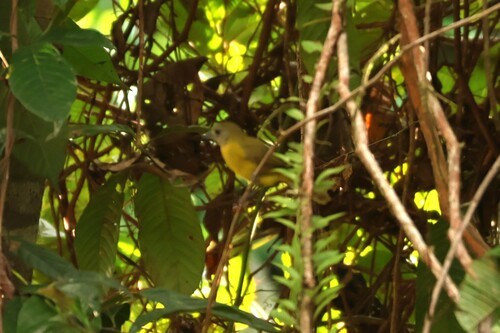 White-shouldered Tanager
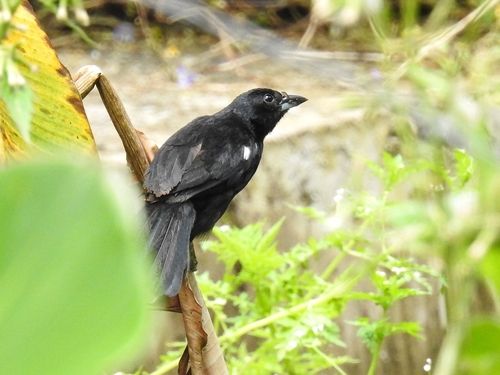 White-lined Tanager
In short
The most reliable field mark between these two tanagers is the female and immature plumage: female and young White-shouldered Tanagers are gray-headed with olive and yellow tones, while female and immature White-lined Tanagers are entirely rufous. For adult males, look at the white wing markings: White-shouldered shows a large, obvious white shoulder patch even when perched, while White-lined's white is much smaller and usually hidden except in flight. Size is also a strong clue, as White-lined is noticeably larger and bulkier. In flight, check for the extent and placement of white on the wing and underwing, and use structure and bill shape as supporting clues.
Identification tips
- Female/immature plumage: If the bird is entirely rufous (including head and underparts), it's a female or immature White-lined Tanager. If it shows a gray head, olive-green back, and yellowish underparts, it's a female or juvenile White-shouldered Tanager. This is the most reliable field mark outside adult males.
- White shoulder patch (adult males): A prominent white patch on the shoulder, visible even when perched, indicates White-shouldered Tanager. If the white is only seen in flight or display and is much smaller, suspect White-lined Tanager.
- White in flight: Both males have white underwing coverts, but White-shouldered's white is more extensive and can be seen at rest; White-lined's is mostly hidden and flashes in flight or display.
- Size and structure: White-lined Tanager is much larger and bulkier, with a noticeably longer tail and a stouter bill. If the bird looks small and slim, White-shouldered is more likely.
- Bill color: White-shouldered Tanager's bill is blackish with a paler base (varies by subspecies), while White-lined's is stout and all black.
- Sexual dimorphism: Only White-shouldered Tanager is strongly sexually dimorphic; White-lined female and immature are rufous, male is black. White-shouldered females are gray/olive/yellow, males are black with a white shoulder.
- Juvenile confusion: Juvenile White-shouldered Tanagers look like duller females (gray/olive/yellow), while juvenile White-lined are rufous like adult females.
- Behavior: White-lined Tanagers are more solitary or in pairs and may display their white underwing in courtship. White-shouldered Tanagers are more likely to join mixed flocks.
- Habitat: White-shouldered prefers forest undergrowth and edges, White-lined is more often in open woodland, gardens, and shrubby areas.
- Perched vs flight views: If you see a perched black male with a large white shoulder patch, it's White-shouldered. If the white is only visible in flight, it's likely White-lined.
- Subspecies variation: Some White-shouldered subspecies have larger or brighter white patches or subtle differences in bill color—check local field guides for details.
- Mixed flocks: If the bird is part of a mixed-species flock, White-shouldered is more likely; White-lined rarely joins such groups.
- Vocalization: If you hear a fast, repetitive 'cheeru,' it's White-lined Tanager. Lack of song is not diagnostic for White-shouldered.
- Nest placement (if observed): White-shouldered nests low in undergrowth; White-lined nests higher in trees or shrubs.
- Geographic overlap: Both species occur together in much of Central and northern South America, so do not rely on range alone.
Size
White-lined Tanager is significantly larger and heavier, measuring about 18.5 cm and 33 g, compared to the White-shouldered Tanager's 13–14 cm and 11.5–15 g [wikipedia]. The White-lined also has a longer tail and a stouter, more robust bill. This size difference is usually apparent in the field, especially when both species are seen in the same area, but can be harder to judge in isolation or at a distance.
Plumage
- Females and immatures: White-shouldered Tanager females and juveniles are gray-headed with olive-green upperparts and yellowish underparts, sometimes with a grayish throat. By contrast, female and immature White-lined Tanagers are entirely rufous, with a paler belly but no gray or olive tones. This difference is immediate and reliable at all ages except adult males.
- Adult males: Both species' males are glossy black overall, but the white markings differ. White-shouldered Tanager males have a prominent white patch on the shoulder (formed by white marginal, lesser, and median coverts) that is visible even when perched. White-lined Tanager males have a much smaller white patch, mostly limited to the underwing coverts and a small area on the upperwing, which is usually only visible in flight or display. Both have white underwing coverts, but the White-shouldered's white is more extensive and obvious at rest.
- Juveniles: Juvenile White-shouldered Tanagers resemble duller, more uniform versions of the female, retaining the gray and olive/yellow pattern. Juvenile White-lined Tanagers are rufous like the adult female, lacking any gray or olive.
- Bill color: White-shouldered Tanagers have a blackish bill with a slightly paler base to the mandible (varies by subspecies), while White-lined Tanagers have a mostly black, stout bill.
Behaviour
White-lined Tanagers are often territorial and tend to be seen singly or in pairs, rarely joining mixed-species flocks. Males may display their white underwing patches in courtship. White-shouldered Tanagers are more likely to join mixed flocks and can be seen foraging in the forest undergrowth or mid-story. Both species build cup nests, but White-lined's is bulkier and placed higher in trees or shrubs, while White-shouldered tends to nest lower in the undergrowth.
Habitat
Both species overlap in much of Central and northern South America, including Trinidad. White-shouldered Tanagers are more often found in forest undergrowth and edges, sometimes joining mixed-species flocks. White-lined Tanagers prefer more open woodland, forest edges, gardens, and shrubby areas, and are less likely to be seen in mixed flocks. Habitat alone is not diagnostic but can support an ID when combined with other marks.
Voice
White-lined Tanager's song is described as a fast, repetitive 'cheeru.' There is no vocal description for White-shouldered Tanager in the provided notes, so voice is not a reliable separator based on these sources.
White-shouldered Tanager · White-lined Tanager · My Tricky Birds