

White-rumped Sandpiper vs Pectoral Sandpiper
Calidris fuscicollis versus Calidris melanotos
Play a quiz with White-rumped Sandpiper and Pectoral Sandpiper
 White-rumped Sandpiper
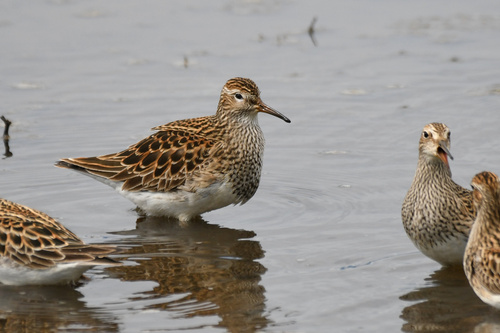 Pectoral Sandpiper
In short
The most reliable way to separate White-rumped Sandpiper from Pectoral Sandpiper is in flight: only White-rumped shows a conspicuous white rump patch, while Pectoral’s rump is plain and matches the back. On the ground, Pectoral Sandpiper stands out by its sharply demarcated, dark breast band, whereas White-rumped’s breast streaking is more diffuse. Pectoral is noticeably bulkier and longer-legged, with a yellowish base to the bill and legs, compared to the slimmer, darker-legged White-rumped. Juvenile plumages are subtly different, but the white rump in flight remains the most foolproof mark at any age.
Identification tips
- White rump in flight (all ages/seasons): Only White-rumped Sandpiper shows a bright white rump patch and uppertail coverts in flight, contrasting with a dark central tail. Pectoral’s rump is plain and matches the back. Always check for this when birds flush or preen.
- Breast pattern (adults and juveniles): Pectoral Sandpiper has a sharply demarcated, dark breast band with a clear lower edge against white belly; this 'cut-off' is visible from the front and sides. White-rumped’s breast streaking is finer and more diffuse, blending into the flanks and belly.
- Leg color: Pectoral has yellowish legs, though sometimes dull; White-rumped’s legs are always very dark, nearly black. This is most useful at close range in good light.
- Bill color and shape: Pectoral’s bill is slightly longer and has a yellowish or olive base with a dark tip. White-rumped’s bill is medium-length, uniformly dark, and thinner overall.
- Size and structure: Pectoral is bulkier, longer-necked, and longer-legged, often standing taller in flocks. White-rumped is smaller, more compact, with proportionally longer wings (primary tips extend well beyond tail when perched).
- Juvenile upperparts: White-rumped juveniles have black-centered feathers with brown and white edges, forming a white 'V' on the back and a pale supercilium. Pectoral juveniles are brighter, with rufous tones and white mantle stripes, but lack the white rump.
- Supercilium: White-rumped’s supercilium is usually more prominent and whiter, especially in juveniles and winter adults. Pectoral’s is weaker and less contrasting.
- Crown and face: White-rumped has a brownish crown and pale face, especially in juveniles. Pectoral’s crown is browner in summer, but less rufous than some similar species.
- Underpart streaking: Pectoral’s streaking is concentrated on the upper breast; White-rumped’s is finer and extends onto the flanks.
- Wing projection: White-rumped’s primaries project well beyond the tail when at rest, giving a long-winged look. Pectoral’s wing tips are shorter relative to the tail.
- Feeding behavior: Pectoral often probes deeper, sometimes in wetter areas, and stands more upright. White-rumped is more delicate and less robust in posture.
- Habitat preference: Both overlap, but Pectoral is more likely in freshwater marshes; White-rumped is more coastal, but this is not diagnostic.
- Sex/season: Both sexes are similar in both species; male Pectorals may appear slightly larger and have a blacker breast in breeding season, but overlap is extensive.
- Pitfalls: Do not rely on size alone in the field, as overlap and posture can mislead. Always try to see the rump in flight for a definitive ID.
- Flock context: If mixed with other 'peeps', White-rumped will stand out by its long wings and white rump; Pectoral will look larger and more robust, with a clear breast band.
Size
Pectoral Sandpiper is significantly larger and heavier than White-rumped Sandpiper. Pectoral averages about 81.4g in body mass and measures 19–23 cm in length, while White-rumped averages 42.8g and is only 15–18 cm long. In the field, Pectoral appears bulkier, longer-necked, and longer-legged, often standing taller in mixed flocks. White-rumped is more compact and delicate, with proportionally longer wings relative to its body size.
Plumage
- Juvenile/immature: Both species show patterned upperparts, but White-rumped juveniles have black-based feathers with brown and white edges, creating a white 'V' on the back, and a pale supercilium. Pectoral juveniles are brighter above, with rufous tones and white mantle stripes, but lack the white rump. In flight, only White-rumped shows a white rump patch at all ages.
- Adult breeding: White-rumped is dull grey-brown above with a pale supercilium, streaked breast and flanks, and white underparts. Pectoral is brownest in summer, with a strong, sharply defined dark breast band and clear lower edge, and yellowish legs.
- Adult winter: Both become greyer above, but Pectoral retains the sharp breast demarcation, while White-rumped’s breast streaking is more diffuse. The rump mark remains diagnostic in flight for White-rumped in all plumages.
Behaviour
Both species forage actively on mudflats and grasslands, picking at invertebrates. Pectoral Sandpiper often appears more upright and alert, sometimes probing deeper with its longer bill and legs. White-rumped Sandpiper may seem more delicate and less robust in posture. During migration, White-rumped is known for extremely long nonstop flights, but this is not a field mark.
Habitat
Both species breed in Arctic tundra and migrate through similar wetland habitats, but Pectoral Sandpiper is more likely to be found in freshwater habitats during migration and winter, while White-rumped can be found along coasts and inland. Both can occur together on migration, especially in North America, so habitat alone is not a reliable separator.
White-rumped Sandpiper · Pectoral Sandpiper · My Tricky Birds