

White-ruffed Manakin vs White-collared Manakin
Corapipo altera versus Manacus candei
Play a quiz with White-ruffed Manakin and White-collared Manakin
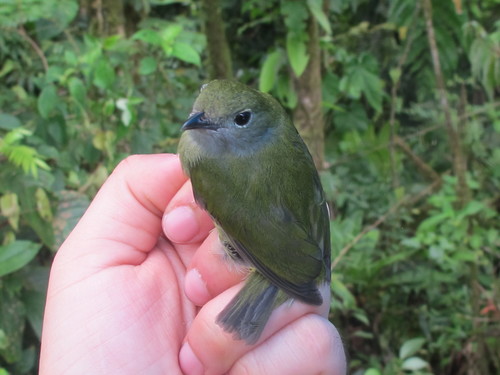 White-ruffed Manakin
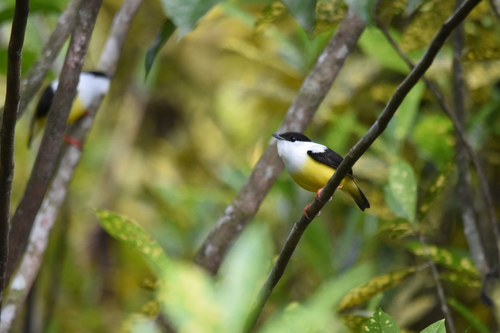 White-collared Manakin
In short
The most reliable field mark between White-ruffed Manakin and White-collared Manakin is the adult male's plumage: White-ruffed shows a glossy blue-black body with a white erectile ruff on the throat, while White-collared males have a striking white collar, black crown and back band, yellow belly, and olive-green rump. Immature and female birds of both species are olive-green, but White-collared always shows a yellow belly, while White-ruffed has a greyish throat. Structurally, White-collared is heavier and has orange legs and a heavier, hooked bill, compared to the dark legs and flat, wide bill of White-ruffed. Both species display at leks, but their display sites and behaviors differ. Habitat can help: White-ruffed prefers wetter, more interior forests, while White-collared favors edge thickets and plantations.
Identification tips
- Adult male plumage is the most reliable field mark: White-ruffed males are glossy blue-black with a white erectile ruff on the throat and neck sides; White-collared males have a white collar, black crown and back band, yellow belly, and olive-green rump.
- Female and immature confusion: Both species' females and immatures are olive-green, but White-collared always shows a yellow belly, while White-ruffed has a greyish throat and lacks yellow below. This is critical for separating first-year birds.
- Second-year male White-ruffed: These birds are mostly green with a developing black mask and partial white ruff—look for the absence of a white collar and yellow belly to rule out White-collared.
- Bill and leg color: White-collared has a heavier, hooked bill and orange legs; White-ruffed has a flat, wide bill and dark legs. These are subtle but can be seen at close range.
- Body size and shape: White-collared is heavier (20 g vs. ~11 g for White-ruffed) and slightly longer, often appearing chunkier, especially when perched.
- Wing structure in males: White-collared males have heavily modified wings with very narrow outer primaries and thickened inner primaries, used for loud snaps; White-ruffed males have a very short outer primary but do not produce such explosive snaps.
- Display behavior: White-ruffed displays on mossy logs with slow, fluttering 'butterfly' flights and throat-flagging; White-collared clears a bare patch and leaps between sticks, producing loud wing snaps. Observing display sites and behavior can be diagnostic.
- Habitat preference: White-ruffed is more likely deep in wet forest or tall secondary growth; White-collared favors edge thickets, secondary growth, and plantations.
- Vocalizations: Listen for high, thin 'seeuw-seeuw' and 'flap-chee-wah' from White-ruffed, versus the rolled 'preew' and sharp wing snaps of White-collared.
- Rump color: Adult male White-collared shows an olive-green rump contrasting with black upperparts; White-ruffed is uniformly glossy blue-black above.
- Underpart color: Only White-collared (all ages/sexes) shows a bright yellow belly; White-ruffed is never yellow below.
- Throat color in females/immatures: White-ruffed females/immatures have a greyish throat, while White-collared is cleaner olive-green above with yellow below.
- Lek location: White-ruffed leks are often on or near logs in the forest interior; White-collared leks are on bare earth patches at forest edge or in plantations.
- Courtship groupings: White-ruffed males may display alone or in small groups, often on logs; White-collared males usually display together, leaping and snapping in coordinated fashion.
- No distinctive flight pattern marks: Neither species has unique upperwing or flight pattern marks for any age, so rely on perched and display views.
Size
White-collared Manakin is noticeably heavier (about 20 g) than White-ruffed Manakin (typically 9–14 g, with males averaging ~11 g). Both are compact and short-tailed, but White-collared is slightly longer (about 11 cm vs. 10 cm for White-ruffed). In the field, White-collared may appear a bit chunkier and more robust, especially when perched.
Plumage
For adult males, plumage is highly diagnostic: White-ruffed Manakin males are glossy blue-black with a distinctive white erectile ruff on the throat and sides of the neck. White-collared Manakin males have a black crown, black mid-back band, black wings and tail, white collar and upperparts, olive-green rump, and a bright yellow belly. Females and immatures of both species are olive-green, but White-collared always shows a yellow belly, while White-ruffed females and first-year birds have a greyish throat and lack the yellow belly. Second-year male White-ruffed are mostly green with a developing black mask and partial white ruff, which can be confusing, but they lack the bright yellow underparts and white collar of White-collared. No distinctive upperwing or flight pattern marks are noted for either species at any age.
Behaviour
Both species are lekking manakins, but their display behaviors and sites differ. White-ruffed males display on or near mossy logs on the forest floor, performing slow 'butterfly' flights and dramatic dives, with throat-flagging and wing flicking. White-collared males clear bare display courts on the forest floor and leap between upright sticks, producing loud wing snaps and erecting their throat feathers into a beard. White-collared's display is more about rapid jumps and snaps, while White-ruffed's involves more fluttering flights and log-based displays. Both species are primarily frugivorous, foraging low in the trees, but White-ruffed males are especially fruit-focused.
Habitat
White-ruffed Manakin is a resident of wet forest interiors and adjacent clearings from eastern Honduras to northwestern Colombia, favoring tall secondary growth and forested areas. White-collared Manakin is found from southeastern Mexico to Costa Rica and extreme west Panama, typically in thickets at forest edges, tall secondary growth, and old cacao plantations. In overlap zones, White-ruffed is more likely in wetter, less disturbed forest, while White-collared prefers edge habitats and human-modified areas.
Voice
White-ruffed Manakin males give high, thin 'seeuw-seeuw' calls during display flights and a 'flap-chee-wah' sequence during their dive and jump display. White-collared Manakin males produce a rolled 'preew' call and very loud wing snaps, along with various rustling and whiffling noises from their modified wings. In the field, the mechanical wing snaps of White-collared are much more prominent and explosive than any White-ruffed display sounds.
White-ruffed Manakin · White-collared Manakin · My Tricky Birds