

White-headed Pigeon vs Pale-vented Pigeon
Columba leucomela versus Patagioenas cayennensis
Play a quiz with White-headed Pigeon and Pale-vented Pigeon
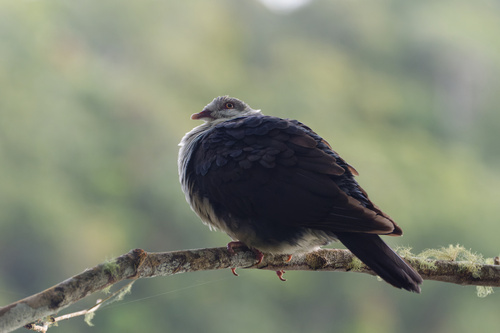 White-headed Pigeon
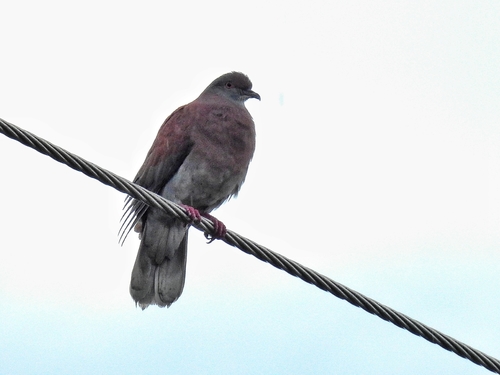 Pale-vented Pigeon
In short
The most reliable field mark to separate White-headed Pigeon from Pale-vented Pigeon is the bright white head, neck, and underparts of adult White-headed, which are never matched by Pale-vented. Immature White-headed Pigeons can be trickier, as their head and underparts are duller and greyer, but they still lack the overall purple tones of Pale-vented. In all ages, Pale-vented Pigeon shows a dull purple head and breast with a coppery nape, and never has a truly white head. Structure and size are similar, but White-headed is heavier and longer. Bill color and underpart tone are also useful, especially at close range. Habitat and range do not overlap, so context can help if known.
Identification tips
- White head and underparts (adults): Only White-headed Pigeon shows a bright white head, neck, breast, and belly; Pale-vented never does, regardless of age or sex.
- Dull purple head and breast (Pale-vented): Adult Pale-vented Pigeon always has a dull purple head and breast, sometimes with copper gloss on the nape, but never white.
- Juvenile confusion: Immature White-headed Pigeons have a greyer head and underparts, but still lack purple or copper tones of Pale-vented; their bill and feet are duller but still not black-billed like Pale-vented.
- Bill color: White-headed Pigeon has a pink to red bill with a pale tip (adults), while Pale-vented has a black bill in all ages.
- Underpart tone: White-headed is white or off-white below (except in very young juveniles), Pale-vented is pale grey or white only in the southern subspecies, but always with a purple or brownish head.
- Upperparts gloss: White-headed shows green or purple iridescence on the upperparts, but not the copper nape gloss of Pale-vented.
- Bare part color: Both have red legs and eye rings, but White-headed's eyes are pale orange or yellow, while Pale-vented's iris is red.
- Size and shape: White-headed is heavier and longer, but this is subtle unless both are seen together.
- Voice: White-headed is loud and gruff ("WHOO! uk"), Pale-vented is soft and multi-noted ("kuk kuk croo-ooos").
- Habitat and range: White-headed only in eastern Australia, Pale-vented only in tropical Americas; never overlap.
- Sex differences: Both sexes similar in each species, but females are duller; this does not cause confusion between species.
- Flight views: No distinctive juvenile upperwing pattern in either, so rely on body color and head contrast.
- Display flight: Pale-vented may show a semi-circular glide, but this is not diagnostic without plumage context.
- Group behavior: Both may be solitary or in small groups; flocking is not a separator.
- Common pitfalls: Immature White-headed can look dull and greyish, but never shows the purple or copper tones of Pale-vented. Bill color and head/underpart contrast are key in these cases.
Size
White-headed Pigeon is distinctly heavier (average 419 g) and longer (38–42 cm) than Pale-vented Pigeon (230–250 g, 30–32 cm). In the field, White-headed appears more robust and stocky, while Pale-vented is slimmer and slightly shorter. However, both are large pigeons and size alone can be misleading without direct comparison.
Plumage
Adult White-headed Pigeons are unmistakable with their clean white head, neck, breast, and belly, contrasting sharply with slate-grey wings and tail and dark upperparts with green or purple gloss. The bill is pink to red with a pale tip, and the eye ring and legs are red. Females are similar but with duller, muddier white. Juveniles are greyer on the head and underparts, with duller bare parts, but still lack any purple or copper gloss. In contrast, Pale-vented Pigeon adults (male and female) have a dull purple head, breast, and upperparts, copper gloss on the nape, and a whitish throat. The lower underparts are pale grey (or white in the southern subspecies), but the head is never white. Immatures are very dull and greyish brown overall, lacking any white or strong contrast. Bill is black, legs and eye ring red. In flight, neither species shows a striking upperwing pattern in juveniles, so separation relies on overall color and contrast.
Behaviour
Both species show typical pigeon flight: fast, direct, with regular wingbeats and occasional flicks. Pale-vented Pigeon is noted for high, fast flights and a semi-circular display glide. Both may perch in open areas, but White-headed Pigeon is more likely to be seen in forest edges along Australia's east coast, while Pale-vented prefers partially open areas with trees in the tropical Americas. Both can be solitary or in small groups.
Habitat
White-headed Pigeon is only found along the east coast of Australia, usually near forests and wooded areas. Pale-vented Pigeon is widespread in the tropical Americas, from southern Mexico to northern Argentina, favoring forest edges, riverbanks, and open areas with scattered trees. There is no range overlap; context of location is a strong clue.
Voice
White-headed Pigeon gives a loud, gruff "WHOO!" followed by a gruff inhaled "uk" (repeated), or a low "oom". Pale-vented Pigeon has a much softer, multi-note call: a row of soft "kuk kuk croo-ooos," with the initial "kuk" characteristic. The difference in volume and pattern is marked, with White-headed much louder and simpler, Pale-vented softer and more complex.