

Motmot

White-fronted Bee-eater vs African Paradise-Flycatcher

Merops bullockoides versus Terpsiphone viridis

Play a quiz with White-fronted Bee-eater and African Paradise-Flycatcher
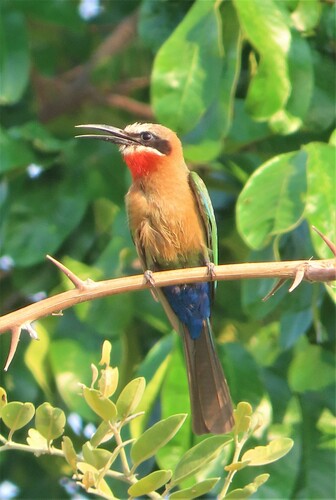
White-fronted Bee-eater (Merops bullockoides) White-fronted Bee-eater
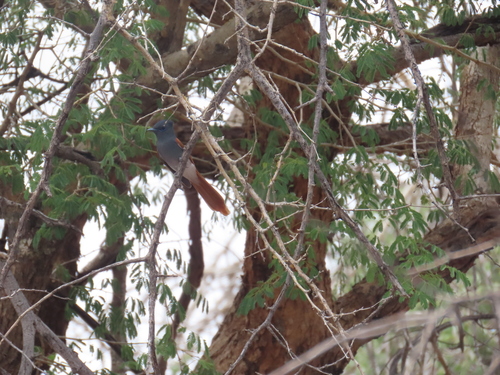
African Paradise-Flycatcher (Terpsiphone viridis) African Paradise-Flycatcher

Media

Loading…

In short

The most reliable field mark to separate White-fronted Bee-eater from African Paradise-Flycatcher is the bee-eater’s bold white forehead and square tail, versus the flycatcher’s extremely long, streamer-like central tail feathers in adult males. Immature and female flycatchers lack the streamers but still show a different jizz: upright posture and a prominent chestnut wing and tail, with a dark head. Bee-eaters are more compact, with green upperparts, cinnamon underparts, and a bright red throat patch. Both species are colorful and often perch openly, but their structure, tail shape, and head pattern are strikingly different in the field.

Identification tips

  1. White forehead (Bee-eater): Only White-fronted Bee-eater shows a clean white forehead above a black mask; African Paradise-Flycatcher never has a white forehead at any age or sex.
  2. Tail shape: Bee-eater has a square tail with no streamers. Adult male flycatchers have extremely long, thin central tail feathers (streamers) that double the bird’s length; females and immatures have a long but not squared tail, never with the bee-eater’s shape.
  3. Red throat patch (Bee-eater): Look for the bright red throat on bee-eaters, contrasting with white forehead and black mask. Flycatchers never have a red throat.
  4. Head color: Bee-eater has a green crown with white forehead and black mask; flycatcher males have a glossy black or blue-black head, females and immatures have a browner, duller head, but never the bee-eater’s mask or white.
  5. Upperparts: Bee-eater is green above; flycatcher is chestnut or rusty above (wings and tail), with no green.
  6. Underparts: Bee-eater is cinnamon below; flycatcher males are dark (black or blue-gray), females and immatures are paler brownish or grayish, never cinnamon.
  7. Wingbar: Only male flycatchers may show a white wingbar, but it is not as bold as the bee-eater’s facial contrast; females and immatures lack it entirely.
  8. Posture: Bee-eaters perch horizontally or slightly upright, often in groups. Flycatchers perch very upright, almost vertical, often alone or in pairs.
  9. Jizz in flight: Bee-eaters sally out with quick, direct flights, sometimes gliding or hovering. Flycatchers have a more fluttery, erratic flight, with males’ long tail streamers trailing.
  10. Social behavior: Bee-eaters are colonial and gregarious; flycatchers are solitary or in pairs.
  11. Habitat context: Bee-eaters are often near banks, cliffs, or open country; flycatchers are more likely in woodland or forest edge.
  12. Vocalizations: Bee-eater’s call is a deep squeak; flycatcher’s is a harsh scold. Listen for these differences if seen poorly.
  13. Sex/age pitfalls: Female and immature flycatchers lack tail streamers but still have chestnut wings/tail and upright stance; never show white forehead or red throat. Bee-eater juveniles retain the white forehead and red throat, so confusion is less likely.
  14. Hybrid flycatchers: Some flycatchers may show white morphs or intermediate colors, but never the bee-eater’s facial pattern or square tail.
  15. Bill shape: Bee-eater has a long, slightly decurved bill typical of bee-eaters; flycatcher’s bill is shorter, straight, and more typical of insectivorous passerines.

Size

White-fronted Bee-eater is about 23 cm (9 in) long, with a square tail and compact, slender build. African Paradise-Flycatcher males are about 17 cm (6.7 in) in body length, but adult males have tail streamers that can double the total length, making them appear much longer and more elongated in silhouette. Females and immatures are closer in length to the bee-eater but still look more elongated due to their tail shape. The bee-eater is stockier, while the flycatcher is more slender and delicate, especially with the long tail streamers.

Plumage

No age-specific upperwing or flight pattern marks are noted for either species, but plumage differences are strong at all ages. White-fronted Bee-eater of all ages shows a distinctive white forehead, black mask, bright red throat, green upperparts, and cinnamon underparts. The tail is square and lacks streamers. African Paradise-Flycatcher adult males have a glossy black head and underparts, chestnut wings and tail, and extremely long central tail feathers (streamers); some morphs are white instead of chestnut. Females and immatures lack streamers, have a browner head and underparts, and no white wingbar, but still show chestnut wings and tail. Both sexes have a prominent dark head, but only the bee-eater has the white forehead and red throat. The flycatcher’s wingbar is only present in adult males and is not as bold as the bee-eater’s facial contrast. Juvenile flycatchers are duller but still lack the bee-eater’s white forehead and red throat.

Behaviour

White-fronted Bee-eaters perch in low trees, often in small colonies, and hunt insects by sallying out from a perch, gliding or hovering briefly to catch prey. They are social, often seen in groups, and nest in holes in cliffs or banks. African Paradise-Flycatchers are more solitary or in pairs, sitting very upright on exposed perches, often flicking their long tails. They are active flycatchers, sallying out to catch insects in flight, and sometimes take spiders or berries. Their upright posture and long tail streamers (in males) are distinctive behavioral cues. Both species are conspicuous and often perch openly, but the bee-eater is more gregarious and less upright in stance.

Habitat

White-fronted Bee-eater is typically found in sub-equatorial Africa, favoring open country with low trees, riverbanks, and cliffs for nesting. They are often seen near water or open woodland edges. African Paradise-Flycatcher inhabits open forest, savanna, and woodland, and is a common resident breeder south of the Sahara. Both can overlap in open woodland, but bee-eaters are more closely tied to banks and colonies, while flycatchers are more often in denser woodland or forest edge.

Voice

White-fronted Bee-eater gives a deep squeak. African Paradise-Flycatcher is noisy, with a harsh, scolding call. Both are vocal, but the flycatcher’s call is harsher and more scolding, while the bee-eater’s is lower-pitched and squeakier. Neither species’ call is likely to be confused with the other in the field.

Submit a better description

Use the same sections as the comparison. Your text is published immediately.

The most reliable field mark to separate White-fronted Bee-eater from African Paradise-Flycatcher is the bee-eater’s bold white forehead and square tail, versus the flycatcher’s extremely long, streamer-like central tail feathers in adult males. Immature and female flycatchers lack the streamers but still show a different jizz: upright posture and a prominent chestnut wing and tail, with a dark head. Bee-eaters are more compact, with green upperparts, cinnamon underparts, and a bright red throat patch. Both species are colorful and often perch openly, but their structure, tail shape, and head pattern are strikingly different in the field.

  1. White forehead (Bee-eater): Only White-fronted Bee-eater shows a clean white forehead above a black mask; African Paradise-Flycatcher never has a white forehead at any age or sex.
  2. Tail shape: Bee-eater has a square tail with no streamers. Adult male flycatchers have extremely long, thin central tail feathers (streamers) that double the bird’s length; females and immatures have a long but not squared tail, never with the bee-eater’s shape.
  3. Red throat patch (Bee-eater): Look for the bright red throat on bee-eaters, contrasting with white forehead and black mask. Flycatchers never have a red throat.
  4. Head color: Bee-eater has a green crown with white forehead and black mask; flycatcher males have a glossy black or blue-black head, females and immatures have a browner, duller head, but never the bee-eater’s mask or white.
  5. Upperparts: Bee-eater is green above; flycatcher is chestnut or rusty above (wings and tail), with no green.
  6. Underparts: Bee-eater is cinnamon below; flycatcher males are dark (black or blue-gray), females and immatures are paler brownish or grayish, never cinnamon.
  7. Wingbar: Only male flycatchers may show a white wingbar, but it is not as bold as the bee-eater’s facial contrast; females and immatures lack it entirely.
  8. Posture: Bee-eaters perch horizontally or slightly upright, often in groups. Flycatchers perch very upright, almost vertical, often alone or in pairs.
  9. Jizz in flight: Bee-eaters sally out with quick, direct flights, sometimes gliding or hovering. Flycatchers have a more fluttery, erratic flight, with males’ long tail streamers trailing.
  10. Social behavior: Bee-eaters are colonial and gregarious; flycatchers are solitary or in pairs.
  11. Habitat context: Bee-eaters are often near banks, cliffs, or open country; flycatchers are more likely in woodland or forest edge.
  12. Vocalizations: Bee-eater’s call is a deep squeak; flycatcher’s is a harsh scold. Listen for these differences if seen poorly.
  13. Sex/age pitfalls: Female and immature flycatchers lack tail streamers but still have chestnut wings/tail and upright stance; never show white forehead or red throat. Bee-eater juveniles retain the white forehead and red throat, so confusion is less likely.
  14. Hybrid flycatchers: Some flycatchers may show white morphs or intermediate colors, but never the bee-eater’s facial pattern or square tail.
  15. Bill shape: Bee-eater has a long, slightly decurved bill typical of bee-eaters; flycatcher’s bill is shorter, straight, and more typical of insectivorous passerines.

White-fronted Bee-eater is about 23 cm (9 in) long, with a square tail and compact, slender build. African Paradise-Flycatcher males are about 17 cm (6.7 in) in body length, but adult males have tail streamers that can double the total length, making them appear much longer and more elongated in silhouette. Females and immatures are closer in length to the bee-eater but still look more elongated due to their tail shape. The bee-eater is stockier, while the flycatcher is more slender and delicate, especially with the long tail streamers.

No age-specific upperwing or flight pattern marks are noted for either species, but plumage differences are strong at all ages. White-fronted Bee-eater of all ages shows a distinctive white forehead, black mask, bright red throat, green upperparts, and cinnamon underparts. The tail is square and lacks streamers. African Paradise-Flycatcher adult males have a glossy black head and underparts, chestnut wings and tail, and extremely long central tail feathers (streamers); some morphs are white instead of chestnut. Females and immatures lack streamers, have a browner head and underparts, and no white wingbar, but still show chestnut wings and tail. Both sexes have a prominent dark head, but only the bee-eater has the white forehead and red throat. The flycatcher’s wingbar is only present in adult males and is not as bold as the bee-eater’s facial contrast. Juvenile flycatchers are duller but still lack the bee-eater’s white forehead and red throat.

White-fronted Bee-eaters perch in low trees, often in small colonies, and hunt insects by sallying out from a perch, gliding or hovering briefly to catch prey. They are social, often seen in groups, and nest in holes in cliffs or banks. African Paradise-Flycatchers are more solitary or in pairs, sitting very upright on exposed perches, often flicking their long tails. They are active flycatchers, sallying out to catch insects in flight, and sometimes take spiders or berries. Their upright posture and long tail streamers (in males) are distinctive behavioral cues. Both species are conspicuous and often perch openly, but the bee-eater is more gregarious and less upright in stance.

White-fronted Bee-eater is typically found in sub-equatorial Africa, favoring open country with low trees, riverbanks, and cliffs for nesting. They are often seen near water or open woodland edges. African Paradise-Flycatcher inhabits open forest, savanna, and woodland, and is a common resident breeder south of the Sahara. Both can overlap in open woodland, but bee-eaters are more closely tied to banks and colonies, while flycatchers are more often in denser woodland or forest edge.

White-fronted Bee-eater gives a deep squeak. African Paradise-Flycatcher is noisy, with a harsh, scolding call. Both are vocal, but the flycatcher’s call is harsher and more scolding, while the bee-eater’s is lower-pitched and squeakier. Neither species’ call is likely to be confused with the other in the field.

Discard your changes?

You have unsaved edits. If you leave now, those changes will be lost.

White-fronted Bee-eater · African Paradise-Flycatcher · My Tricky Birds