

White-faced Whistling-Duck vs Egyptian Goose
Dendrocygna viduata versus Alopochen aegyptiaca
Play a quiz with White-faced Whistling-Duck and Egyptian Goose
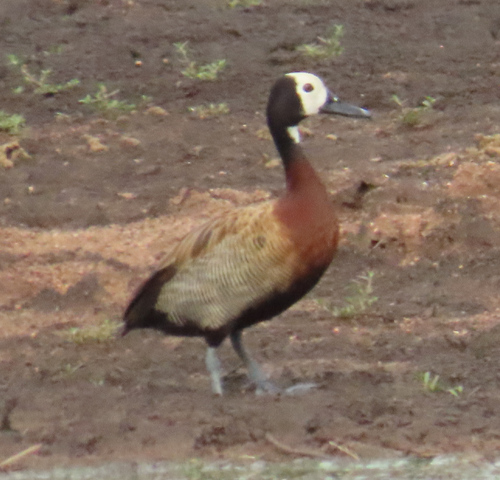 White-faced Whistling-Duck
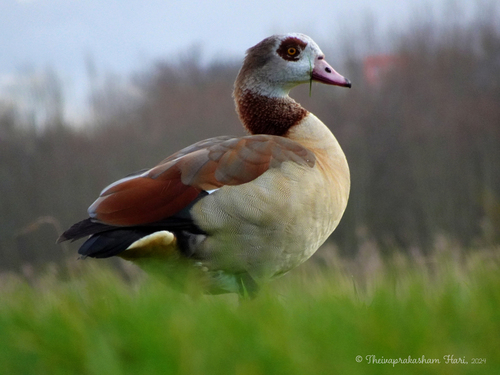 Egyptian Goose
In short
The most reliable field mark between White-faced Whistling-Duck and Egyptian Goose is the striking white face and black neck of the whistling-duck, which is never matched by the Egyptian Goose. In flight, Egyptian Goose shows a large white wing patch (hidden when perched), while White-faced Whistling-Duck has dark wings with fine white barring on the flanks but no bold white panel. Structure is also a strong clue: Egyptian Goose is much heavier and bulkier, with a goose-like jizz, while White-faced Whistling-Duck is slimmer and longer-necked. Juveniles of the whistling-duck have a less contrasting head, which can cause confusion, but the overall darker plumage and lack of white wing patch still separate them. Voice and flocking behavior can also help: whistling-ducks are noisy and gregarious, geese are more aggressive and territorial.
Identification tips
- White face and black neck (adults): Only White-faced Whistling-Duck shows a sharply defined white face and black neck; Egyptian Goose never does. This is the single best field mark at any distance.
- White wing patch in flight: Egyptian Goose of all ages shows a large white patch on the upperwing in flight or display, hidden when perched. White-faced Whistling-Duck has uniformly dark wings with no bold white patch, only fine white barring on the flanks (visible at rest, not in flight).
- Juvenile confusion: Juvenile White-faced Whistling-Ducks have a duller, less contrasted head, but still lack the pale head and dark eye patch of Egyptian Goose. Egyptian Goose juveniles look like adults in wing pattern and body plumage.
- Size and structure: Egyptian Goose is much larger and bulkier, with a heavy body and thick neck. White-faced Whistling-Duck is slim, long-necked, and lighter.
- Bill and legs: White-faced Whistling-Duck has a long, grey bill and longish legs, giving a more delicate impression. Egyptian Goose has a shorter, stouter bill and proportionally shorter legs.
- Body posture and jizz: In flight, Egyptian Goose appears heavy and slow, more like a true goose, while White-faced Whistling-Duck is agile and buoyant. On water, whistling-ducks sit lower and often in tight groups; geese are more upright and spaced out.
- Plumage tone: Egyptian Goose is variable in body color (greyer or browner), but always lacks the white face and black neck. It often shows a chestnut breast band and a dark eye patch. White-faced Whistling-Duck is more uniform in color, with a chestnut neck and black underparts with fine white barring.
- Flocking behavior: Large, tight flocks (hundreds or thousands) at dawn are typical of White-faced Whistling-Duck. Egyptian Goose is usually in pairs or small family groups, and is highly territorial in breeding season.
- Vocalizations: Listen for a clear, three-note whistle from White-faced Whistling-Duck flocks. Egyptian Goose is mostly quiet, but females can give a loud, raucous quack when disturbed.
- Habitat context: In urban parks or tree-dotted lakes in Europe, Egyptian Goose is more likely. In large open wetlands with big flocks, especially in Africa or South America, White-faced Whistling-Duck is more probable.
- Sex and age: Both species have similar plumage between sexes, so sex is not a useful field mark. Only juvenile White-faced Whistling-Duck may cause confusion due to duller head pattern, but overall structure and lack of white wing patch still separate them.
- Display and alarm: Egyptian Goose may show its white wing patch when alarmed or displaying, even when perched. Watch for sudden flashes of white if the bird is agitated.
- Regional variation: Amount of white on the face of White-faced Whistling-Duck varies by region (more black in western Africa), but the white is always present to some degree and never matched by Egyptian Goose.
- Aggressive behavior: Egyptian Goose is notably aggressive and may chase or attack other birds, especially in breeding season. Whistling-ducks are much more tolerant of close company.
- Potential pitfalls: At long range, a juvenile White-faced Whistling-Duck with a dull head can be misjudged as a pale-faced goose, but the absence of a white wing patch in flight and the more slender, upright posture should clarify the ID.
Size
Egyptian Goose is substantially larger and heavier than White-faced Whistling-Duck. Egyptian Goose typically weighs 1,500–2,348 g and measures 63–73 cm in length, giving it a bulky, heavyset appearance, especially in flight, much more like a true goose. In contrast, White-faced Whistling-Duck is much lighter (674 g) and more slender overall, with a longer neck and a more delicate build. This difference is usually obvious when both species are seen together or compared to familiar waterfowl.
Plumage
- Juvenile/immature birds: White-faced Whistling-Duck juveniles have a less contrasting head pattern than adults, but still lack any bold white wing patch. Egyptian Goose does not show age-related variation in wing pattern; all ages have a large white patch on the wing, visible in flight but hidden at rest.
- Adults: White-faced Whistling-Duck adults have a black head and neck with a distinctive white face (amount of white varies regionally), chestnut neck, dark brown to black back and wings, and black underparts with fine white barring on the flanks. Egyptian Goose adults are variable in tone (greyer or browner), but always lack the white face and black neck. Instead, they have a pale head with a dark eye patch and a chestnut breast band, and a large white wing patch only visible in flight or display. Both species have similar plumage between sexes.
Behaviour
White-faced Whistling-Duck is highly gregarious, often seen in large, tightly packed flocks, sometimes numbering in the thousands, especially at dawn. Egyptian Goose is more territorial and aggressive, especially during breeding, often seen in pairs or small family groups. Egyptian Goose may chase intruders and even attack other birds or aerial objects. In flight, Egyptian Goose appears heavy and deliberate, while White-faced Whistling-Duck is more agile and buoyant.
Habitat
Both species can overlap in wetland habitats, but White-faced Whistling-Duck is more strongly associated with open water and marshes in sub-Saharan Africa and South America, often in large flocks. Egyptian Goose is native to Africa but has been widely introduced in Europe and elsewhere, and is often found in parkland, lakes, and even urban areas. Egyptian Goose is more likely to nest in tree holes and is less tied to open water than the whistling-duck.
Voice
White-faced Whistling-Duck is very noisy, with a clear, three-note whistling call, often heard from flocks. Egyptian Goose is generally quieter, but the sexes have different calls: males give a subdued, hoarse quack or a breathy, steam-engine-like sequence when aroused, while females have a much louder, raucous quack, especially when aggressive or tending young. In the field, a chorus of whistling is a strong pointer to White-faced Whistling-Duck.
White-faced Whistling-Duck · Egyptian Goose · My Tricky Birds