

White-faced Storm-Petrel vs Cook's Petrel
Pelagodroma marina versus Pterodroma cookii
Play a quiz with White-faced Storm-Petrel and Cook's Petrel
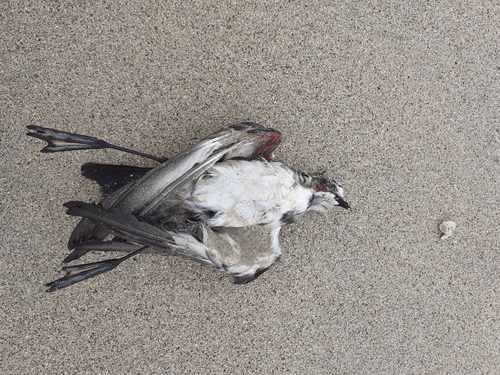 White-faced Storm-Petrel
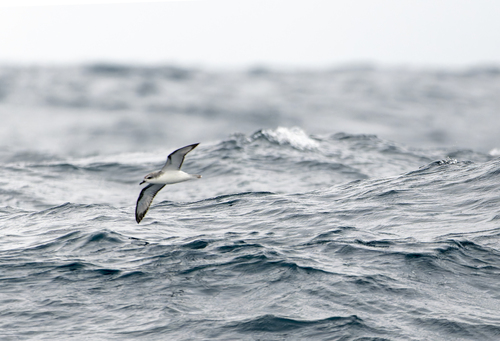 Cook's Petrel
In short
The most reliable field mark to separate White-faced Storm-Petrel from Cook's Petrel is size and flight style: White-faced Storm-Petrel is much smaller and shows a unique, buoyant pattering flight, often skipping over the water with dangling legs, while Cook's Petrel is larger, with a more typical petrel gliding and shearing flight. In plumage, White-faced Storm-Petrel has a striking white face with a dark eye mask and pale underparts, versus the more typical gadfly petrel pattern of Cook's Petrel, which has a pale grey upperwing with a dark 'M' and white underparts. Juvenile White-faced Storm-Petrels may show more obvious pale fringes above, but both age classes are much paler-faced than Cook's. Bill structure and overall jizz are also distinct. In any direct comparison, size and flight jizz are the fastest field clues.
Identification tips
- Size is a primary clue: White-faced Storm-Petrel is much smaller than Cook's Petrel—about a fifth of the mass and with a much shorter wingspan. If you see both together, the difference is striking. This applies to all ages and sexes.
- Flight style is diagnostic: White-faced Storm-Petrel bounces and patters over the water, wings out, legs dangling or skipping; Cook's Petrel glides and shears, rarely if ever pattering. Watch for this especially in windy conditions, when the storm-petrel's pendulum-like movement is obvious.
- Face pattern: White-faced Storm-Petrel has a bright white face with a dark eye mask, very distinctive even at a distance. Cook's Petrel has a plain pale grey face, lacking any mask or white blaze.
- Upperwing pattern: Cook's Petrel shows a dark 'M' across pale grey upperwings, a classic gadfly petrel mark. White-faced Storm-Petrel has pale brown to grey upperwings with black flight feathers but no 'M' pattern. This is visible in all ages.
- Underparts: Both are white below, but the storm-petrel's white extends up to the face, while Cook's Petrel's white is limited to the underbody.
- Bill structure: Cook's Petrel has a long, black bill with prominent tubular nostrils (as in all Procellariiformes), while White-faced Storm-Petrel's bill is shorter and less robust. This is best seen at close range.
- Legs and feet: White-faced Storm-Petrel has long legs, often visible trailing behind in flight or when pattering; Cook's Petrel's legs are much shorter and rarely seen in flight.
- Tail shape: Some White-faced Storm-Petrel subspecies (notably P. m. maoriana) have a forked tail, but this is subtle. Juveniles may show a shallower fork. Cook's Petrel has a more typical petrel tail, not deeply forked.
- Juvenile plumage: Juvenile White-faced Storm-Petrels have broader pale fringes above and may look greyer or browner, but still show the white face and mask. Cook's Petrel juveniles do not mimic this pattern.
- Context: In New Zealand, both can be seen offshore, but Cook's Petrel is strictly endemic, while White-faced Storm-Petrel is more widespread. If seen outside New Zealand, it's almost certainly not Cook's Petrel.
- Sex and seasonal variation: Neither species shows strong sexual or seasonal plumage differences, so these marks are reliable year-round.
- Plumage pitfalls: Do not confuse the pale underparts of both species—focus on face pattern and flight style. The storm-petrel's white face is never matched by Cook's Petrel.
- Behavior at sea: If the bird is frequently touching or skipping off the water, it's a storm-petrel. If it's gliding and rarely contacts the surface, it's a Cook's Petrel.
- Bill color: Both have dark bills, so this is not a useful mark.
- Vocalizations: Not diagnostic at sea; both are generally silent away from breeding colonies.
Size
White-faced Storm-Petrel is considerably smaller and lighter (body mass around 40 g, length 19–21 cm, wingspan 41–44 cm) than Cook's Petrel (length 25–30 cm, wingspan 65–66 cm, weight about 200 g) [wikidata][wikipedia]. This difference is obvious in the field: Cook's Petrel is nearly twice the mass and has a much longer wingspan. Even at a distance, the storm-petrel's daintiness and short body are apparent next to the more robust, long-winged Cook's Petrel.
Plumage
Juvenile and adult White-faced Storm-Petrels are similar, but juveniles show fresher plumage with broader pale fringes and tips to upperparts feathers, and may appear greyer or browner depending on moult [wikipedia]. The tail fork is shallower in juveniles, especially in the New Zealand subspecies. Both ages have a distinctive white face with a dark eye mask, pale brown to grey back and wings, and white underparts. In contrast, Cook's Petrel (all ages) shows the classic gadfly petrel look: pale grey upperparts with a bold dark 'M' across the upperwings, white underparts, and a long, black bill with tubular nostrils [wikipedia]. The face is not white, and there is no dark mask. There are no age-specific upperwing patterns in Cook's Petrel that overlap with the storm-petrel's appearance.
Behaviour
White-faced Storm-Petrel is unique among petrels for its almost constant pattering flight: it skips or bounces over the water, wings outstretched, using its long legs to touch or push off the surface [wikipedia]. This creates a buoyant, erratic, almost phalarope-like jizz. Cook's Petrel, by contrast, flies with typical gadfly petrel grace—long, arcing glides, shearing low over the waves, rarely if ever pattering. The storm-petrel's flight is much more fluttery and active, while Cook's Petrel is more direct and powerful.
Habitat
Both species are pelagic, but Cook's Petrel is endemic to New Zealand waters, while White-faced Storm-Petrel has a much wider distribution, including southern Australia, New Zealand, and several Atlantic islands [wikipedia]. In New Zealand, both can occur offshore, but Cook's Petrel is more likely to be seen further from land. Habitat is not usually diagnostic at sea, but the storm-petrel's habit of feeding close to the water surface and its unique foraging style can help.