

White-crowned Pigeon vs Red-billed Pigeon
Patagioenas leucocephala versus Patagioenas flavirostris
Play a quiz with White-crowned Pigeon and Red-billed Pigeon
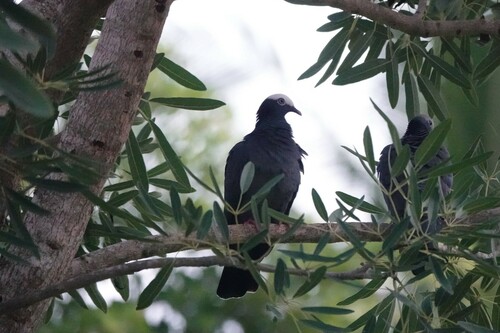 White-crowned Pigeon
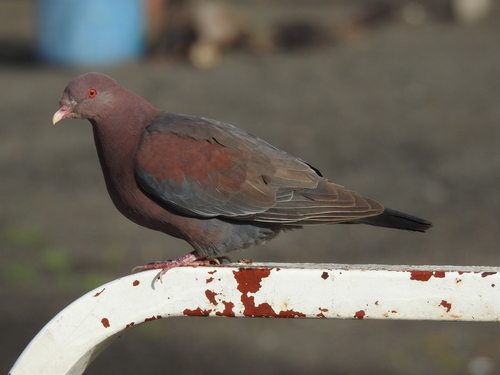 Red-billed Pigeon
In short
The most reliable field mark between White-crowned and Red-billed Pigeon is the presence of a white or grayish-white crown patch on adult White-crowned Pigeons, which is always absent on Red-billed. In flight or perched, look for the iridescent collar on White-crowned (adults only, and only in good light), versus the uniform maroon-to-purple head and neck of Red-billed. Juveniles of both are duller, but White-crowned juveniles may show a few pale crown feathers while Red-billed juveniles never do. Bill color is also distinctive: Red-billed has a red bill with a yellow tip, while White-crowned shows a red bill with a pale tip. Both are large, robust pigeons, but White-crowned is less chunky and has a longer, squarer tail. Habitat can help: White-crowned favors mangroves and Caribbean islands, while Red-billed is mostly found in dry lowland forests and riversides of Mexico and Central America.
Identification tips
- Crown Patch (Adults): Only White-crowned Pigeon shows a white or gray-white crown patch; Red-billed Pigeon never does. This is the single most reliable mark for adults, especially in perched birds.
- Crown Patch (Juveniles): Juvenile White-crowned may show a few pale crown feathers, but never a full patch. Juvenile Red-billed never shows any pale crown feathers; crown is always dull and uniform.
- Iridescent Collar (Adults): White-crowned Pigeon can show a green-barred iridescent collar in good light; Red-billed Pigeon lacks any iridescent collar. This is subtle and not always visible.
- Head and Neck Color: Red-billed Pigeon has a maroon to purple head, neck, and wing coverts; White-crowned Pigeon is slate gray to nearly black, with no maroon or purple tones.
- Bill Color: Red-billed Pigeon has a red bill with a yellow tip; White-crowned Pigeon has a red bill with a pale (not yellow) tip. This can be hard to see at distance.
- Eye Color: White-crowned Pigeon has a white iris; Red-billed Pigeon has a pale red iris with an orange orbital ring. Useful at close range.
- Tail Shape: White-crowned Pigeon has a longer, more square tail; Red-billed Pigeon is more robust and less elongated in the tail.
- Body Structure: White-crowned appears less chunky and more slender; Red-billed is heavier and more robust.
- Juvenile Upperparts: Juvenile Red-billed is browner with dusky shoulders and a brown mantle; juvenile White-crowned is grayish-brown but lacks the strong brown tones of Red-billed.
- Flight Pattern: No unique upperwing or trailing edge marks are described for either; rely on overall coloration and crown patch (if visible) in flight.
- Vocalizations: White-crowned gives a deep, triple-coo; Red-billed gives a higher, more complex coooo-cuk-c'-c'-coo. Use voice if heard clearly.
- Habitat: White-crowned is almost always in mangroves or nearby forests in the Caribbean or southern Florida; Red-billed is in dry forests and riversides of Mexico and Central America. If seen in the Florida Keys or Caribbean islands, it's almost certainly White-crowned.
- Behavior: White-crowned is very wary and quick to flush; Red-billed may be less skittish but can produce a wing-clap on takeoff.
- Sex Differences: Female White-crowned has a duller gray-white crown; female Red-billed has a duller maroon head/neck, but no crown patch.
- Seasonal Context: Red-billed is rare in winter throughout its range; White-crowned may be present year-round in the Caribbean. Use season as a supporting clue.
Size
Both species are similar in length (White-crowned: 29–35 cm; Red-billed: 30–37 cm) [wikipedia], but Red-billed is generally heavier (White-crowned: 150–301 g; Red-billed: 230–425 g) [wikipedia]. White-crowned is slightly less chunky, with a longer, more square tail, while Red-billed is more robust overall. In the field, size alone is not a reliable separator, but White-crowned may appear a bit more slender and longer-tailed.
Plumage
- Juveniles: Both are duller than adults, but juvenile White-crowned Pigeons are grayish-brown, lack the adult's white crown and iridescent collar, and may show a few pale feathers on the crown. Juvenile Red-billed Pigeons are even duller, with dark/dusky shoulders and a browner mantle and wings, but never show a pale crown patch.
- Adults: White-crowned Pigeon adults are slate gray to nearly black, with a white (males) or gray-white (females) crown patch. Their iridescent collar-patch is only visible in good light. The iris is white, and the bill is red with a pale tip. Red-billed Pigeon adults are dark slate-gray with a maroon to purple head, neck, and wing coverts, blue-gray belly and tail coverts, and a red bill with yellow tip. They lack any crown patch or iridescent collar. The eye is pale red with an orange orbital ring.
- Flight views: No unique upperwing or trailing edge marks are described for either species; separation relies on overall coloration and crown patch (if visible).
Behaviour
White-crowned Pigeon is notably skittish and quick to flush, often abandoning nests if disturbed. Both species are strong fliers, but White-crowned may appear less bulky and more elongated in flight due to its longer tail. Red-billed Pigeon can produce a wing-clapping sound when taking off. Both species are typically seen singly or in small groups, though White-crowned may form larger flocks at fruiting trees.
Habitat
White-crowned Pigeon is almost always associated with coastal mangroves and nearby hardwood forests, especially on Caribbean islands and the southern tip of Florida. It requires isolated, often tidally inundated mangrove islets for nesting, but may forage inland. Red-billed Pigeon is found in dry forests and along riversides, primarily in Mexico and Central America, and only rarely in southern Texas. Habitat overlap is minimal except possibly in parts of Central America; context is a strong clue.
Voice
White-crowned Pigeon's call is a loud, deep coo-cura-coo or coo-croo, with a triple-coo rhythm. Red-billed Pigeon gives a long, high-pitched coooo followed by three cuk-c'-c'-coo notes, with an ascending pattern. Red-billed's call is higher and more complex; White-crowned's is deeper and simpler. In the field, voice is helpful if heard well.