

White-crowned Pigeon vs Band-tailed Pigeon
Patagioenas leucocephala versus Patagioenas fasciata
Play a quiz with White-crowned Pigeon and Band-tailed Pigeon
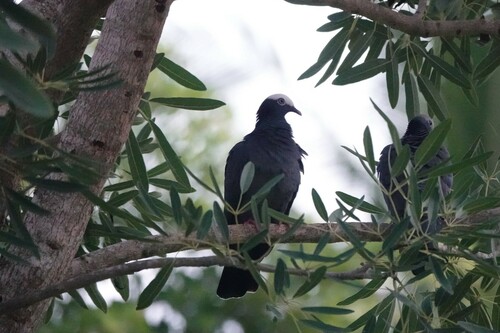 White-crowned Pigeon
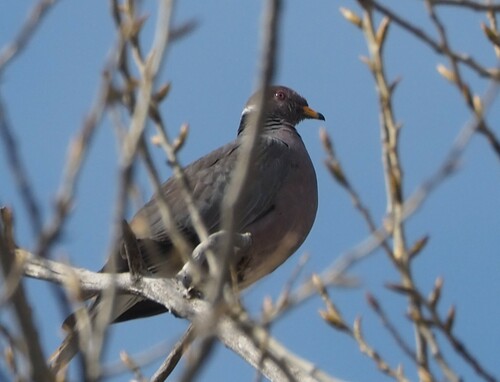 Band-tailed Pigeon
In short
The most reliable field mark is the white crown patch of adult White-crowned Pigeon, which is never shown by Band-tailed Pigeon; instead, Band-tailed has a thin white nape collar and a pale tail band, both absent in White-crowned. Juvenile birds can be tricky: young White-crowned Pigeons lack a full white crown and are duller, but never show the scaly upperparts or pale tail band of juvenile Band-tailed. In flight, Band-tailed Pigeon’s pale tail tip and broad wings stand out, while White-crowned appears darker overall with a more squared tail. Structure and bill color also help at close range. Habitat is a strong clue: White-crowned is a Caribbean mangrove and coastal specialist, while Band-tailed is a woodland and montane pigeon of the Americas.
Identification tips
- White crown patch (adult White-crowned only): Look for a bright white (male) or grayish-white (female) crown patch, sharply set off from the rest of the head. Band-tailed Pigeon never shows this feature at any age.
- Nape collar (adult Band-tailed only): Band-tailed Pigeon has a thin, crisp white collar on the nape, adjacent to green neck iridescence. White-crowned lacks any nape collar; its neck may show iridescence in good light but never a white band.
- Tail pattern in flight: Band-tailed Pigeon shows a broad, pale gray tail tip with a contrasting dark subterminal band (except Baja subspecies). White-crowned Pigeon’s tail is darker, more squared, and lacks any pale band.
- Juvenile upperparts: Juvenile Band-tailed Pigeon has pale-edged, scaly-looking upperparts and no white collar or neck gloss. Juvenile White-crowned is a duller gray-brown, lacks both the white crown and nape collar, and does not show scaly upperparts or a pale tail band.
- Bill color: Band-tailed Pigeon has a yellow bill (with or without a black tip depending on subspecies). White-crowned Pigeon has a red bill with a pale tip. This is best seen at close range.
- Iris color: Adult White-crowned Pigeon has a white iris, while Band-tailed’s iris is dark. Juvenile White-crowned has a dark iris, so this mark is only reliable for adults.
- Underparts: Band-tailed Pigeon’s belly is nearly white, often contrasting with the pinkish-gray breast and gray upperparts. White-crowned Pigeon is more uniformly dark below.
- Overall color tone: White-crowned Pigeon is darker and more slate-gray to blackish, especially in adults. Band-tailed is paler gray, with a subtle pinkish cast on the head and breast in males.
- Feet color: Band-tailed Pigeon has yellow feet; White-crowned’s feet are not described as distinctive in the notes.
- Structure and jizz: Band-tailed Pigeon is bulkier, with broader wings and a longer, more rounded tail. White-crowned is slimmer, with a more squared tail and less chunky build.
- Habitat context: If seen in Caribbean mangroves or low coastal islands, White-crowned is expected. In montane or oak woodland, especially in western North America or the Andes, Band-tailed is the default.
- Behavior: Both are wary, but White-crowned is especially skittish and may flush at greater distance. Band-tailed often flocks, especially at food sources.
- Vocalization: White-crowned’s deep, resonant coo-cura-coo is distinctive if heard; Band-tailed’s call is not described here.
- Sex differences: Male White-crowned has a brighter white crown than female, but both sexes show the patch. Band-tailed shows only subtle sexual dimorphism (males slightly pinker on breast).
- Pitfalls: Immature White-crowned can lack the white crown and appear dull, but will never show the scaly upperparts or pale tail band of juvenile Band-tailed. Always check for tail pattern and overall color in flight if the head is not visible.
Size
Band-tailed Pigeon is the larger of the two, measuring 33–40 cm in length and weighing 226–460 g [wikipedia]. White-crowned Pigeon is slightly smaller and slimmer, at 29–35 cm and 150–301 g [wikipedia]. Band-tailed also has a broader wingspan (up to 66 cm) compared to White-crowned’s 48–59 cm. In the field, Band-tailed often looks bulkier and longer-winged, while White-crowned is more slender and less chunky, with a relatively longer, more squared tail.
Plumage
- Juveniles: Juvenile Band-tailed Pigeon shows pale edges to upperparts feathers, giving a scaly appearance, and lacks the adult’s white nape collar and neck iridescence. Juvenile White-crowned Pigeon is a duller gray-brown, lacks the white crown and nape pattern, and has a darker iris; it does not show scaly upperparts or a pale tail band.
- Adults: Adult White-crowned Pigeon is dark slate-gray to nearly black, with a distinctive white (male) or grayish-white (female) crown patch, white iris, and a pale-tipped red bill. The iridescent neck patch is only visible in good light. Band-tailed Pigeon is overall gray, darker above, with a faint pinkish cast on the head and breast (especially males), a thin white nape collar, green neck iridescence, yellow bill and feet, and a broad pale tail tip with a contrasting dark subterminal band. The belly is nearly white in Band-tailed, contrasting with the darker underparts of White-crowned.
Behaviour
Both species are wary and may flush at a distance. White-crowned Pigeon is particularly skittish and prone to abandoning nests if disturbed. Band-tailed Pigeon often forms loose flocks, especially at food sources, and may be seen flying high over forests or perching in groups in trees. White-crowned is more likely to be seen singly or in small groups, especially when commuting between feeding and nesting areas.
Habitat
White-crowned Pigeon is a specialist of low-lying coastal and mangrove forests in the Caribbean and extreme southern Florida, rarely venturing far from these habitats except to feed inland on fruiting trees. Band-tailed Pigeon is a bird of montane and foothill forests, oak woodlands, and sometimes suburban parks, ranging from western North America through Central and into South America. If you are in a mangrove or Caribbean island setting, White-crowned is much more likely; in montane or oak woodland, expect Band-tailed.
Voice
White-crowned Pigeon gives a loud, deep coo-cura-coo or coo-croo, which is lower and more resonant than typical pigeon calls. Band-tailed Pigeon’s call is not described in detail in the provided notes, but is not a key separation point in most field situations.