

White-crested Elaenia vs White-crested Tyrannulet
Elaenia albiceps versus Serpophaga subcristata
Play a quiz with White-crested Elaenia and White-crested Tyrannulet
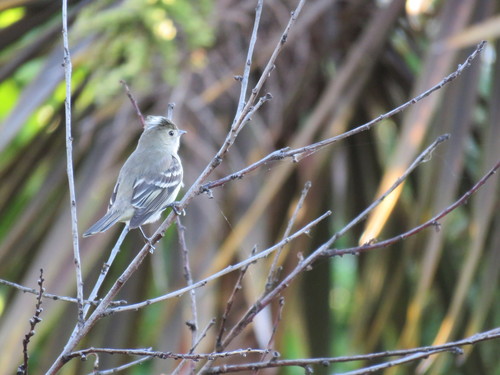 White-crested Elaenia
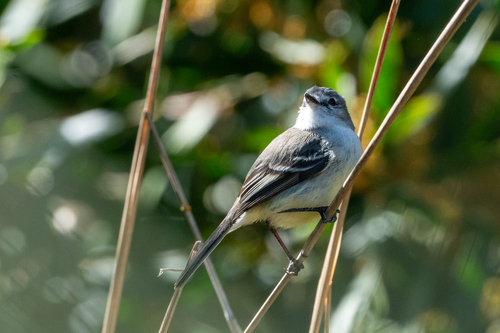 White-crested Tyrannulet
In short
The most reliable field mark between White-crested Elaenia and White-crested Tyrannulet is size: Elaenia is distinctly larger and bulkier, with a heavier build and longer body, while Tyrannulet is noticeably smaller and more delicate. Both species can show a white crest (often concealed), two pale wing bars, and similar olive-gray upperparts, making quick views tricky. However, the Tyrannulet has a much shorter, finer bill and a more contrasting facial pattern with a thin white supercilium and partial eyering, while the Elaenia’s face is plainer and the lores and eyering are less distinct. Juvenile Tyrannulets have buffier wing bars and little or no white on the crown, which can help in autumn. Structure and overall jizz—especially in direct comparison—are often more helpful than plumage alone.
Identification tips
- Size is the quickest separator: White-crested Elaenia is nearly twice the mass and distinctly longer than White-crested Tyrannulet. If the bird looks small, delicate, and compact, Tyrannulet is more likely; if it looks medium-sized and robust, think Elaenia. (All ages/seasons)
- Bill shape and size: Elaenia has a noticeably larger, deeper bill with a pale base to the mandible, while Tyrannulet’s bill is short, fine, and all black. Bill structure is often visible even at a distance. (All ages)
- Facial pattern: Tyrannulet shows a thin white supercilium, a partial white eyering, and a dusky eye-line on a grayish face, giving a more marked facial pattern. Elaenia’s face is plainer, with only a whitish eyering and lores, and less contrast. (All ages)
- Crest visibility: Both species have a white crest stripe that is usually hidden. When visible, Tyrannulet’s is a sharply defined white central stripe on a gray crown; Elaenia’s is a broader, creamy white or white stripe on an olive-gray head. Crest is rarely visible, so do not rely on this mark alone. (All ages)
- Wing bars: Both species have two pale wing bars, but Elaenia’s are typically whiter and more prominent (except in duller subspecies), while Tyrannulet’s are paler or buffier, especially in juveniles. (All ages, but especially juveniles)
- Juvenile Tyrannulet: Juvenile Tyrannulets have buff wing bars and little or no white on the crown, which can help in late summer and autumn. Juvenile Elaenias do not show this combination. (Juveniles)
- Tail pattern: Tyrannulet has whitish edges only on the outer tail feathers; Elaenia’s tail has narrow olive edges throughout. This is subtle but can be seen in good views. (All ages)
- Underparts color: Tyrannulet’s belly is pale yellow (sometimes brighter in certain subspecies), while Elaenia’s is whitish or with a faint yellow wash (in some subspecies). This is variable and not always reliable, but can support other marks. (All ages)
- Upperparts color: Elaenia is dull olive to olive-gray above; Tyrannulet is grayish olive, sometimes with a faint olive tinge. The difference is subtle and often masked by light, but Tyrannulet can look grayer overall. (All ages)
- Behavior: Tyrannulet is more active, flitting and hovering in low scrub; Elaenia is more sedate, often perching upright in mid-story or canopy. (All ages)
- Habitat and elevation: If seen in high-elevation montane forest or drier intermontane valleys, Elaenia is more likely; in lowland or foothill scrub and open woodland, especially in southern South America, Tyrannulet is more likely. (All ages)
- Vocalizations: If you know the local calls, Elaenia’s burry, sneezing notes differ from Tyrannulet’s, but this is only useful with experience. (All ages)
- Subspecies variation: Some Elaenia subspecies have duller wing bars and less distinct facial markings, which can overlap with Tyrannulet; in these cases, rely more on size, structure, and bill shape. (All ages)
- Sexes are similar: In both species, males and females look alike, so sex is not a useful field mark. (All ages)
- Direct comparison: If you see both species together, the size and structure difference is striking and should resolve most confusion.
Size
White-crested Elaenia is almost twice as heavy as White-crested Tyrannulet (15.6 g vs. 7.0 g) and is longer (13.5–15 cm vs. 11 cm). In the field, Elaenia appears medium-sized for a flycatcher, with a robust, rounded body and a proportionally larger head and bill. Tyrannulet is much smaller, daintier, and more compact, with a noticeably shorter tail and a finer, shorter bill. When seen side by side or with familiar species, the size gap is usually obvious.
Plumage
Juvenile White-crested Tyrannulets have buff wing bars and lack or show very little white on the crown, while adult Tyrannulets have two pale (whitish to buffy) wing bars and a white central crown stripe that is usually hidden. White-crested Elaenia adults and immatures both show two white or whitish wing bars, but these are generally more prominent and cleaner than the Tyrannulet's, except in some subspecies where they can be duller. Elaenia’s crest stripe is also usually hidden, but when visible, it is creamy white and less sharply defined than the Tyrannulet’s. Elaenia’s upperparts are dull olive to olive-gray, with a plain face, whitish lores, and eyering, while Tyrannulet’s upperparts are grayish olive with a gray crown, thin white supercilium, white partial eyering, and a dusky eye-line. Both have dusky tails with pale edges, but Tyrannulet shows whitish edges only on the outer tail feathers, while Elaenia’s tail edges are olive. Underparts are paler in both, but Tyrannulet’s belly is pale yellow (brighter in some subspecies), while Elaenia’s is whitish or with a pale yellow wash depending on subspecies.
Behaviour
White-crested Elaenia typically forages singly, often in the mid-story or canopy, and can appear more sluggish or deliberate in its movements. White-crested Tyrannulet is a much more active forager, flitting rapidly through scrubby vegetation, often hovering briefly or sallying out for insects. Tyrannulet’s foraging is more energetic and agile, while Elaenia tends to perch more upright and move less frequently.
Habitat
White-crested Elaenia is found in a range of wooded habitats, including edges of subtropical and temperate forests, open woodlands, secondary forest, and scrublands, often favoring drier intermontane valleys at mid to high elevations (up to 3,500 m in Peru). White-crested Tyrannulet is more widespread in lowland and foothill regions of southern South America, favoring scrub, open woodland, and bushy areas, and is generally absent from higher elevations and dense forest interiors. Overlap is possible in Bolivia and adjacent regions, but context can help: Elaenia is more likely at higher elevations and in more forested or montane settings.
Voice
Both species have distinctive vocalizations, but these are variable and not always diagnostic without experience. White-crested Elaenia’s song is described as a series of burry, rising-falling notes, with calls that are burry or sneezing in quality. White-crested Tyrannulet’s voice is not detailed in the notes, but it is known to differ strongly from similar species and is a key separation from Straneck’s Tyrannulet. In practice, voice is useful if you know the local repertoire, but not always reliable for a first-time observer.
White-crested Elaenia · White-crested Tyrannulet · My Tricky Birds