

White-chinned Swift vs White-collared Swift
Cypseloides cryptus versus Streptoprocne zonaris
Play a quiz with White-chinned Swift and White-collared Swift
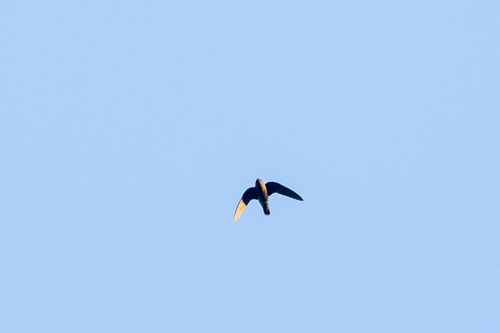 White-chinned Swift
 White-collared Swift
In short
The most reliable field mark between White-chinned Swift and White-collared Swift is the presence or absence of a bold white collar: White-collared Swift shows a prominent white band circling the neck, broadest on the breast, while White-chinned Swift lacks this collar and instead has only a small white chin patch. Size is also a major clue, as White-collared Swift is much larger and heavier. In flight, both species are dark and fast, but the collar on White-collared is visible even at a distance, while the White-chinned’s pale chin is subtle and often missed. Juvenile White-collared Swifts can show white-tipped feathers, but never the isolated chin patch of White-chinned. Both species are often seen in mixed flocks, so careful attention to these marks is essential.
Identification tips
- White collar vs. white chin: The single most important mark—White-collared Swift has a bold white collar circling the neck (broadest on the breast), visible from most angles. White-chinned Swift lacks this collar and instead has a small white patch on the chin, only visible from below and close.
- Size: White-collared Swift is much larger and heavier (20–21.5 cm, 90–125 g) than White-chinned Swift (15 cm, 35 g). If seen together, the size difference is striking; alone, compare to other swifts or swallows in the flock.
- Flight impression: White-collared Swift appears bulkier and more powerful in flight, with a slightly forked tail; White-chinned is slimmer and less robust.
- Juvenile confusion: Juvenile White-collared Swifts are duller and have white-tipped feathers, but always show at least a partial collar. Juvenile White-chinned Swifts look like adults, with the white chin patch but no collar.
- Facial markings: White-chinned Swift has a short white streak above the eye and a white chin; White-collared Swift has a sooty forehead and no pale marks on the face.
- Underparts: Both are dark below, but White-chinned Swift is paler on the underparts and underwing compared to the upperparts; this is subtle and not a strong field mark.
- Back and rump gloss: White-collared Swift has a slight blue gloss on the back, rump, and uppertail coverts, especially in good light; White-chinned Swift is more uniformly dark brown to blackish brown.
- Tail shape: White-collared Swift has a very slightly forked tail; White-chinned Swift’s tail is less distinctly shaped, but this is not a strong separator.
- Flock size: White-collared Swifts often occur in very large, noisy flocks; White-chinned Swifts are usually in smaller groups.
- Habitat context: If near a waterfall or in moist forest, especially during breeding season, consider White-chinned Swift, but do not rely on habitat alone.
- Range: Both species overlap widely, so range is not a reliable separator except in the Antilles and Trinidad, where only White-collared occurs.
- Sexes: Both species are sexually monomorphic—sex cannot be determined by plumage.
- Perched views: Both species rarely perch in the open; if seen, the white collar of White-collared Swift is obvious, while White-chinned’s chin patch may be hard to see unless the bird is facing you.
- Mixed flocks: Both species may join mixed swift flocks; always check for the collar and chin patch on each bird.
- When marks fail: In poor light or at great distance, size and flock structure may be the only clues—White-collared is the giant, White-chinned is mid-sized and lacks the collar.
Size
White-collared Swift is dramatically larger: adults measure 20–21.5 cm in length and weigh 90–125 g, with a wingspan of 45–55 cm. In contrast, White-chinned Swift is much smaller at about 15 cm and 35 g. This size difference is obvious when both are seen together, but can be harder to judge in isolation or at a distance. White-collared also appears bulkier and more robust in flight, while White-chinned is slimmer and more delicate.
Plumage
-
Juveniles: Juvenile White-collared Swifts are duller and sootier than adults, with grayish white to white tips on most body feathers. However, they still show the white collar (though it may be narrower or less crisp), and never have a white chin patch. Juvenile White-chinned Swifts resemble adults, with the white chin streak already present.
-
Adults: Adult White-collared Swifts have a bold white collar encircling the neck, broadest on the breast, contrasting with otherwise black plumage with a slight blue gloss on the back and rump. The White-chinned Swift lacks any collar; instead, it shows a short white streak above the eye and a small white chin patch, with the rest of the plumage dark brown to blackish brown, and paler underparts. The underwing of White-chinned is paler below than above, but this is subtle and not a strong field mark.
-
Flight views: In both species, the overall impression is of a dark swift, but the white collar of White-collared is visible from most angles, while the White-chinned’s pale chin is only obvious from below and close up. No distinctive upperwing patterns are noted for either species at any age.
Behaviour
Both species are aerial insectivores and are often seen in fast, direct flight high above forests or open areas. White-collared Swifts are especially powerful fliers, often ascending thermals to great heights and forming large flocks (sometimes 200+ birds). White-chinned Swifts are less likely to be seen in such large numbers and may appear more delicate and less robust in flight. Both may join mixed swift flocks, so careful observation is needed.
Habitat
Both species overlap widely in range, occurring from Mexico through Central and South America. White-collared Swift is more widespread, including the Antilles and Trinidad, and is found in a broader range of elevations and habitats. White-chinned Swift is also widespread but is generally less common and more localized, often near waterfalls or moist forests, especially during breeding. Habitat alone is not diagnostic, but White-collared is more likely in open areas and at higher elevations.
White-chinned Swift · White-collared Swift · My Tricky Birds