

White-chinned Petrel vs Parkinson's Petrel
Procellaria aequinoctialis versus Procellaria parkinsoni
Play a quiz with White-chinned Petrel and Parkinson's Petrel
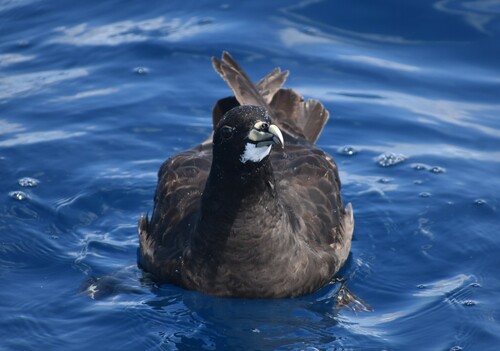 White-chinned Petrel
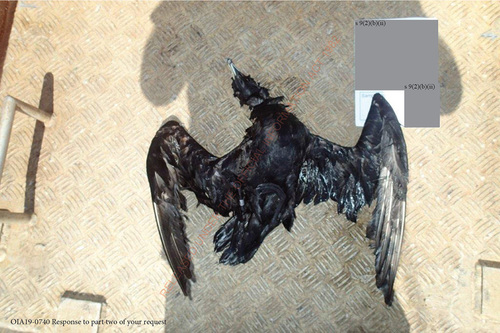 Parkinson's Petrel
In short
The most reliable field mark to separate White-chinned Petrel from Parkinson's Petrel is the presence of obvious white on the chin and throat of White-chinned Petrel, which is entirely lacking in Parkinson's. White-chinned is also distinctly larger and bulkier, with a heavier bill and broader wings, while Parkinson's is smaller, slimmer, and all-black. In flight, look for the silvery underwing primaries of White-chinned, which can be absent or much less noticeable on Parkinson's. Both species share overall dark plumage and black legs, but careful attention to size, bill color, and the presence or absence of white on the face is key. These differences hold for adults and immatures, though white on the chin of White-chinned can be variable and sometimes limited.
Identification tips
- White chin/throat patch: Look for any white on the chin or throat—this is diagnostic for White-chinned Petrel of all ages and never shown by Parkinson's. The extent can vary, but even a small patch is significant.
- Overall size and bulk: White-chinned is much larger and heavier-bodied, with a noticeably stouter build and broader wings. Use this when birds are seen together or with other species for scale.
- Bill color and shape: White-chinned has a horn or yellowish bill with black between the nostrils, appearing heavier and more robust. Parkinson's has a mostly black bill with some pale areas, but is slimmer overall.
- Uniformity of plumage: Parkinson's is entirely black, including the chin and throat, with no pale markings at any age. White-chinned is sooty-black but always has at least some white on the chin in adults and immatures.
- Underwing in flight: White-chinned may show a silvery sheen to the underwing primaries, especially in strong light, which can help in flight views. Parkinson's underwing is uniformly dark.
- Leg and foot color: Both have black legs and feet—this is not useful for separation.
- Flight style: White-chinned appears heavier and more ponderous, with slower, deeper wingbeats interspersed with glides. Parkinson's is lighter and more agile, but this is subtle and best used in combination with other marks.
- Geographic context: If seen in the Hauraki Gulf or near New Zealand, especially during the breeding season, Parkinson's is more likely, but White-chinned can occur as a vagrant. In the far southern oceans, White-chinned predominates.
- No age-specific upperwing marks: Neither species shows distinctive juvenile or immature upperwing patterns that override the chin/throat and size differences.
- Bill structure in close views: If seen well, the heavier, more bulbous bill of White-chinned is distinctive compared to the slimmer bill of Parkinson's.
- White-chinned variability: Be aware that the white chin patch on White-chinned can be small or extensive, and may be less obvious in poor light or at distance—always try for multiple views.
- Plumage pitfalls: Do not rely on overall darkness alone, as both are dark-plumaged; focus on the chin/throat and bill.
- Vocalizations not useful at sea: Both are silent away from colonies, so calls are not a field mark.
- Sex differences minor: Both species show only slight size differences between sexes, not useful for field ID.
- Seasonal context: During the New Zealand breeding season (October–June), Parkinson's is more likely near its colonies, but both can be found at sea in overlapping ranges.
Size
White-chinned Petrel is substantially larger and heavier than Parkinson's Petrel. White-chinned averages 51–58 cm in length with a wingspan of 134–147 cm and a mass around 1335 g, making it the largest Procellaria petrel and second only to the giant petrels in its family. Parkinson's Petrel is noticeably smaller at about 46 cm long, with a wingspan of 115 cm and a mass of 680–720 g. In direct comparison, White-chinned appears bulkier, with a more robust build and a heavier, stouter bill. If seen together, White-chinned will dwarf Parkinson's both at rest and in flight.
Plumage
The key plumage difference is the white chin and throat patch on White-chinned Petrel, which is absent in Parkinson's Petrel of all ages. This white can be extensive or limited, but even a small patch is diagnostic. White-chinned is otherwise sooty-black, sometimes with a silvery sheen to the underwing primaries, especially in flight. Parkinson's Petrel is uniformly black throughout, including the chin and throat, with no pale markings. Both have black legs and feet, but bill color differs: White-chinned has a horn or yellowish bill with some black between the nostrils, while Parkinson's has a mostly black bill with some pale areas. There are no reported age-specific upperwing patterns or juvenile-specific marks for either species that would override these contrasts; both are dark-plumaged at all ages.
Behaviour
White-chinned Petrel tends to appear heavier and more ponderous in flight, mixing slow, deep wingbeats with glides, befitting its larger size. Parkinson's Petrel, being smaller and lighter, may appear more agile and less labored in its flight style. Both species are typically quiet at sea, but White-chinned can rattle or groan at colonies. There are no strong behavioral differences in foraging or sociality that are useful for field separation when seen at sea.
Habitat
Range and context can help: White-chinned Petrel is widespread across the Southern Ocean, breeding on scattered subantarctic islands and ranging to southern Australia, Peru, and Namibia. Parkinson's Petrel is a New Zealand endemic breeder, restricted to Great and Little Barrier Islands, but disperses widely at sea, sometimes reaching Australia and the eastern Pacific. If seen near New Zealand, especially in the Hauraki Gulf, Parkinson's is more likely, but both can overlap offshore. White-chinned is much more likely in the far southern oceans, while Parkinson's is rare outside the New Zealand region.
Voice
Both species are usually silent at sea. At colonies, White-chinned Petrel may give rattling or groaning calls, but these are unlikely to be heard in typical field conditions. No distinctive vocal field marks are reported for Parkinson's Petrel.