

White-cheeked Pintail vs Ruddy Duck
Anas bahamensis versus Oxyura jamaicensis
Play a quiz with White-cheeked Pintail and Ruddy Duck
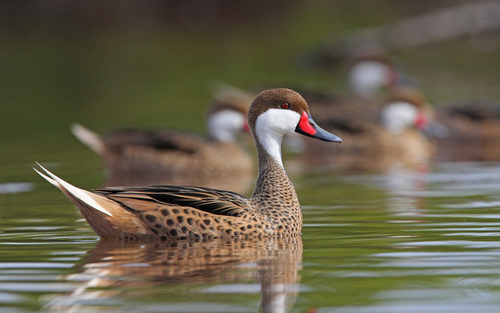 White-cheeked Pintail
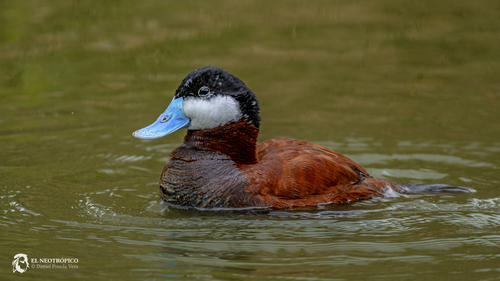 Ruddy Duck
In short
The most reliable field mark to separate White-cheeked Pintail from Ruddy Duck is the cheek pattern: White-cheeked Pintail has broad white cheeks on a mainly brown face, while Ruddy Duck shows a bright white cheek patch sharply set off against a dark cap and nape, especially in males. In flight, White-cheeked Pintail displays a green speculum on the wing, while Ruddy Duck’s upperwings are solidly dark with no iridescent panel. Structurally, Ruddy Duck is a compact, short-necked, stiff-tailed bird often seen with its tail cocked upward, while White-cheeked Pintail is slimmer with a more pointed tail and a longer neck. Bill color is also a strong clue: adult male Ruddy Ducks in breeding plumage have a striking blue bill, while White-cheeked Pintail has a red-based gray bill. Females and immatures of both species are duller, but the cheek and wing patterns remain useful.
Identification tips
- Cheek pattern (all ages): White-cheeked Pintail has broad white cheeks on a brown face; Ruddy Duck shows a bright white cheek patch sharply bordered by a dark cap and nape, especially in males. Female and immature Ruddy Ducks have a blurry brown line across the pale cheek.
- Wing pattern in flight (all ages): White-cheeked Pintail shows a green iridescent speculum on the wing, visible as a colored panel in flight or at rest with wings open. Ruddy Duck’s upperwing is solidly dark with no speculum or contrasting panel.
- Tail shape and carriage: Ruddy Duck has a stiff tail often held cocked upright, even when swimming or at rest. White-cheeked Pintail’s tail is pointed but not stiff, and is usually held in line with the body.
- Bill shape and color: Ruddy Duck’s bill is broad, scoop-shaped, and bright blue in adult breeding males; in females and non-breeding males, it is gray. White-cheeked Pintail has a slender gray bill with a red base; juveniles have a duller bill.
- Body shape and posture: Ruddy Duck is compact, short-necked, and sits low in the water. White-cheeked Pintail is longer-necked, more slender, and sits higher with a more graceful profile.
- Male breeding plumage: Ruddy Duck males in breeding season are chestnut-bodied with a blackish cap, white cheeks, and blue bill—unique among ducks. White-cheeked Pintail males are brown with white cheeks and lack any blue on the bill.
- Female and immature confusion: Female and immature Ruddy Ducks are brownish with a pale cheek patch crossed by a blurry stripe and a dark cap; White-cheeked Pintail females/immatures are duller than males but always show broad white cheeks without a dark cap or cheek stripe.
- Flight behavior: Ruddy Ducks rarely fly, but when they do, their flight is fast and low over water with rapid wingbeats. White-cheeked Pintail takes flight more readily and flies with a more typical dabbling duck profile.
- Feeding behavior: Ruddy Duck dives and forages underwater, often disappearing for long periods. White-cheeked Pintail dabbles at the surface, tipping forward but rarely diving.
- Habitat clues: In the Caribbean and South America, White-cheeked Pintail is the only pintail and prefers open, shallow wetlands. Ruddy Duck is more likely in marshy, vegetated lakes, especially in introduced European populations.
- Vocalizations: If you hear a drumming or bubbling sound, especially during display, it points to Ruddy Duck; White-cheeked Pintail is generally quiet.
- Size impression: Both are similar in mass, but Ruddy Duck looks much chunkier and shorter-necked, while White-cheeked Pintail is more elegant and elongated.
- Bill structure: Ruddy Duck’s bill is noticeably broader and more spatulate than the slender bill of White-cheeked Pintail, especially obvious at close range.
- Tail in swimming birds: If you see a duck with its tail cocked up like a wren, it is a Ruddy Duck; White-cheeked Pintail keeps its tail level.
- Seasonal variation: Ruddy Duck males only show the blue bill and chestnut body in breeding season; in winter, they are duller but still show the white cheek patch and dark cap. White-cheeked Pintail does not have strong seasonal plumage changes.
Size
Both species are similar in mass, with Ruddy Duck averaging about 544.5 g [wikidata], and White-cheeked Pintail varying by subspecies but generally in the 474–710 g range [wikipedia]. However, Ruddy Duck appears more compact and chunky, with a short, thick neck and a squat body, while White-cheeked Pintail is more elongated and slender, with a longer, more pointed tail. In the field, Ruddy Duck’s short, stiff tail and stocky build are distinctive compared to the more graceful, pintail-like shape of the White-cheeked Pintail.
Plumage
-
Juvenile/immature and female plumage: Both species are duller than adult males, but the cheek pattern is still diagnostic. White-cheeked Pintail of all ages shows broad white cheeks on a brown face; juveniles have a duller bill but retain the cheek contrast. Ruddy Duck (female and immature) shows a white cheek patch crossed by a blurry brown line and a dark cap, with the rest of the face and body brownish-gray.
-
Adult male breeding plumage: Ruddy Duck males are unmistakable with a bright blue bill, blackish cap, and white cheeks, plus a rich chestnut body. White-cheeked Pintail males are brown overall with white cheeks and a red-based gray bill.
-
Wing pattern in flight: White-cheeked Pintail of all ages shows an iridescent green speculum, visible as a colored panel on the wing. Ruddy Duck’s upperwings are solidly dark with no speculum or contrasting panel.
-
Tail: Ruddy Duck’s tail is stiff and often held upright, while White-cheeked Pintail’s tail is pointed but not as stiff or cocked.
-
Bill: Ruddy Duck’s bill is broad, scoop-shaped, and blue in breeding males; gray in winter and in females/immatures. White-cheeked Pintail’s bill is gray with a red base (duller in juveniles).
Behaviour
Ruddy Duck is a diving duck, often foraging underwater and rarely flying unless flushed; when it does fly, it uses rapid wingbeats and stays low over water. It often sits low in the water and frequently cocks its stiff tail upward. White-cheeked Pintail is a dabbling duck, feeding at the surface by tipping forward rather than diving. It is more likely to be seen swimming with a level tail and neck extended, and it takes flight more readily than Ruddy Duck.
Habitat
Both species use freshwater habitats, but White-cheeked Pintail is more likely found in open, shallow wetlands, lagoons, and brackish ponds, especially in the Caribbean and South America. Ruddy Duck prefers marshy lakes and ponds with dense emergent vegetation, and in its introduced range in Europe, it is often found on deeper lakes. White-cheeked Pintail is patchily distributed in its range, while Ruddy Duck can be locally abundant where established.
Voice
Neither species is especially vocal in the field. Ruddy Duck males can produce a distinctive drumming or 'bubbling' display sound by beating their bill on the breast, often accompanied by bubbles in the water. White-cheeked Pintail is not noted for distinctive vocalizations in the provided sources.