

Motmot

White-cheeked Pintail vs Rosy-billed Pochard

Anas bahamensis versus Netta peposaca

Play a quiz with White-cheeked Pintail and Rosy-billed Pochard
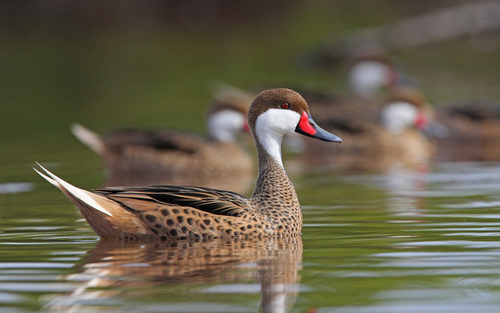
White-cheeked Pintail (Anas bahamensis) White-cheeked Pintail
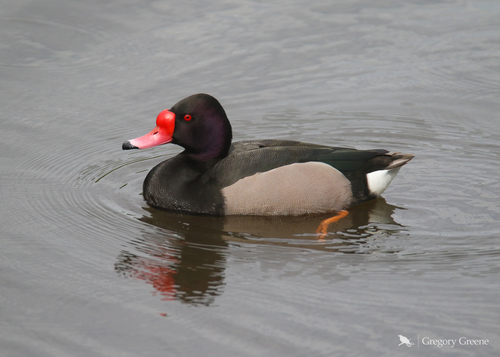
Rosy-billed Pochard (Netta peposaca) Rosy-billed Pochard

Media

Loading…

In short

The most reliable way to separate White-cheeked Pintail from Rosy-billed Pochard is by head and bill pattern: the pintail shows crisp white cheeks and a red-based gray bill, while the male pochard has a striking bright red bill with a prominent knob and a dark, purplish-black head; females and immatures are dull brown with a bluish-gray bill. In flight, Rosy-billed Pochard reveals a bold white wing stripe (primaries and secondaries) contrasting with otherwise dark plumage, while White-cheeked Pintail shows an iridescent green speculum but lacks such a strong white panel. Structure also differs: the pintail is more slender with a pointed tail, the pochard is heavier-bodied and has a blunter tail. Both species can be found in South American wetlands, but their behavior and posture differ, with the pochard less agile on land and more likely to dive. Size is also a clue, as the pochard is nearly twice as heavy as the pintail.

Identification tips

  1. White cheek patch (all ages, both sexes): Only White-cheeked Pintail has a crisp, well-defined white cheek; Rosy-billed Pochard never shows this feature.
  2. Bill color and shape (adults): Male Rosy-billed Pochard has a bright red bill with a large, rounded basal knob; females/immatures have a bluish-gray bill with a black tip. White-cheeked Pintail shows a gray bill with a red base (duller in juveniles), and no knob.
  3. Head and neck color: Adult male pochard has a glossy purplish-black head and neck; female and immature pochards are brown. Pintail is brown overall with white cheeks.
  4. Flight wing pattern (all ages): Pochard shows a broad, bright white stripe on the primaries and secondaries in flight; pintail shows an iridescent green speculum but no white wing panel.
  5. Tail shape: Pintail has a slender, pointed tail (though less so than Northern Pintail); pochard's tail is shorter and blunter.
  6. Body shape and posture: Pintail is more slender and elongated, with a longer neck and tail; pochard is bulkier, with a deeper chest and larger head.
  7. Size: Pochard is nearly twice as heavy as pintail; this is most obvious when birds are side by side, but can be judged by bulk and proportions.
  8. Crissum (undertail area): Female and immature pochards have a contrasting white crissum; pintails do not show this feature.
  9. Eye color: Male pochard has red eyes; pintail's eye color is not distinctive for separation.
  10. Leg color: Pochard legs are yellow to orange (can be gray in females); pintail leg color is not described as distinctive.
  11. Behavior on land: Pintail walks more easily and is agile on land; pochard is awkward, with legs set far back.
  12. Feeding behavior: Both dabble, but pochard may dive more often, especially when alarmed.
  13. Habitat: Pintail is more likely in brackish or coastal lagoons; pochard prefers freshwater lakes and marshes, but overlap is common.
  14. Sexual dimorphism: Pintail sexes are similar; pochard males are much more colorful than females/immatures.
  15. Vocalizations: Not a reliable field mark; pochard's call is a quiet, deep 'honk.'

Size

Rosy-billed Pochard is substantially larger and heavier than White-cheeked Pintail. Adult pochards average about 1090 g, while pintails (depending on subspecies) are typically 470–710 g. The pochard also appears bulkier and more robust in the field, with a larger head and deeper chest, while the pintail is more slender and elongated, especially in the tail. This size difference is usually obvious when birds are seen together, but can be less apparent at a distance or on the water.

Plumage

Juvenile and female Rosy-billed Pochards are brown overall, with a pale bluish-gray bill tipped black and a contrasting white crissum (undertail area); they lack the male's red bill and knob. In flight, all ages of Rosy-billed Pochard show a broad, bright white stripe across the primaries and secondaries—a key mark visible only with wings spread. White-cheeked Pintail of all ages shows brown upperparts with a distinct white cheek patch and an iridescent green speculum in the wing, but lacks any broad white wing stripe. The pintail's bill is gray with a red base (duller in juveniles), and the tail is pointed. Adult male pochards have a glossy blackish head and breast, red eyes, and a bright red bill with a large basal knob, while females and immatures are much duller. Pintails are similar between sexes, with females only slightly duller. The pintail's white cheeks are unique and diagnostic at all ages.

Behaviour

White-cheeked Pintail is a typical dabbling duck, agile on land and water, often seen feeding at the surface or tipping up. Rosy-billed Pochard, though classified as a diving duck, often feeds by dabbling as well, but is less graceful on land due to its rear-set legs and is more likely to dive when alarmed. In flight, the pochard appears heavier and beats its wings faster, needing a longer run to take off, while the pintail is more streamlined and agile. Social behavior and flocking tendencies are not notably different for field ID.

Habitat

Both species occur in South American wetlands, but White-cheeked Pintail is more widespread in the Caribbean and patchy in South America, while Rosy-billed Pochard is endemic to southern South America (Argentina, Chile, Paraguay, Uruguay, southern Brazil). Pintails are more likely in brackish and coastal lagoons, while pochards prefer freshwater lakes and marshes. However, range overlap is sufficient that habitat alone is not diagnostic.

Voice

Vocalizations are not a strong field mark for separation. Rosy-billed Pochard gives a deep, quiet 'honk' that is less obvious than the typical mallard-like quacks of many ducks. No distinctive vocalization is noted for White-cheeked Pintail in the sources.

Submit a better description

Use the same sections as the comparison. Your text is published immediately.

The most reliable way to separate White-cheeked Pintail from Rosy-billed Pochard is by head and bill pattern: the pintail shows crisp white cheeks and a red-based gray bill, while the male pochard has a striking bright red bill with a prominent knob and a dark, purplish-black head; females and immatures are dull brown with a bluish-gray bill. In flight, Rosy-billed Pochard reveals a bold white wing stripe (primaries and secondaries) contrasting with otherwise dark plumage, while White-cheeked Pintail shows an iridescent green speculum but lacks such a strong white panel. Structure also differs: the pintail is more slender with a pointed tail, the pochard is heavier-bodied and has a blunter tail. Both species can be found in South American wetlands, but their behavior and posture differ, with the pochard less agile on land and more likely to dive. Size is also a clue, as the pochard is nearly twice as heavy as the pintail.

  1. White cheek patch (all ages, both sexes): Only White-cheeked Pintail has a crisp, well-defined white cheek; Rosy-billed Pochard never shows this feature.
  2. Bill color and shape (adults): Male Rosy-billed Pochard has a bright red bill with a large, rounded basal knob; females/immatures have a bluish-gray bill with a black tip. White-cheeked Pintail shows a gray bill with a red base (duller in juveniles), and no knob.
  3. Head and neck color: Adult male pochard has a glossy purplish-black head and neck; female and immature pochards are brown. Pintail is brown overall with white cheeks.
  4. Flight wing pattern (all ages): Pochard shows a broad, bright white stripe on the primaries and secondaries in flight; pintail shows an iridescent green speculum but no white wing panel.
  5. Tail shape: Pintail has a slender, pointed tail (though less so than Northern Pintail); pochard's tail is shorter and blunter.
  6. Body shape and posture: Pintail is more slender and elongated, with a longer neck and tail; pochard is bulkier, with a deeper chest and larger head.
  7. Size: Pochard is nearly twice as heavy as pintail; this is most obvious when birds are side by side, but can be judged by bulk and proportions.
  8. Crissum (undertail area): Female and immature pochards have a contrasting white crissum; pintails do not show this feature.
  9. Eye color: Male pochard has red eyes; pintail's eye color is not distinctive for separation.
  10. Leg color: Pochard legs are yellow to orange (can be gray in females); pintail leg color is not described as distinctive.
  11. Behavior on land: Pintail walks more easily and is agile on land; pochard is awkward, with legs set far back.
  12. Feeding behavior: Both dabble, but pochard may dive more often, especially when alarmed.
  13. Habitat: Pintail is more likely in brackish or coastal lagoons; pochard prefers freshwater lakes and marshes, but overlap is common.
  14. Sexual dimorphism: Pintail sexes are similar; pochard males are much more colorful than females/immatures.
  15. Vocalizations: Not a reliable field mark; pochard's call is a quiet, deep 'honk.'

Rosy-billed Pochard is substantially larger and heavier than White-cheeked Pintail. Adult pochards average about 1090 g, while pintails (depending on subspecies) are typically 470–710 g. The pochard also appears bulkier and more robust in the field, with a larger head and deeper chest, while the pintail is more slender and elongated, especially in the tail. This size difference is usually obvious when birds are seen together, but can be less apparent at a distance or on the water.

Juvenile and female Rosy-billed Pochards are brown overall, with a pale bluish-gray bill tipped black and a contrasting white crissum (undertail area); they lack the male's red bill and knob. In flight, all ages of Rosy-billed Pochard show a broad, bright white stripe across the primaries and secondaries—a key mark visible only with wings spread. White-cheeked Pintail of all ages shows brown upperparts with a distinct white cheek patch and an iridescent green speculum in the wing, but lacks any broad white wing stripe. The pintail's bill is gray with a red base (duller in juveniles), and the tail is pointed. Adult male pochards have a glossy blackish head and breast, red eyes, and a bright red bill with a large basal knob, while females and immatures are much duller. Pintails are similar between sexes, with females only slightly duller. The pintail's white cheeks are unique and diagnostic at all ages.

White-cheeked Pintail is a typical dabbling duck, agile on land and water, often seen feeding at the surface or tipping up. Rosy-billed Pochard, though classified as a diving duck, often feeds by dabbling as well, but is less graceful on land due to its rear-set legs and is more likely to dive when alarmed. In flight, the pochard appears heavier and beats its wings faster, needing a longer run to take off, while the pintail is more streamlined and agile. Social behavior and flocking tendencies are not notably different for field ID.

Both species occur in South American wetlands, but White-cheeked Pintail is more widespread in the Caribbean and patchy in South America, while Rosy-billed Pochard is endemic to southern South America (Argentina, Chile, Paraguay, Uruguay, southern Brazil). Pintails are more likely in brackish and coastal lagoons, while pochards prefer freshwater lakes and marshes. However, range overlap is sufficient that habitat alone is not diagnostic.

Vocalizations are not a strong field mark for separation. Rosy-billed Pochard gives a deep, quiet 'honk' that is less obvious than the typical mallard-like quacks of many ducks. No distinctive vocalization is noted for White-cheeked Pintail in the sources.

Discard your changes?

You have unsaved edits. If you leave now, those changes will be lost.

White-cheeked Pintail · Rosy-billed Pochard · My Tricky Birds