

White-browed Sparrow-Weaver vs Cape Sparrow
Plocepasser mahali versus Passer melanurus
Play a quiz with White-browed Sparrow-Weaver and Cape Sparrow
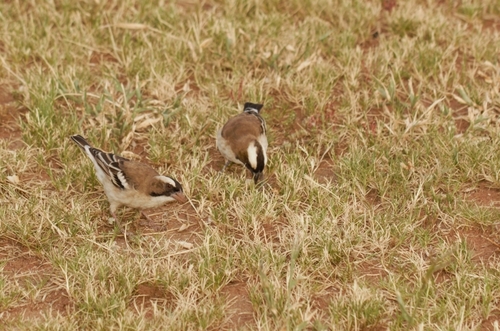 White-browed Sparrow-Weaver
 Cape Sparrow
In short
The most reliable field mark to separate White-browed Sparrow-Weaver from Cape Sparrow is the broad, white eyebrow stripe and white rump in flight of the Sparrow-Weaver, versus the Cape Sparrow’s bold head pattern with a black head (male) and broad white face stripe. The Sparrow-Weaver is also noticeably larger and heavier-bodied, with a stouter, often black bill (male), compared to the Cape Sparrow’s smaller size and pinkish-brown bill. Juvenile and female Cape Sparrows lack the male’s black head but still show a pale head stripe, while the Sparrow-Weaver’s eyebrow remains prominent in all ages. Bill color and head pattern are key at all ages and sexes, but especially note the Sparrow-Weaver’s white rump in flight and larger size when birds are moving or distant.
Identification tips
- Broad white eyebrow (supercilium): White-browed Sparrow-Weaver of all ages and sexes shows a bold, bright white eyebrow stripe from bill to above the eye, much broader and whiter than the Cape Sparrow’s.
- White rump in flight: Sparrow-Weaver flashes a white rump when flying, absent in Cape Sparrow; check this especially in flushed or flying birds.
- Bill color: Male Sparrow-Weaver has a black bill, female horn-colored, juvenile pinkish-brown. Cape Sparrow’s bill is always pinkish-brown, never black.
- Head pattern (male Cape Sparrow): Male Cape Sparrow has a mostly black head with a broad white stripe curling from behind the eye to the throat, plus a black bib. Sparrow-Weaver never shows this pattern.
- Head pattern (female/juvenile Cape Sparrow): Female and juvenile Cape Sparrows have a duller grey head with a pale stripe, but it is narrower and less striking than the Sparrow-Weaver’s eyebrow. Young male Cape Sparrows may show some black on the head early.
- Chestnut back and shoulders: Only Cape Sparrow (especially males) shows bright chestnut on the back and shoulders; Sparrow-Weaver is plain brown above.
- Underparts: Sparrow-Weaver has white underparts, sometimes with faint brown spotting (notably in Zimbabwe); Cape Sparrow’s are greyish, darker on the flanks.
- Wing bars: Cape Sparrow males have a white and black wing bar below the shoulder, which Sparrow-Weaver lacks. However, this is subtle and less reliable than head and rump marks.
- Size and bulk: Sparrow-Weaver is much larger and heavier-bodied (49 g vs. 29 g), with a longer body and stouter build. Use this when both species are present or compared to other sparrows.
- Feet color: Sparrow-Weaver has black feet; Cape Sparrow’s are pink (not always visible but can help at close range).
- Group size and behavior: Sparrow-Weaver is usually in small, tight family groups; Cape Sparrow often in larger, loose colonies.
- Habitat: Sparrow-Weaver prefers dry savannah and thornveld, avoids broad-leaved woodland; Cape Sparrow is more generalist and often found in towns and gardens.
- Voice: Cape Sparrow’s calls are more musical and distinctive; Sparrow-Weaver’s voice is not described here, so use Cape Sparrow’s song if heard.
- Sex differences: Only male Sparrow-Weaver has a black bill; both sexes of Cape Sparrow have similar bill color but differ in head pattern.
- Pitfalls: Female and juvenile Cape Sparrows can look superficially like Sparrow-Weavers due to pale head stripes, but the eyebrow is always narrower and less white, and overall size is smaller.
Size
White-browed Sparrow-Weaver is significantly larger and heavier (49 g vs. 29 g) than Cape Sparrow. In the field, this translates to a bulkier, more robust bird with a longer body (17–19 cm vs. 14–16 cm). The Sparrow-Weaver’s size is especially apparent when both species are seen together or near other sparrows. Cape Sparrow is more compact and lighter, with a more typical sparrow build.
Plumage
-
Juveniles and Females: Both species have pale head stripes, but the White-browed Sparrow-Weaver’s is broader and brighter white, running from the bill over the eye, while the Cape Sparrow’s is narrower and buffier in females and juveniles. Juvenile Sparrow-Weavers have a pinkish-brown bill; Cape Sparrow juveniles resemble dull females but young males begin to show black on the head early.
-
Adult Males: Sparrow-Weaver males have a black bill and broad white eyebrow; Cape Sparrow males have a striking black head with a curling white stripe from behind the eye to the throat, plus a black bib and chestnut back. The Sparrow-Weaver’s underparts are white with faint brown spotting (notably in Zimbabwe), while the Cape Sparrow’s are greyish and darker on the flanks.
-
Flight/Upperwing: The Sparrow-Weaver shows a white rump in flight, which is absent in Cape Sparrow. Cape Sparrow males have a white and a black wing bar, but no white rump. Both species have brown upperparts, but the Sparrow-Weaver lacks the Cape Sparrow’s chestnut shoulders and back.
-
Bill Color: Male Sparrow-Weaver has a black bill, female is horn-colored, juvenile is pinkish-brown. Cape Sparrow’s bill is pinkish-brown in all ages.
Behaviour
White-browed Sparrow-Weavers are typically seen in small family groups (2–11), often moving together and foraging on the ground or low in bushes. They are more likely to be seen perched upright and conspicuously, sometimes displaying their white eyebrow and rump. Cape Sparrows are social as well, but often form larger, looser colonies (50–100 birds) and can be seen feeding on the ground or in low vegetation, sometimes in mixed flocks. The Sparrow-Weaver’s group structure is more tightly knit, while Cape Sparrows are more gregarious and colonial.
Habitat
White-browed Sparrow-Weaver favors dry savannah, thornveld, and open woodland, especially in central and north-central southern Africa. It avoids broad-leaved woodland, where Cape Sparrow may occur. Cape Sparrow is widespread in southern Africa and is more adaptable, found in a range of open habitats including towns, farmland, and gardens. If seen in broad-leaved woodland, Cape Sparrow is more likely; in dry thornveld or open bush, both are possible but Sparrow-Weaver is more typical.
Voice
Cape Sparrow has a series of musical, mellow chirps and a distinctive, loud advertising call ("tweeng" or "twileeng"), sometimes extended into a jerky song. White-browed Sparrow-Weaver’s vocalizations are not described in the provided notes, so voice is less reliable for separation unless Cape Sparrow’s distinctive calls are recognized.
White-browed Sparrow-Weaver · Cape Sparrow · My Tricky Birds