
White-browed Coucal vs Black-crowned Tchagra
Centropus superciliosus versus Tchagra senegalus
Play a quiz with White-browed Coucal and Black-crowned Tchagra
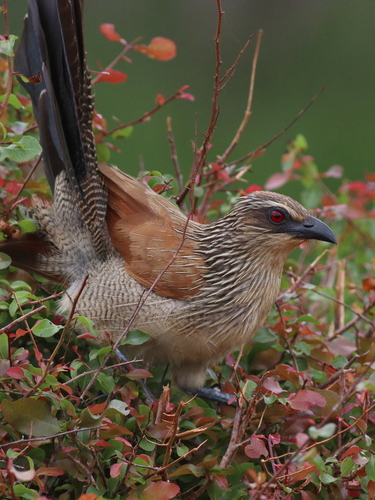 White-browed Coucal
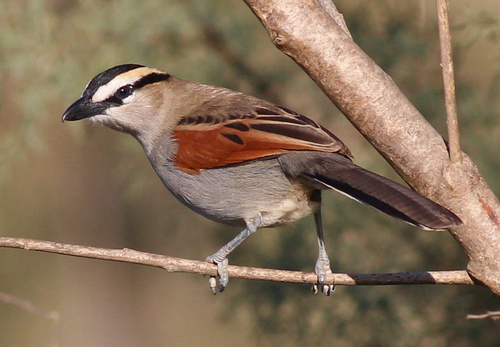 Black-crowned Tchagra
In short
The most reliable field mark is size and structure: White-browed Coucal is much larger and bulkier than Black-crowned Tchagra, with a heavier body and longer tail. Juvenile coucals show rufous streaking on the crown and barred upperparts, while young tchagras have a brown cap and pale yellow bill. Both species have a white supercilium, but the coucal’s is broader and set off by a blackish crown, while the tchagra’s is bordered by black crown and eye-stripes. In flight or perched, note the coucal’s creamy-white underparts and chestnut wings versus the tchagra’s pale grey underparts and chestnut wings. Habitat overlap is possible, but coucal prefers denser cover. Use size, structure, and detailed plumage checks for confident separation.
Identification tips
- Size and Structure: White-browed Coucal is much larger and heavier than Black-crowned Tchagra. If the bird appears crow-sized or has a very long, heavy tail, suspect coucal.
- Tail Length and Shape: Coucal’s tail is long, black with a green gloss and white tip; tchagra’s tail is shorter, black, and also tipped white but lacks the green gloss.
- Supercilium and Crown: Both have a white supercilium, but coucal’s is broad and set off by a blackish crown and nape, while tchagra’s is bordered above by a black crown and below by a black eyestripe, giving a more sharply defined facial pattern.
- Juvenile Plumage: Juvenile coucal has rufous streaking on the crown and barred upperparts; juvenile tchagra has a plain brown cap and a pale yellow bill. If you see a streaked crown and barring above, it’s a young coucal.
- Bill Color: Both adults have black bills, but only juvenile tchagra has a pale yellow bill. This is a useful check for young birds.
- Underparts Color: Coucal underparts are creamy-white; tchagra’s are pale grey. In good light, this can be a subtle but useful distinction.
- Upperparts and Wings: Coucal has rufous-brown back and chestnut wings, with a blackish rump; tchagra has pale brown upperparts and chestnut wings, but overall is paler above.
- Eye Color: Adult coucal has red eyes; tchagra’s eye color varies by subspecies and is less distinctive.
- Behavior: Coucal is usually low in dense cover, moving slowly and often hidden; tchagra may perch up in bushes, sometimes responding to calls, but is less conspicuous than true shrikes.
- Flight Style: Coucal flies with heavy, labored wingbeats and long tail trailing; tchagra’s flight is more direct and less ponderous.
- Habitat: Dense, tangled undergrowth points to coucal; more open bush, woodland, or cultivated areas suggest tchagra.
- Voice: If you hear a descending whistling 'chee-chee chee cheroo cheroo,' it’s tchagra. Coucal’s calls are not described here.
- Sexes: Both species are similar in plumage between sexes, so do not rely on sex for separation.
- Season: No strong seasonal plumage differences are noted for either species; age-related marks are more important.
- Common Pitfall: The shared white supercilium and chestnut wing can cause confusion, especially in quick views, but size, structure, and crown pattern are decisive if checked carefully.
Size
White-browed Coucal is significantly larger and heavier (body mass ~170g [wikidata]) and measures 36–42 cm in length, making it a robust, long-tailed bird. Black-crowned Tchagra is much smaller and slimmer at 19–22 cm, with a lighter build and shorter tail. Even at a distance, the coucal’s bulk and length are distinctive, especially when perched or moving through vegetation. The tchagra is more sparrowhawk-sized and generally appears daintier.
Plumage
- Juveniles: Juvenile White-browed Coucal shows rufous streaking on the crown, a faint buff supercilium, barred upperparts, and darker underparts. Juvenile Black-crowned Tchagra has a brown cap (not streaked), a pale yellow bill, and otherwise similar pattern to adults.
- Adults: Both have a white supercilium, but the coucal’s is broader and set off by a blackish crown and nape; tchagra’s supercilium is bordered above by a black crown and below by a black eyestripe. Coucal upperparts are rufous-brown with chestnut wings, blackish rump, and a long black tail with a green gloss and white tip. Tchagra upperparts are pale brown, wings are chestnut, and tail is black tipped white. Underparts of coucal are creamy-white; tchagra’s are pale grey. Eye color is red in adult coucal, variable in tchagra subspecies. Bill is black in both adults, but only tchagra juveniles have a pale yellow bill.
Behaviour
White-browed Coucal is secretive, moving through dense undergrowth and often skulking low in thick vegetation. It is less likely to perch conspicuously. Black-crowned Tchagra, while also preferring cover, hunts from perches in bushes and is more likely to be seen sitting up, though less openly than true shrikes. Tchagra responds to imitated calls and may perform a display flight. Coucal is more likely to be seen clambering through tangles or flying low between cover.
Habitat
Both species can occur in areas with scrub and bush, but White-browed Coucal is more strictly tied to dense, rank undergrowth and thickets, including coastal scrub. Black-crowned Tchagra is more adaptable, found in scrub, open woodland, semi-desert, and cultivated areas, often in less dense cover than the coucal. If the habitat is very dense and tangled, coucal is more likely; in more open bush or woodland, tchagra is favored.
Voice
Black-crowned Tchagra has a distinctive descending whistling song, often described as 'chee-chee chee cheroo cheroo,' and is responsive to playback or imitation. White-browed Coucal’s vocalizations are not described in the provided notes, so voice is only diagnostic if the tchagra’s song is heard.
White-browed Coucal · Black-crowned Tchagra · My Tricky Birds