

White-banded Tanager vs Hooded Tanager
Neothraupis fasciata versus Nemosia pileata
Play a quiz with White-banded Tanager and Hooded Tanager
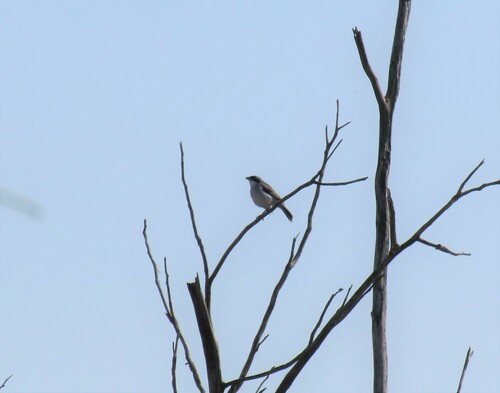 White-banded Tanager
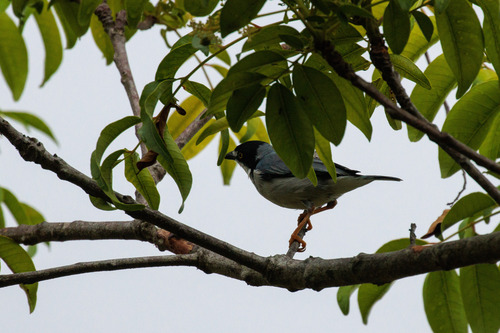 Hooded Tanager
In short
The most reliable field mark between White-banded Tanager and Hooded Tanager is the striking difference in head pattern: adult Hooded Tanager males have a jet-black hood with white lores and throat, while White-banded Tanager shows a shrike-like, more uniform pattern without such a hood. Females and immatures of Hooded Tanager lack the black hood but still differ in head and underpart tones. White-banded Tanager is notably larger and heavier-bodied, often seen in cohesive groups, while Hooded Tanager is smaller and more delicate. Juvenile and helper White-banded Tanagers can show brownish tones, which may cause confusion with immature Hooded Tanagers, but careful attention to head pattern and size will resolve most field encounters.
Identification tips
- Head pattern is key: Adult male Hooded Tanagers have a solid black hood with white lores and throat—no other tanager in this comparison shows this pattern. If you see a black-headed bird with white face patches, it's Hooded Tanager (male).
- Female and immature head color: Female Hooded Tanagers lack the black hood but have a grayish blue head matching the upperparts; White-banded Tanager of any age never shows this uniform blue-gray head.
- Juvenile confusion: Juvenile White-banded Tanagers (helpers) show brownish tones in the gray areas, sometimes misidentified as females. Hooded Tanager juveniles are pale blue above and bluish gray below, with rose-orange legs—look for these leg and underpart colors to separate.
- Underpart tones: White-banded Tanager has a more uniform, shrike-like gray and white pattern. Hooded Tanager females and immatures have a buff tinge to the white underparts, especially on the throat and breast.
- Bill color: Hooded Tanager males have a black bill; females have a black upper mandible and pale lower mandible. White-banded Tanager's bill is not described as distinctive, so use this mark with caution.
- Leg color: Hooded Tanager (especially juveniles) has yellow or yellow-brown (adults) or rose-orange (juveniles) legs and feet. White-banded Tanager's leg color is not described as diagnostic.
- Size and structure: White-banded Tanager is much larger and heavier-bodied than Hooded Tanager. If the bird looks notably stocky and long, suspect White-banded.
- Group size and behavior: White-banded Tanager is often in tight groups of 7 or more, sometimes with brownish helpers. Hooded Tanager is less likely to be in such large, cohesive groups.
- Sexual dimorphism: White-banded Tanager shows no sexual dimorphism—males and females look alike. Hooded Tanager is sexually dimorphic, with males showing the black hood.
- Plumage consistency: White-banded Tanager's plumage is consistent across sexes and ages (except for brownish juveniles/helpers), while Hooded Tanager varies by sex and age.
- Upperwing pattern: No distinctive upperwing or flight pattern marks are described for either species in these notes—do not rely on wing panels or trailing edges.
- Habitat overlap: Both species may occur in similar habitats, so do not rely on habitat alone for separation unless you have strong local knowledge.
- Vocalizations: Not described in these notes—do not use voice as a separator here.
- Seasonal context: White-banded Tanager breeds in October–November; Hooded Tanager's breeding season varies by region. Presence of helpers in White-banded Tanager groups may indicate breeding season.
- Pitfalls: Beware of brownish juvenile White-banded Tanagers and female Hooded Tanagers—always check head pattern, underpart tone, and size before concluding.
Size
White-banded Tanager is substantially larger and heavier (16 cm, 29–32 g) than Hooded Tanager (12–13.5 cm, 12–21 g) [wikipedia][wikidata]. In the field, White-banded Tanager will appear bulkier and longer-bodied, with a more robust jizz, while Hooded Tanager is noticeably smaller and lighter. This size difference is often apparent even at a distance, especially when both species are seen in the same habitat.
Plumage
- Juveniles and immatures: White-banded Tanager helpers (recent fledglings) have brownish areas replacing the adult's gray, which can be mistaken for a duller tanager. Hooded Tanager juveniles are pale blue above and bluish gray below, with rose-orange legs and feet—look for these leg colors and overall blue-gray wash to separate from brownish White-banded.
- Adult males: Hooded Tanager males are instantly separated by their solid black hood, contrasting sharply with white lores, throat, and sides of neck, and grayish blue upperparts. White-banded Tanager lacks any black hood or mask; its plumage is shrike-like, with gray and white but no sharply defined black head.
- Adult females: Female Hooded Tanager lacks the black hood but has a uniform grayish blue head and upperparts, with a buff tinge on the white underparts (especially throat and breast). White-banded Tanager females are identical to males, so no sexual dimorphism is present—look for the consistent shrike-like pattern.
- Bill and bare parts: Hooded Tanager males have a black bill, females a two-toned bill (black above, pale below); both sexes have yellow or yellow-brown legs and feet, while White-banded Tanager's bill and legs are not described as distinctive in these notes.
Behaviour
White-banded Tanager is typically seen in pairs or small, tight-knit groups (up to 12, average 7), often with cooperative helpers from previous broods [wikipedia]. This social structure can be a clue in the field. Hooded Tanager's social behavior is less described here, but it is not noted for such large, cohesive groups. Both species forage for insects, but White-banded Tanager's tendency to move as a group is a useful behavioral cue.
Habitat
Hooded Tanager is widespread across mainland South America except Chile, Ecuador, and Uruguay, and is found in a variety of habitats [wikipedia]. White-banded Tanager's range and habitat are not detailed in these notes, so habitat is not a strong separator unless local knowledge is applied.