

Motmot

White-backed Vulture vs Black Kite

Gyps africanus versus Milvus migrans

Play a quiz with White-backed Vulture and Black Kite
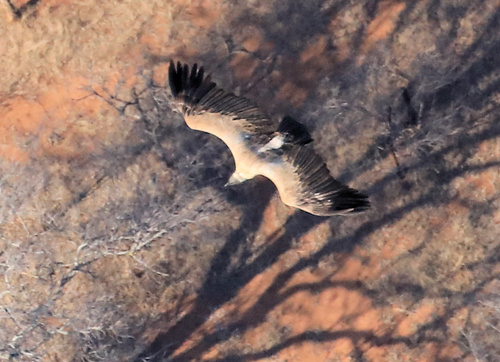
White-backed Vulture (Gyps africanus) White-backed Vulture
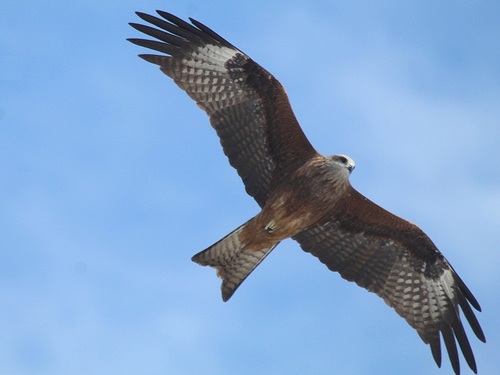
Black Kite (Milvus migrans) Black Kite

Media

Loading…

In short

The most reliable field mark to separate White-backed Vulture from Black Kite in the field is overall structure and flight profile: White-backed Vulture is much larger, with extremely broad wings, a short tail, and a distinct white back (adults), while Black Kite is a medium-sized raptor with narrower, more pointed wings and a long, shallowly forked tail. Juvenile White-backed Vultures are uniformly dark and lack the white back, which can cause confusion with Black Kite, but the vulture’s bulk, short tail, and slow, heavy flight remain distinctive. Black Kites show a more agile, buoyant flight and, especially in flight, the forked tail is often visible. Perched, the vulture’s bare head and neck ruff contrast with the kite’s feathered head and sleeker profile. Size difference is extreme and diagnostic at any distance.

Identification tips

  1. Size is the most immediate clue: White-backed Vulture is vastly larger than Black Kite; if you see both together, the difference is unmistakable. Even singly, a vulture will appear eagle-sized or larger, while a kite is much smaller.
  2. Wing shape and flight profile: Vultures have extremely broad, plank-like wings and a short, straight-edged tail; Black Kites have narrower, more pointed wings and a long, shallowly forked tail. In flight, the vulture’s wings look almost rectangular, while the kite’s are more angular and flexible.
  3. Tail shape: Black Kite shows a shallow fork in the tail, especially when fanned in flight or when gliding; White-backed Vulture’s tail is always short and squared off.
  4. Plumage (adult): Adult White-backed Vulture has a conspicuous white back and neck ruff, contrasting with dark wings and body; Black Kite is overall dark brown with a paler head and no white back.
  5. Plumage (juvenile/immature): Juvenile White-backed Vultures are mostly dark and lack the white back, but still have the vulture’s structure and bare head. Juvenile Black Kites are paler below with streaking, but always have a feathered head and kite-like proportions.
  6. Head and neck: Vultures have a bare, downy head and neck with a fluffy white ruff; kites have a fully feathered head and neck, with no ruff.
  7. Bill shape: Vulture’s bill is heavy, hooked, and pale at the base; kite’s bill is slimmer, all black, and less deeply hooked.
  8. Leg color: Black Kite has yellow legs and black claws; vulture’s legs are less conspicuous in the field, but are not bright yellow.
  9. Behavior at food: Vultures feed in large, aggressive groups at carcasses; kites are more solitary or in loose flocks, often picking up scraps or small prey.
  10. Habitat: Vultures are rarely seen in towns or cities; kites are common in urban and suburban areas, especially near water or refuse.
  11. Vocalizations: Black Kite gives a loud, whistling or whinnying call; White-backed Vulture is almost always silent.
  12. Flight style: Vultures soar with slow, heavy wingbeats and rarely flap; kites are more agile, often gliding, tilting, and flapping with quick, flexible wingbeats.
  13. Perched posture: Vultures appear hunched with a thick neck and short tail; kites are sleeker, with a longer tail and more upright stance.
  14. Social behavior: Both species can be seen in groups, but vulture gatherings are usually at carcasses, while kite flocks are more likely in flight or at roosts.
  15. Seasonality: In Africa, Black Kite numbers may increase in the dry season due to migrants; White-backed Vulture is resident but declining and now much less common than in the past.

Size

White-backed Vulture is truly massive compared to Black Kite: it weighs 4.2–7.2 kg and measures 78–98 cm in length with a wingspan up to 2.25 m [wikipedia], while Black Kite averages just 828 g and has a wingspan around 1.5 m [wikidata, wikipedia]. In the field, even a distant vulture will appear much larger and bulkier, with a heavier build and broader wings than any kite. The kite is only about the size of a large crow or small buzzard, while the vulture is eagle-sized or larger.

Plumage

Juvenile White-backed Vultures are mostly dark brown to blackish and lack the adult’s white back, which can make them superficially similar to Black Kites at a distance. However, even young vultures have a bare, downy head and neck, and their wings are proportionally broader and the tail much shorter and squarer than any kite. Adult White-backed Vultures show a striking white back and neck ruff contrasting with otherwise dark plumage, while Black Kites are overall dark brown with a paler head and neck, and never show a white back. In flight, Black Kites have a shallowly forked tail and dark outer primaries, with a streaked appearance below and no strong contrast on the back. The vulture’s wings are much broader and the tail is always short and straight-edged. Black Kite juveniles are paler below with streaking, but always show the kite’s typical wing and tail shape.

Behaviour

White-backed Vultures soar on thermals with slow, heavy, and steady wingbeats, often circling high in groups and descending en masse to carcasses. They are obligate scavengers, feeding almost exclusively on carrion, and are usually seen in open savannahs or near large animal herds. Black Kites are agile, buoyant fliers, often seen gliding, tilting, and maneuvering with quick wingbeats and frequent changes of direction. They are opportunistic and often seen near water, urban areas, or human settlements, scavenging a wide variety of food including small prey, fish, and refuse. Kites are also more likely to be seen alone or in loose flocks, sometimes hovering or swooping low.

Habitat

White-backed Vultures are most often found in wooded savannahs and open country where large mammals are present, rarely venturing into urban areas. They nest in large trees and are highly dependent on the availability of carcasses. Black Kites are more adaptable, found in a wide range of habitats including urban areas, wetlands, rivers, open country, and even near human habitation. In Africa, Black Kites are especially common in and around towns, cities, and rubbish dumps, where vultures are rare.

Voice

White-backed Vultures are generally silent, occasionally making hissing or grunting sounds at carcasses, but are not vocal in flight or at rest. Black Kites, by contrast, have a distinctive shrill whistle followed by a rapid, whinnying call, often heard when the bird is soaring or perched. If you hear a loud, whistling or whinnying call, it is almost certainly a Black Kite.

Submit a better description

Use the same sections as the comparison. Your text is published immediately.

The most reliable field mark to separate White-backed Vulture from Black Kite in the field is overall structure and flight profile: White-backed Vulture is much larger, with extremely broad wings, a short tail, and a distinct white back (adults), while Black Kite is a medium-sized raptor with narrower, more pointed wings and a long, shallowly forked tail. Juvenile White-backed Vultures are uniformly dark and lack the white back, which can cause confusion with Black Kite, but the vulture’s bulk, short tail, and slow, heavy flight remain distinctive. Black Kites show a more agile, buoyant flight and, especially in flight, the forked tail is often visible. Perched, the vulture’s bare head and neck ruff contrast with the kite’s feathered head and sleeker profile. Size difference is extreme and diagnostic at any distance.

  1. Size is the most immediate clue: White-backed Vulture is vastly larger than Black Kite; if you see both together, the difference is unmistakable. Even singly, a vulture will appear eagle-sized or larger, while a kite is much smaller.
  2. Wing shape and flight profile: Vultures have extremely broad, plank-like wings and a short, straight-edged tail; Black Kites have narrower, more pointed wings and a long, shallowly forked tail. In flight, the vulture’s wings look almost rectangular, while the kite’s are more angular and flexible.
  3. Tail shape: Black Kite shows a shallow fork in the tail, especially when fanned in flight or when gliding; White-backed Vulture’s tail is always short and squared off.
  4. Plumage (adult): Adult White-backed Vulture has a conspicuous white back and neck ruff, contrasting with dark wings and body; Black Kite is overall dark brown with a paler head and no white back.
  5. Plumage (juvenile/immature): Juvenile White-backed Vultures are mostly dark and lack the white back, but still have the vulture’s structure and bare head. Juvenile Black Kites are paler below with streaking, but always have a feathered head and kite-like proportions.
  6. Head and neck: Vultures have a bare, downy head and neck with a fluffy white ruff; kites have a fully feathered head and neck, with no ruff.
  7. Bill shape: Vulture’s bill is heavy, hooked, and pale at the base; kite’s bill is slimmer, all black, and less deeply hooked.
  8. Leg color: Black Kite has yellow legs and black claws; vulture’s legs are less conspicuous in the field, but are not bright yellow.
  9. Behavior at food: Vultures feed in large, aggressive groups at carcasses; kites are more solitary or in loose flocks, often picking up scraps or small prey.
  10. Habitat: Vultures are rarely seen in towns or cities; kites are common in urban and suburban areas, especially near water or refuse.
  11. Vocalizations: Black Kite gives a loud, whistling or whinnying call; White-backed Vulture is almost always silent.
  12. Flight style: Vultures soar with slow, heavy wingbeats and rarely flap; kites are more agile, often gliding, tilting, and flapping with quick, flexible wingbeats.
  13. Perched posture: Vultures appear hunched with a thick neck and short tail; kites are sleeker, with a longer tail and more upright stance.
  14. Social behavior: Both species can be seen in groups, but vulture gatherings are usually at carcasses, while kite flocks are more likely in flight or at roosts.
  15. Seasonality: In Africa, Black Kite numbers may increase in the dry season due to migrants; White-backed Vulture is resident but declining and now much less common than in the past.

White-backed Vulture is truly massive compared to Black Kite: it weighs 4.2–7.2 kg and measures 78–98 cm in length with a wingspan up to 2.25 m [wikipedia], while Black Kite averages just 828 g and has a wingspan around 1.5 m [wikidata, wikipedia]. In the field, even a distant vulture will appear much larger and bulkier, with a heavier build and broader wings than any kite. The kite is only about the size of a large crow or small buzzard, while the vulture is eagle-sized or larger.

Juvenile White-backed Vultures are mostly dark brown to blackish and lack the adult’s white back, which can make them superficially similar to Black Kites at a distance. However, even young vultures have a bare, downy head and neck, and their wings are proportionally broader and the tail much shorter and squarer than any kite. Adult White-backed Vultures show a striking white back and neck ruff contrasting with otherwise dark plumage, while Black Kites are overall dark brown with a paler head and neck, and never show a white back. In flight, Black Kites have a shallowly forked tail and dark outer primaries, with a streaked appearance below and no strong contrast on the back. The vulture’s wings are much broader and the tail is always short and straight-edged. Black Kite juveniles are paler below with streaking, but always show the kite’s typical wing and tail shape.

White-backed Vultures soar on thermals with slow, heavy, and steady wingbeats, often circling high in groups and descending en masse to carcasses. They are obligate scavengers, feeding almost exclusively on carrion, and are usually seen in open savannahs or near large animal herds. Black Kites are agile, buoyant fliers, often seen gliding, tilting, and maneuvering with quick wingbeats and frequent changes of direction. They are opportunistic and often seen near water, urban areas, or human settlements, scavenging a wide variety of food including small prey, fish, and refuse. Kites are also more likely to be seen alone or in loose flocks, sometimes hovering or swooping low.

White-backed Vultures are most often found in wooded savannahs and open country where large mammals are present, rarely venturing into urban areas. They nest in large trees and are highly dependent on the availability of carcasses. Black Kites are more adaptable, found in a wide range of habitats including urban areas, wetlands, rivers, open country, and even near human habitation. In Africa, Black Kites are especially common in and around towns, cities, and rubbish dumps, where vultures are rare.

White-backed Vultures are generally silent, occasionally making hissing or grunting sounds at carcasses, but are not vocal in flight or at rest. Black Kites, by contrast, have a distinctive shrill whistle followed by a rapid, whinnying call, often heard when the bird is soaring or perched. If you hear a loud, whistling or whinnying call, it is almost certainly a Black Kite.

Discard your changes?

You have unsaved edits. If you leave now, those changes will be lost.

White-backed Vulture · Black Kite · My Tricky Birds