

White-backed Mousebird vs Narina Trogon
Colius colius versus Apaloderma narina
Play a quiz with White-backed Mousebird and Narina Trogon
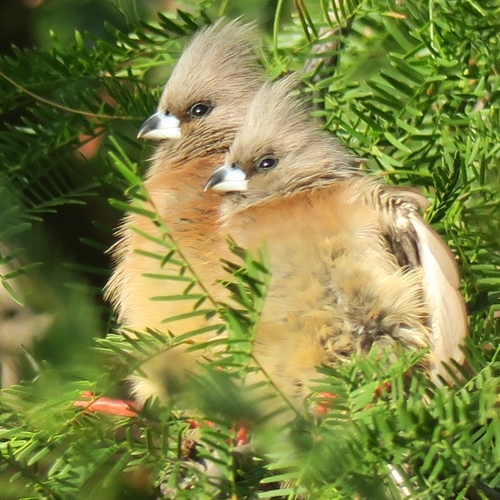 White-backed Mousebird
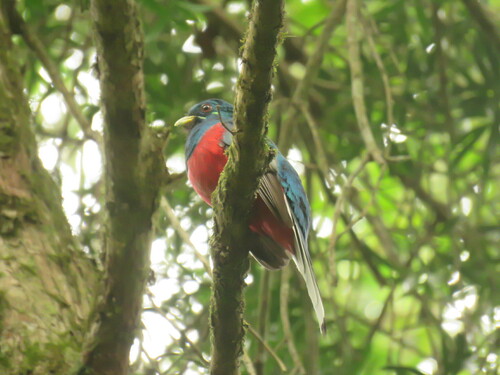 Narina Trogon
In short
The most reliable field mark to separate White-backed Mousebird from Narina Trogon is the presence of a bold white back stripe (flanked by black) on the mousebird, only visible when wings are open or partly spread; Narina Trogon never shows this. In perched views, the mousebird is a slim, long-tailed, grayish bird with a prominent crest and red legs, while the trogon is chunkier, with a short neck, vivid green upperparts, and (in males) bright red underparts. Mousebirds are social, parrot-like in posture, and favor dry scrub, whereas trogons are solitary, upright, and strictly forest birds. Juvenile/immature-specific wing marks are not described for mousebird, but Narina Trogon immatures show white tertial tips. If you see a bird with a metallic green tail, white undertail, and red belly, it is the trogon; if it has a long, graduated tail, gray crest, and white back stripe, it is the mousebird.
Identification tips
- White back stripe (mousebird only): Look for a bold white stripe flanked by black on the back, visible when the wings are open or partly spread (e.g., landing or in hot weather). Trogon never shows this.
- Tail shape and length: Mousebird has a very long, narrow, graduated tail (about half its body length); trogon's tail is shorter, broad, and has a metallic blue-green gloss with white tips/fringes underneath.
- Crest (mousebird only): Mousebird always shows a prominent, pointed crest; trogon has a smooth, rounded head with no crest.
- Plumage color: Mousebird is overall gray above with buff underparts and a maroon band at tail base; trogon is vivid green above, with males showing bright red underparts and females duller red. Mousebird never shows green or metallic colors.
- Bill color: Mousebird's bill is bluish-white with a black tip; trogon's is dark, with green bare skin at the gape (male) or blue orbital skin (female).
- Leg color: Mousebird has red legs and feet; trogon's legs are dark and not conspicuous.
- Undertail: Trogon shows a striking white undertail when perched, formed by white tips/fringes to outer tail feathers; mousebird's undertail is plain and lacks white.
- Juvenile/immature marks: Immature trogons have white tips to tertials (inner wing), useful if seen well; mousebird immatures lack distinctive wing marks.
- Social behavior: Mousebirds are almost always in small, active groups; trogons are solitary or in pairs.
- Perching posture: Mousebirds often hang or perch parrot-like, sometimes gripping different branches with each foot; trogons perch upright and motionless.
- Flight style: Mousebird flight is weak and undulating; trogon flies in short, direct bursts between perches.
- Habitat: Mousebirds are in dry, open scrub or semi-desert; trogons are in forests or dense woodland.
- Voice: Mousebird gives high, whistled and buzzing calls in groups; trogon gives a low, grating hoot, only by males.
- Sexual dimorphism: Only trogon shows strong male/female differences (male bright red below, female browner); mousebird sexes are similar.
- Context: If you see a bird feeding openly on fruit or flowers in a group, it's likely a mousebird; a solitary, motionless bird in forest is likely a trogon.
Size
White-backed Mousebird is slightly lighter (41.3g vs 61.0g [wikidata]) but appears longer (about 34 cm, with half of that being tail). Narina Trogon is about the same length (32–34 cm) but is much bulkier, with a stocky build, deep body, and a shorter, more squared-off tail. Mousebird's tail is extremely long and thin, making the bird look even more elongated, while trogon's tail is broad, with a metallic blue-green gloss and obvious white tips/fringes underneath.
Plumage
Juvenile/immature Narina Trogons have distinct white tips to the tertials (inner wing feathers), which can be a subtle but telling field mark if seen well; mousebird immatures are not described as having such marks. Adult White-backed Mousebird is gray above with a prominent white back stripe flanked by black, only visible with wings open or partly spread, and a maroon band at the tail base. The crest is always prominent. Underparts are buff, and the bill is bluish-white with a black tip; legs and feet are red. Narina Trogon adults are sexually dimorphic: both sexes have gingery green upperparts and metallic blue-green tails, but males have bright red underparts and green bare skin at the gape and around the eyes, while females are browner on the face/chest and have duller red below. The undertail is strikingly white in both sexes, especially from below. Immature trogons resemble females but with white tertial tips and less distinct bare skin coloration. Mousebirds lack any green, metallic, or red underparts, and never show a white undertail.
Behaviour
White-backed Mousebird is highly social, often seen in small, noisy groups, feeding together and preening each other. They perch almost parrot-like, sometimes hanging from branches, and are quick to flush or sit quietly if disturbed. Their flight is undulating and weak. Narina Trogon is solitary or in pairs, perches upright and motionless for long periods, and rarely joins mixed flocks. Trogons are usually quiet and unobtrusive, moving by short, direct flights between perches, and are rarely seen in open areas. Mousebirds often feed on fruit, buds, and flowers in the open, even on lawns; trogons feed mostly on insects and small vertebrates, rarely coming to the ground.
Habitat
White-backed Mousebird is found in dry, scrubby habitats such as thornveld, fynbos, and semi-desert across southern Africa, avoiding dense forests. Narina Trogon is strictly a forest and woodland species, ranging from lowland to montane forests across much of sub-Saharan Africa, and is never found in open scrub or semi-desert. If you are in thick forest, expect trogon; in dry, open country, expect mousebird.
Voice
White-backed Mousebird gives a whistled 'zwee-wewit' and various buzzing or crackling calls, often heard from groups keeping contact. Narina Trogon's call is a low, grating, repeated hoot, given only by males, usually in territorial or courtship contexts. Mousebird calls are higher-pitched and social; trogon calls are deeper, more resonant, and infrequent.