

Whiskered Tern vs White-winged Black Tern
Chlidonias hybrida versus Chlidonias leucopterus
Play a quiz with Whiskered Tern and White-winged Black Tern
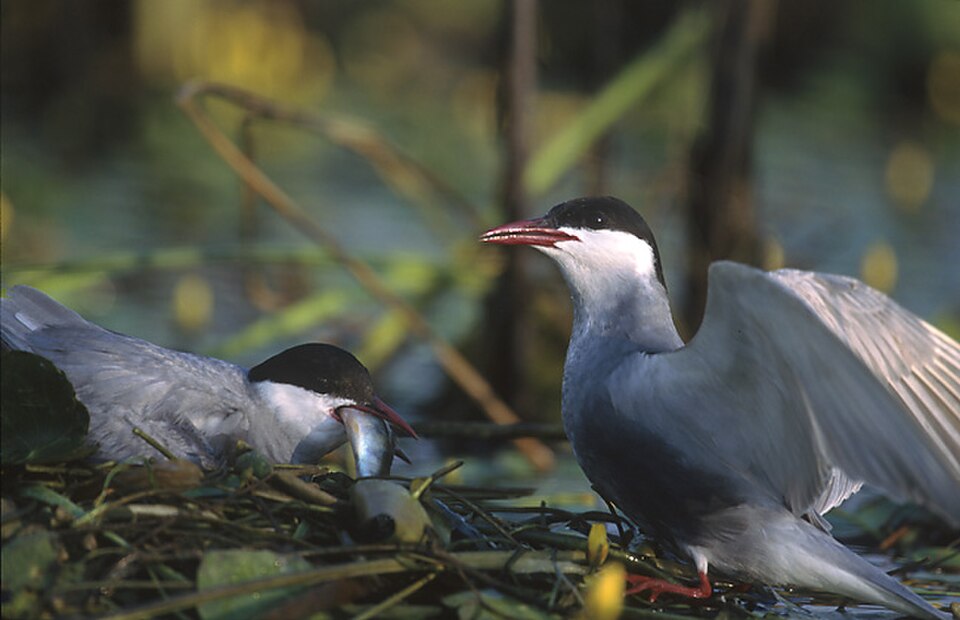 Whiskered Tern
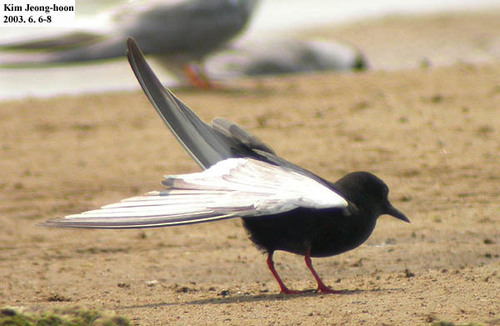 White-winged Black Tern
In short
Juvenile and first-winter Whiskered Tern and White-winged Black Tern can be tricky to separate, but the most reliable field mark is the upperwing and mantle pattern: juvenile Whiskered Tern shows a ginger, scaly back with broad buff edges, while juvenile White-winged Black Tern has a dark brown 'saddle' mantle sharply isolated by a clear white rump and collar. In adults, Whiskered Tern in breeding plumage is darker grey above and below, with white cheeks and a less defined collar, whereas White-winged Black Tern is strikingly black below with white wings and rump. Structurally, Whiskered Tern has a longer, stronger bill and a more forked tail, while White-winged Black Tern has a shorter, stubbier bill and a squarer tail. Both species overlap in habitat and have similar size, but careful attention to mantle, rump, and collar patterns—especially in flight—will resolve most confusion.
Identification tips
- Juvenile/First-winter mantle and rump: Juvenile Whiskered Tern shows a ginger, scaly back with broad buff edges on the mantle and scapulars, and a pale gray rump. Juvenile White-winged Black Tern has a dark brown 'saddle' mantle sharply set off by a clear white rump and collar. This is the most reliable mark in flight or perched.
- Collar and rump contrast (all ages): White-winged Black Tern always shows a broad, clear white collar and rump, isolating the dark mantle. Whiskered Tern's collar is less sharply defined, and the white on the nape may be incomplete or diffuse.
- Tail shape: Whiskered Tern has a short, forked-looking tail; White-winged Black Tern's tail is squarer, especially obvious in juveniles.
- Bill structure: Whiskered Tern's bill is longer and more robust (males 29–34 mm, females 25–27 mm), with a pronounced gonys; White-winged Black Tern's bill is short, stubby, and distinctly shorter than the head (22–25 mm). This is best seen at close range.
- Adult breeding underparts: Whiskered Tern is dark grey both above and below, with white cheeks and red bill/legs. White-winged Black Tern is black on the head, neck, and belly, with white wings and rump—a much more contrasting look.
- Cheek and ear-covert pattern: Whiskered Tern has white cheeks with black ear-coverts joined to the black hindcrown, forming a C-shaped band. White-winged Black Tern has a black head with a dark triangular patch forward of the eye and a white collar.
- Winter head pattern: Both species develop white foreheads and paler plumage, but Whiskered Tern's crown and hindcrown are flecked with white, while White-winged Black Tern retains more blackish feathers in the underwing-coverts and crown, and the collar remains broad and white.
- Leg color: Both species have red legs in summer, but this is not a strong separator.
- Flight jizz: Whiskered Tern may recall Common or Arctic Tern in flight due to its size, black cap, and strong bill, but the short, forked tail and overall dark grey plumage are distinctive. White-winged Black Tern's flight is more shallow and leisurely, with white wings and rump standing out.
- Face color in juveniles: Juvenile White-winged Black Tern's face is tinged yellowish, which can be a subtle but helpful mark.
- Underwing pattern: White-winged Black Tern retains blackish underwing-coverts in non-breeding plumage; Whiskered Tern does not show this feature.
- Mantle feather edges: Juvenile Whiskered Tern has broad buff edges and often subterminal bars on mantle feathers; White-winged Black Tern's mantle feathers have narrow pale brown tips.
- Bill color: Both species have dark bills, but Whiskered Tern's is longer and more pointed, especially in males.
- Voice: Only Whiskered Tern's 'krekk' call is described; not a strong separator unless heard clearly.
- Context: Both species can occur together, so do not rely on habitat or flock composition alone.
Size
Whiskered Tern is slightly heavier (body mass about 84 g [wikidata]), but both species are similar in overall size and shape. Whiskered Tern has a longer, more robust bill (males 29–34 mm, females 25–27 mm), while White-winged Black Tern's bill is distinctly shorter and stubbier (22–25 mm, shorter than the head) [wikipedia]. Tail shape also differs: Whiskered Tern's tail is short and forked, while White-winged Black Tern's tail is squarer, especially in juveniles.
Plumage
- Juvenile/First-winter:
- Whiskered Tern: Back and scapulars are dark brown with broad buff edges and often subterminal buff bars or centers, giving a ginger, scaly appearance. Mantle may show some new gray feathers early in fall. Rump is always pale gray. Cheeks are white, and the crown is flecked with white; hindcrown is more uniformly blackish.
- White-winged Black Tern: Mantle forms a dark brown 'saddle' sharply isolated by a clear white rump and collar. Mantle feathers have narrow pale brown tips. Tail is almost white and looks squarer. Head shows a dark triangular patch forward of the eye, and the face is tinged yellowish.
- Adult breeding:
- Whiskered Tern: Dark grey above and below, with white cheeks, a less sharply defined collar, and red legs and bill. Black cap extends to ear-coverts, forming a C-shaped band. Tail is short and forked.
- White-winged Black Tern: Black head, neck, and belly; white wings and rump; back is very dark grey. Bill is short and black, legs are short and red. Collar is broad and white, isolating the dark mantle.
- Non-breeding/winter:
- Both species develop white foreheads and paler body plumage. Whiskered Tern's crown and hindcrown are flecked with white; White-winged Black Tern retains some blackish feathers in the underwing-coverts and crown, but the collar remains broad and white, and the rump stays pale gray.
Behaviour
Both species are marsh terns and feed mainly by flying slowly over water to pick insects and small fish from the surface, rather than plunge-diving. White-winged Black Tern's flight is described as shallow and leisurely. Both species breed in colonies, often in similar wetland habitats, and may be seen foraging together during migration or in mixed flocks.
Habitat
Both species are closely associated with freshwater wetlands, marshes, and lakes across Europe, Asia, Africa, and Australia [wikipedia]. They often overlap in breeding and wintering grounds, so habitat alone is not a reliable separator. Whiskered Tern may be more likely to breed among Black-headed Gulls, but this is not a strong field mark.
Voice
Whiskered Tern gives a characteristic 'krekk' call. No distinctive vocalization is described for White-winged Black Tern in the sources, so voice is not a reliable separator in the field.