
Whimbrel vs Wilson's Snipe
Numenius phaeopus versus Gallinago delicata
Play a quiz with Whimbrel and Wilson's Snipe
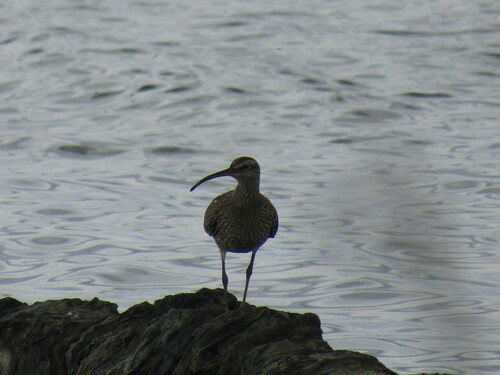 Whimbrel
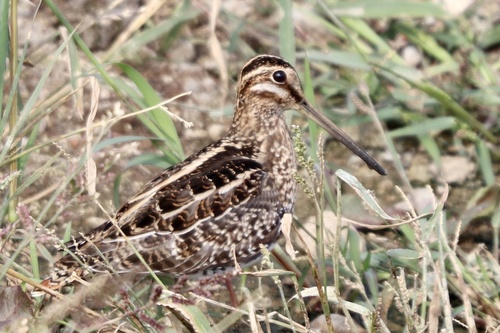 Wilson's Snipe
In short
The most reliable field mark to separate Whimbrel from Wilson's Snipe is size and structure: Whimbrel is a much larger, lankier bird with a long, strongly downcurved bill, while Wilson's Snipe is compact and short-billed by comparison. In flight, Whimbrel (in Eurasia) shows a conspicuous white rump and lower back, while Wilson's Snipe lacks this and instead has a mottled brown back. Whimbrel's flight is steady and direct, whereas snipe are fast, erratic, and zigzagging. If you see a large shorebird with a long, kinked bill and a white rump flashing in flight, it's a Whimbrel; a small, dumpy bird with a straight bill and no white rump is a Wilson's Snipe. Both can be brown and streaky on the ground, but the difference in size and bill shape is always clear.
Identification tips
- Size and shape: Whimbrel is much larger and lankier than Wilson's Snipe. If you see a shorebird the size of a small gull, it's not a snipe.
- Bill shape: Whimbrel's bill is very long and strongly downcurved with a kink, visible at any angle. Wilson's Snipe has a straight, thick bill, long for its body but much shorter than Whimbrel's.
- Flight rump pattern: In Eurasian Whimbrel (N. p. phaeopus, N. p. alboaxillaris), the white rump and lower back flash in flight—this is never present in Wilson's Snipe, which has a brown, streaked back and rump.
- Wing pattern in flight: Wilson's Snipe has a narrow white trailing edge to the wing, but this is subtle and easily missed; Whimbrel lacks this, but the white rump is far more obvious.
- Head pattern: Both have pale supercilia and crown stripes, but Wilson's Snipe's head is more boldly patterned with strong contrast, while Whimbrel's is plainer and the stripes are less sharply defined.
- Body shape on ground: Whimbrel stands tall, with long legs and neck; Snipe is squat, short-legged, and often crouched.
- Behavior when flushed: Whimbrel takes off with steady, direct flight; Snipe explodes from cover with a rapid, zigzagging, erratic flight path.
- Habitat: Whimbrel favors open mudflats, beaches, and grasslands; Snipe is almost always in dense marsh, wet meadows, or grassy edges of water.
- Voice: Whimbrel's call is a rippling whistle or trill; Snipe gives a sharp 'scaipe' call when flushed and, in display, a winnowing sound. If you hear the winnowing, it's a snipe.
- Tail shape and display: Snipe males perform 'winnowing' display flights with tail feathers; Whimbrel does not.
- Group size: Whimbrel may be seen in loose flocks, especially on migration; Snipe are usually solitary or in small groups, and much more secretive.
- Leg color: Snipe has short greenish-grey legs; Whimbrel's legs are longer and duller.
- Feeding behavior: Whimbrel probes mud or sand with a sweeping motion; Snipe probes in soft ground, often hidden in vegetation.
- Juvenile/immature confusion: Both species' young look similar to adults in structure; the white rump in Whimbrel is present at all ages for the relevant subspecies, so this mark is always reliable.
- Geographic context: In Eurasia, a white-rumped whimbrel is the local species; in North America, beware Hudsonian Whimbrel (which lacks the white rump), but Wilson's Snipe never shows a white rump.
Size
Whimbrel is dramatically larger: 37–47 cm (15–19 in) long, 75–90 cm (30–35 in) wingspan, and 270–493 g (9.5–17.4 oz) in weight [wikipedia][avonet]. Wilson's Snipe is much smaller: 23–28 cm (9.1–11.0 in) long, 39–45 cm (15–18 in) wingspan, and 79–147 g (2.8–5.2 oz) [wikipedia][avonet]. Even at a distance, Whimbrel's size and long-legged, long-necked look stand out, while Wilson's Snipe is squat and short-legged. The bills are also proportionally different: Whimbrel's is long, slender, and strongly decurved with a kink; Wilson's Snipe's is long for its body but straight and thick.
Plumage
The most diagnostic plumage difference is in flight: adult and immature Eurasian Whimbrel (N. p. phaeopus, N. p. alboaxillaris) show a striking white rump and lower back, contrasting with the brown upperparts and visible even at distance [wikipedia]. Wilson's Snipe never shows a white rump; its back is mottled brown with no strong contrast to the rump. On the ground, Whimbrel is overall greyish-brown with a pale supercilium and crown stripes, but appears plainer and larger. Wilson's Snipe is intricately patterned with bold pale and dark stripes on the head and back, and a narrow white trailing edge to the wing (seen in flight, but much less obvious than Whimbrel's white rump). Juvenile and adult snipes look similar, with no strong age-related flight marks. Whimbrel's white rump is present in all ages for the relevant subspecies. Bill color is not a reliable separator, but bill shape is: Whimbrel's is always long and decurved, Snipe's is straight.
Behaviour
Whimbrel typically walks steadily on open mudflats, beaches, or grasslands, probing for food with its long bill. In flight, it is direct and strong, often in loose groups. Wilson's Snipe is secretive, often crouched or hiding in wet grass or marsh, flushing only when approached closely. Its flight is rapid, zigzagging, and erratic, often accompanied by a sharp call. During display, male snipe perform 'winnowing' flights, producing a distinctive sound with their tail feathers. Whimbrel does not perform such displays.
Habitat
Whimbrel is found in open coastal habitats, mudflats, estuaries, and sometimes inland grasslands, especially on migration. It is rarely found in dense marsh or wet grassland. Wilson's Snipe prefers freshwater marshes, wet meadows, bogs, and grassy edges of ponds—habitats with dense cover and soft ground for probing. While both may be seen near water, Whimbrel is much more likely on open mud or sand, Snipe in grassy or marshy cover.
Voice
Whimbrel's call is a rippling whistle, often prolonged into a trill, and is distinctive if heard. Wilson's Snipe gives a sharp, harsh 'scaipe' call when flushed, and males produce a 'winnowing' sound in display flights, reminiscent of a Boreal Owl. The vocalizations are quite different, but both species may be silent when feeding.