

Whimbrel vs Slender-billed Curlew
Numenius phaeopus versus Numenius tenuirostris
Play a quiz with Whimbrel and Slender-billed Curlew
 Whimbrel
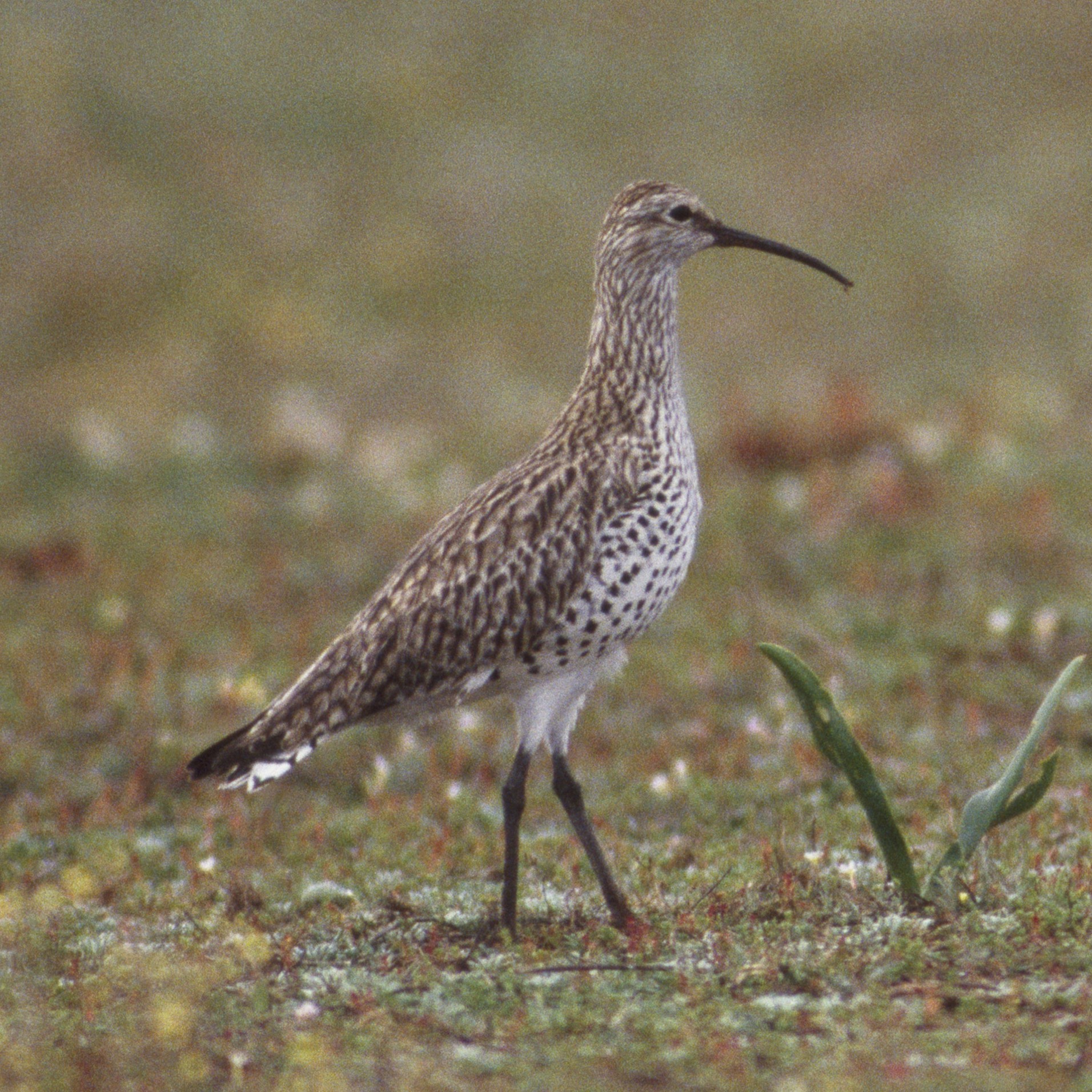 Slender-billed Curlew
In short
The most reliable field mark to separate Whimbrel from Slender-billed Curlew is the head and flank pattern: Whimbrel shows a bold head pattern with a central crown stripe and strong supercilium, while Slender-billed Curlew has a less distinct head pattern and, in adults, distinctive round or heart-shaped flank spots. In flight, both show a white rump, but Slender-billed Curlew is whiter below and on the tail, with fewer tail bars and a more uniform dark 'hand' (outer primaries) underneath. Bill shape also helps: Whimbrel's bill is longer and more obviously kinked, while Slender-billed Curlew's is shorter, more slender, and straighter at the base. Both are similar in size, but context and age-specific plumage details are crucial for confident identification.
Identification tips
- Head pattern: Whimbrel shows a bold, contrasting head pattern with a strong whitish supercilium, dark crown, and a central pale crown stripe. Slender-billed Curlew's head is less distinctly marked, lacking the clear central crown stripe and with a less obvious supercilium. This is most useful in perched or feeding birds.
- Flank markings (adults): Adult Slender-billed Curlew has round or heart-shaped black spots on the flanks, while Whimbrel has only streaks or bars, never spots. In juveniles and first-winters, Slender-billed Curlew shows only streaking until the first post-juvenile moult.
- Underwing and primaries (all ages): In flight, Slender-billed Curlew shows a uniformly dark underside to the outer 4–6 primaries ('hand'), a key field mark. Whimbrel does not show this feature; its underwing is more patterned.
- Tail pattern: Slender-billed Curlew has a whiter tail with fewer, less distinct dark bars compared to Whimbrel, which has a more heavily barred tail.
- Rump: Both species show a white rump in flight (Eurasian Whimbrel and Slender-billed Curlew), so this is not diagnostic between them, though it separates both from New World Hudsonian Whimbrel.
- Bill shape: Whimbrel's bill is long, strongly decurved with a noticeable kink. Slender-billed Curlew's bill is shorter, more slender, and straighter at the base, especially in males (females are longer-billed but still less kinked than Whimbrel).
- Leg color: Slender-billed Curlew adults have black legs; juveniles and first-years have at least darker grey legs. Whimbrel's leg color is not specified as diagnostic, but is not described as black.
- Underparts: Slender-billed Curlew is whiter below, especially on the breast, tail, and underwing, compared to Whimbrel, which is more evenly streaked and less white overall.
- Supercilium and crown stripe: Whimbrel's supercilium is strong and the crown stripe is obvious; Slender-billed Curlew's are faint or absent, making the head look plainer.
- Sex differences: Female Slender-billed Curlew has a longer bill than male, but both sexes are similar in plumage. Whimbrel shows little sexual dimorphism in the field.
- Age pitfalls: Juvenile Slender-billed Curlew lacks the diagnostic heart-shaped flank spots, so beware confusing streaked-flank juveniles with Whimbrel. Use underwing and head pattern in these cases.
- Habitat/context: Any curlew-like bird seen in Eurasia today is overwhelmingly likely to be a Whimbrel; Slender-billed Curlew is considered extinct, so claims require exceptional evidence.
- Flight jizz: Both species are similar in flight, but look for the combination of underwing pattern, tail barring, and head pattern for best separation.
- Voice: Only Whimbrel's call is described; if you hear a rippling whistle or trill, it supports Whimbrel but does not rule out Slender-billed Curlew.
- Season: Heart-shaped flank spots in Slender-billed Curlew only appear after the first winter, so do not rely on this mark for juveniles seen in autumn or early winter.
Size
Both species are very similar in size: Whimbrel measures 37–47 cm in length with a 75–90 cm wingspan, while Slender-billed Curlew is 36–41 cm long with a 77–88 cm wingspan. Mass is not diagnostic in the field. Overall, size alone will not reliably separate these two species, especially at a distance or in mixed flocks.
Plumage
-
Juvenile/First-winter: Juvenile Slender-billed Curlew resembles adults but lacks the distinctive heart-shaped flank spots, showing instead brown streaking on the flanks. These spots develop toward the end of the first winter. The underwing is white, but this is not as reliable as a field mark as sometimes suggested. The underside of the outer primaries (the 'hand') is uniformly dark in Slender-billed Curlew (4–6 feathers), which is a key mark for all ages, especially in flight. Whimbrel juveniles and adults do not show this feature and have a more patterned underwing.
-
Adult breeding: Whimbrel is mainly greyish brown above with a white back and rump (in Eurasian birds), and a strongly marked head pattern (bold supercilium, dark crown with a central pale stripe). Underparts are streaked but lack the round/heart-shaped spots of adult Slender-billed Curlew. Slender-billed Curlew adults are also greyish brown above with a whitish rump and lower back, but the underparts are whiter and heavily streaked, with distinctive round or heart-shaped spots on the flanks. The tail is whiter with fewer dark bars than Whimbrel.
-
Non-breeding: Slender-billed Curlew non-breeding plumage is similar to breeding but with fewer flank spots. Whimbrel's non-breeding plumage is not markedly different from breeding, but the head pattern remains strong.
Behaviour
No diagnostic behavioral differences are noted in the sources. Both species feed by probing mud for invertebrates and may be seen picking prey from the surface. Flight and foraging behavior are not reliably different in the field.
Habitat
Both species historically occurred in Eurasian wetlands, but Slender-billed Curlew is now considered extinct and was always much rarer. Whimbrel is widespread across subarctic and temperate Eurasia, breeding in open tundra and moorland, while Slender-billed Curlew bred mainly in the Kazakh Steppe and wintered around the Mediterranean in shallow freshwater habitats. In the modern context, any curlew-like bird seen in Europe is almost certainly a Whimbrel, as Slender-billed Curlew is functionally extinct.
Voice
Only Whimbrel's call is described: a rippling whistle, sometimes prolonged into a trill. No details are given for Slender-billed Curlew's vocalizations, so voice is not a reliable separator based on current information.