

Whimbrel vs Little Whimbrel
Numenius phaeopus versus Numenius minutus
Play a quiz with Whimbrel and Little Whimbrel
 Whimbrel
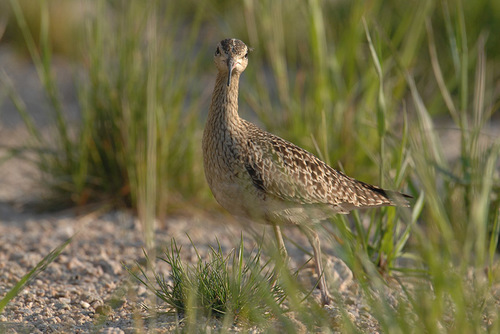 Little Whimbrel
In short
The most reliable field mark to separate Whimbrel from Little Whimbrel is size: Little Whimbrel is much smaller and more delicate, with a notably shorter bill. In flight, Whimbrel (Eurasian) shows a distinctive white rump and lower back, while Little Whimbrel lacks this, appearing uniformly greyish-brown above. Both species share a similar head pattern with crown and superciliary stripes, which can mislead at a distance. Structure, especially bill length and body proportions, is crucial for separation, especially when birds are not in direct comparison.
Identification tips
- White rump in flight (Whimbrel only): Eurasian Whimbrel shows a bright white rump and lower back in flight, a key mark at all ages. Little Whimbrel lacks this, appearing plain greyish-brown above.
- Size and structure: Little Whimbrel is much smaller and more delicate, with a compact, round body and short legs. Whimbrel is large and rangy, with a longer neck and legs. Use this even at a distance, especially if other waders are present for scale.
- Bill length and shape: Whimbrel has a long, strongly decurved bill with a noticeable 'kink,' while Little Whimbrel's bill is much shorter (for a curlew), only gently downcurved, and looks proportionally small for the genus. This is reliable at all ages and seasons.
- Head pattern: Both species have a dark crown with a pale central stripe and strong supercilium, so this is not a safe separator. However, Whimbrel's head may look broader and the pattern more contrasting due to its size.
- Underwing and belly: Little Whimbrel has greyish-brown underwings and a clean white belly, while Whimbrel is darker below with more streaking on the breast and flanks. This is subtle but can help at close range.
- Flight style: Whimbrel flies with slow, deep wingbeats and appears heavy. Little Whimbrel is quicker and more agile, sometimes resembling a large sandpiper or godwit in flight.
- Feeding behavior: Little Whimbrel is more active and runs quickly, picking at food, while Whimbrel moves more slowly and probes deeply.
- Habitat context: Little Whimbrel prefers short grass, floodplains, and meadows on passage, while Whimbrel is more often on open moorland, tundra, or coastal mudflats. If seen in grassy inland habitat, consider Little Whimbrel, but check for vagrancy.
- Voice: Whimbrel's call is a rippling, trilled whistle; Little Whimbrel's is a repetitive, simpler whistle. Use with caution unless familiar with both.
- Direct comparison: If both species are present, the size, bill length, and rump pattern differences are unmistakable. If alone, rely on structure and flight marks.
- Juvenile/immature plumage: No distinctive upperwing or age-specific marks are noted for either species, so focus on rump and structure for all ages.
- Pitfalls: Do not rely on head pattern alone; both species are similar here. Beware of Whimbrel in poor light or distant views appearing smaller or paler than they are.
- Season/sex: No significant seasonal or sexual dimorphism is noted for either species in the sources, so all tips apply year-round.
- Geographic context: Whimbrel is widespread; Little Whimbrel is much rarer outside its migration corridor. Use range as a supporting clue, not a primary separator.
- When in doubt: Prioritize rump pattern in flight, overall size, and bill length for the most reliable separation.
Size
Whimbrel is substantially larger, measuring 37–47 cm in length and 75–90 cm in wingspan, while Little Whimbrel is only 28–31 cm long with a 68–71 cm wingspan. Whimbrel is also heavier (270–493 g) compared to Little Whimbrel (about 172–175 g). In the field, Little Whimbrel looks noticeably daintier, with a smaller, rounder body and shorter legs and bill. If seen together, the size difference is striking, but even singly, Little Whimbrel's proportions are more reminiscent of a large sandpiper than a typical curlew.
Plumage
For all ages, the most diagnostic plumage feature is the rump and lower back in flight: Whimbrel (Eurasian) shows a strong white rump and lower back, contrasting with the rest of the upperparts, while Little Whimbrel lacks this and appears plain greyish-brown above. Both species have a similar head pattern with dark crown stripes and a pale supercilium, which can cause confusion when seen head-on or at rest. Little Whimbrel is generally paler below, with a white belly, and its underwings are also greyish-brown, lacking any strong contrast. Whimbrel is overall darker and bulkier, with more extensive streaking on the breast and flanks. There are no notes on age-specific upperwing patterns for either species, so focus on rump and structure for all ages.
Behaviour
Both species are waders and feed by probing mud for invertebrates, but Little Whimbrel often appears more active and 'nervous,' running and picking more like a large sandpiper. Whimbrel is slower and more methodical, with a heavier gait. In flight, Whimbrel's larger size and longer wings give it a more ponderous, curlew-like flight, while Little Whimbrel is quicker and more agile, sometimes recalling godwits or large Tringa sandpipers.
Habitat
Whimbrel breeds across the subarctic Palearctic and is widespread in Europe and Asia, often found on open moorland, tundra, and coastal mudflats. Little Whimbrel breeds in the far north of Siberia and is much more restricted in range, typically seen on migration in grassy floodplains, wet meadows, or short turf—habitats more like those used by smaller waders than by large curlews. If context is known, Little Whimbrel is much less likely outside its migration corridor.
Voice
Whimbrel gives a rippling, prolonged whistle, often trilled, which is distinctive and carries far. Little Whimbrel's call is a repetitive, simpler whistle. Both calls are high-pitched but Whimbrel's is more complex and musical, while Little Whimbrel's is shorter and less varied. Voice is helpful if the birds are calling, but not always diagnostic at distance or for inexperienced listeners.