

Western Subalpine Warbler vs Marmora's Warbler
Curruca iberiae versus Curruca sarda
Play a quiz with Western Subalpine Warbler and Marmora's Warbler
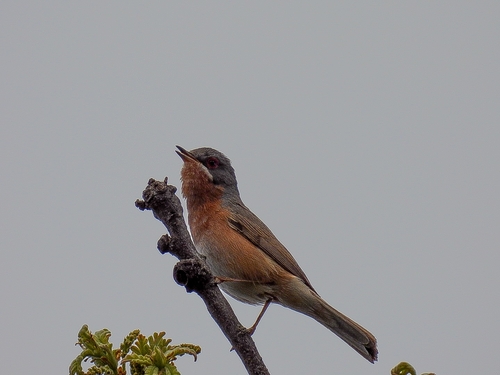 Western Subalpine Warbler
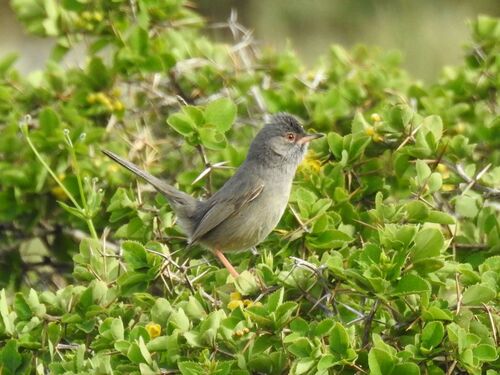 Marmora's Warbler
In short
The most reliable way to separate Western Subalpine Warbler from Marmora's Warbler is by underpart color: adult male Western Subalpine Warblers show brick-red underparts and white malar streaks, while Marmora's Warbler is uniformly grey below with no reddish wash. Females and immatures are trickier, but Marmora's is always greyish below, whereas female Western Subalpine Warblers are brownish above with a pinkish or whitish flush below. Marmora's Warbler also has a red iris and legs in adults, while Western Subalpine Warbler's eye color is not noted as distinctive. Both species are small, long-tailed warblers with similar overall structure and a fast rattling song, so careful attention to plumage and soft part color is essential.
Identification tips
- Adult male underparts: The most straightforward field mark is the underpart color. Western Subalpine Warbler males show brick-red underparts, while Marmora's Warbler males are uniformly grey below. This is diagnostic in spring and early summer.
- White malar streaks: Adult male Western Subalpine Warbler has prominent white 'moustache' marks, which Marmora's lacks. Look for these on perched birds or in good light.
- Iris and leg color: Marmora's Warbler adults have a red iris and red legs, which are visible at close range or in photographs. Western Subalpine Warbler does not have a red iris or legs; this is especially useful if underpart color is obscured.
- Female/immature underparts: Female Western Subalpine Warbler is brown above with a pinkish or whitish flush below. Marmora's Warbler (including immatures) is always grey below, with a paler throat but no pink or brick-red tones. This is subtle but can be seen in good light.
- Head and back color: Western Subalpine Warbler males have a grey back and head, contrasting with brick-red underparts. Marmora's Warbler is grey both above and below, with no strong contrast.
- Forehead and lores: Marmora's Warbler males show darker patches on the forehead and between the eye and bill, which are not present on Western Subalpine Warbler.
- Song: Both species have a fast rattling song, so do not rely on vocalizations for separation.
- Structure: Both are small, long-tailed, large-headed warblers. Structure is not helpful for separation.
- Habitat and range: If you are on Sardinia or Corsica, Marmora's is much more likely. On the mainland or in north-west Africa, Western Subalpine is expected. However, vagrancy is possible, so always check plumage.
- Immature confusion: Marmora's Warbler immatures can be confused with young Dartford Warbler, but not with Western Subalpine, as they lack any pinkish or brick-red tones below.
- Perched vs. in flight: No distinctive wing or tail pattern is described for either species, so focus on underpart color and soft part color even in flight views.
- Pitfalls: In poor light, the brick-red underparts of Western Subalpine can look dull or greyish, so always try to get multiple angles and check for white malar streaks or red iris.
- Soft part color in immatures: While red iris is a good mark for adult Marmora's, immatures have a dark iris, so this mark is less useful in young birds.
- Seasonal variation: Both species show their most distinctive features in spring and early summer. In autumn, worn or fresh plumage may obscure some marks, so extra care is needed.
- Photographic checks: If uncertain in the field, photos can help confirm underpart color, malar streaks, and iris color, especially when reviewing later.
Size
Both species are small warblers of similar build, with Marmora's Warbler recorded at 10.5g adult mass [wikidata]. No direct mass is given for Western Subalpine Warbler, but structurally they are comparable: both are small, long-tailed, and large-headed for their group. Size is not a reliable field mark between these two.
Plumage
- Adults (breeding males): Western Subalpine Warbler males have a grey back and head, brick-red underparts, and distinctive white malar streaks ('moustaches'). Marmora's Warbler males are grey above and below, lacking any brick-red tones, but show darker patches on the forehead and lores, with red legs and iris.
- Females: Female Western Subalpine Warbler is brown above (greyer head), whitish below with a pink flush. Female Marmora's Warbler is not described in detail, but immatures are grey below, not pinkish or brick-red.
- Immatures/juveniles: Marmora's Warbler immatures are grey below with a paler throat, and can be confused with young Dartford Warblers, but not with the brick-red/pinkish tones of Western Subalpine. No specific juvenile wing pattern is described for either species, so upperwing pattern is not diagnostic.
- Soft parts: Marmora's Warbler adults have red legs and iris; Western Subalpine Warbler does not have a noted red iris or legs.
Behaviour
Both species are active, long-tailed warblers, often seen flitting through low vegetation. No specific behavioral differences are noted in the sources; both can appear restless and are often detected by their song. Jizz is similar and not a reliable separator.
Habitat
Western Subalpine Warbler breeds in southernmost Europe and north-western Africa, typically in Mediterranean scrub. Marmora's Warbler is not described in detail here, but is known to be restricted to Mediterranean islands (notably Sardinia and Corsica) and similar scrubby habitats. Overlap is possible in Mediterranean scrub, but Marmora's is much more localized and insular.
Voice
Both species have a fast, rattling song. Western Subalpine Warbler's song is described as similar to Lesser Whitethroat. Marmora's Warbler's song is also a fast rattle. Song alone is not a reliable separator between these two.
Western Subalpine Warbler · Marmora's Warbler · My Tricky Birds