

Western Orphean Warbler vs Eastern Orphean Warbler
Curruca hortensis versus Curruca crassirostris
Play a quiz with Western Orphean Warbler and Eastern Orphean Warbler
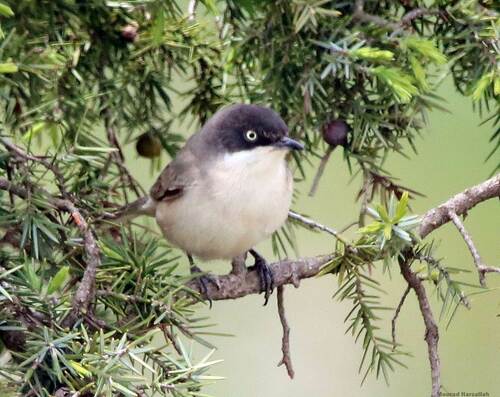 Western Orphean Warbler
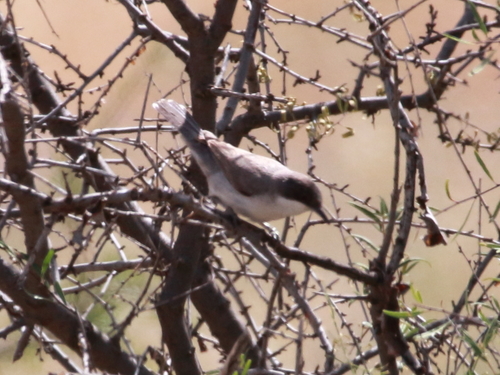 Eastern Orphean Warbler
In short
Western and Eastern Orphean Warblers are extremely similar in the field, especially in adult plumage, and are best separated by subtle differences in underpart coloration in females and immatures, and by song quality in males. Juvenile and immature birds of both species show a grey back with a brownish tinge and a pale head, but Western tends to have buff underparts, while Eastern shows reddish tones. Adult males are nearly indistinguishable visually, but the Eastern's song is notably richer and more varied. Structural features, iris color by age, and size are not reliable for separation.
Identification tips
- Juvenile/immature underparts: In fresh juvenile and first-year birds, look closely at the underpart color: Western Orphean Warbler tends to show buff tones, while Eastern is more reddish. This is the most reliable plumage clue for non-adults.
- Adult male plumage: Adult males of both species are nearly identical—plain grey back, dark grey head with black eye mask, white throat, and white iris. Visual separation is not possible in the field for this age/sex.
- Female/immature head and back: Both have a paler head and a grey back with a brownish tinge; this is not diagnostic. Focus on underpart color instead.
- Iris color by age: Both species have a dark iris in juveniles/immatures and white in adults. This helps age the bird but not separate the species.
- Bill and leg color: Both have long, pointed bills and black legs. These are not useful for separation.
- Song: The best field mark for adult males is the song: Eastern Orphean Warbler's song is more varied and richer, sometimes reminiscent of a Nightingale, while Western's is simpler. Use this when birds are singing.
- Habitat and range: If you are in western Europe or northwest Africa, Western is more likely; in the Balkans, Turkey, Caucasus, or Central Asia, Eastern is more likely. In the eastern Mediterranean, both may occur, so do not rely solely on location.
- Flight and wing pattern: No distinctive upperwing or flight pattern differences are described for any age; do not use wing pattern to separate these species.
- Size and structure: Both are large warblers (15–16 cm), slightly bigger than Blackcap, with similar structure. Size is not a field mark.
- Voice (calls): Both give scolding notes, which are not described as different; use song rather than call for identification.
- Feeding behavior: Both are primarily insectivorous and forage in similar ways; behavior is not diagnostic.
- Pitfalls: Do not rely on subtle differences in back color, head pattern, or iris color alone. Only the underpart tone in immatures/females and song in males are reliable.
- Seasonal context: In autumn, when juveniles and immatures are present, focus on underpart color. In spring/summer, listen for song.
- Mixed flocks: If both species occur in your area, use a combination of underpart color (for immatures/females) and song (for males) for best results.
- Uncertainty: If you cannot hear the song and the underpart color is ambiguous, it may not be possible to safely identify the bird to species in the field.
Size
Both species are among the largest typical warblers, measuring 15–16 cm in length—slightly larger than a Blackcap. No consistent differences in size, bill length, or leg color are noted between Western and Eastern Orphean Warblers. Both have long, pointed bills and black legs. Size is not a useful field mark for separation. [wikipedia]
Plumage
Juveniles and immatures of both species have a grey back with a brownish tinge and a paler head, but Western Orphean Warbler typically shows buff underparts, while Eastern Orphean Warbler has reddish underparts. Both have a dark iris when young, turning white in adults. Adult males of both species are extremely similar: plain grey back, dark grey head with a black eye mask, white throat, and white iris. Females and immatures are best separated by underpart tone: buff (Western) vs reddish (Eastern). No distinctive upperwing or flight pattern differences are described for any age. [wikipedia]
Behaviour
Both species forage in open deciduous woodland, often in bushes or trees, and are insectivorous (though one source mentions nectarivory for Eastern, this is likely an error or minor dietary difference). Their general behavior and jizz are not distinct enough for reliable separation in the field. [wikipedia]
Habitat
Habitat preferences are nearly identical: both breed in open deciduous woodland, often near the Mediterranean. Western Orphean Warbler ranges through western Europe and northwest Africa, while Eastern Orphean Warbler is found from the Balkans through Turkey and into Central Asia. In areas of overlap (eastern Mediterranean), range may not be diagnostic without precise locality. [wikipedia]
Voice
Both species give a series of warbling 'liroo-liroo' and scolding notes, but the Eastern Orphean Warbler's song is more varied and richer, approaching the Nightingale in complexity. This is the most reliable distinction in the field, especially for singing males. The Western's song is simpler and less varied. [wikipedia]
Western Orphean Warbler · Eastern Orphean Warbler · My Tricky Birds