

Western Crested Guineafowl vs Southern Crested Guineafowl
Guttera verreauxi versus Guttera edouardi
Play a quiz with Western Crested Guineafowl and Southern Crested Guineafowl
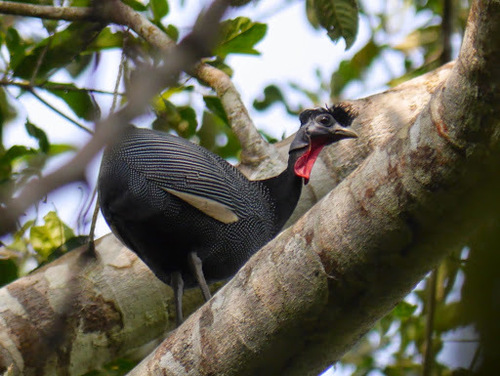 Western Crested Guineafowl
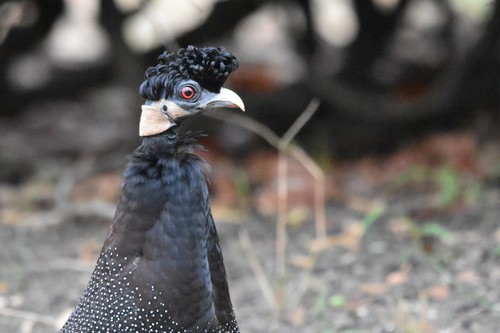 Southern Crested Guineafowl
In short
Western Crested Guineafowl and Southern Crested Guineafowl are extremely similar in the field, both showing blackish plumage densely marked with white spots and a prominent black crest. The most reliable way to separate them is by geographic range: Western Crested occurs from West Africa east to Kenya and south to Angola, while Southern Crested is found from Tanzania south to South Africa. Structural and plumage differences are minimal and not reliably diagnostic in the field, especially as both species share the same size, overall shape, and spotted pattern. If you see a crested guineafowl outside the overlap zone, use location as your primary clue.
Identification tips
- Geographic range is the key separator: Western Crested Guineafowl occurs from West Africa (Guinea-Bissau) east to Kenya and south to Angola; Southern Crested is found from Tanzania south to South Africa. Use your location as the primary clue.
- Crest shape is not diagnostic: Both species have a prominent black crest, which can be curly or downy, but this varies within both species and is not a reliable field mark.
- Plumage pattern is identical: Both show blackish plumage with dense white spots at all ages. There are no documented differences in the spotting or overall coloration.
- Juvenile and immature birds: No distinctive age-specific wing or flight patterns are described for either species, so immatures cannot be separated by plumage or wing pattern.
- Size and structure: Both species have the same length and weight range, and share similar body proportions, bill size, and tail length. Structure is not helpful for separation.
- Behavior: Both species forage in groups on the ground and use similar habitats. Flocking and foraging behavior will not separate them.
- Habitat: Both use open forest, woodland, and forest-savanna mosaics. Only the geographic range differs.
- Vocalizations: No differences in voice are described in the available sources, so calls and songs are not useful for separation.
- Sex and season: No sexual dimorphism or seasonal plumage changes are noted for either species; males and females look alike year-round.
- Common pitfalls: The names "crested" and "plumed" are often misapplied, but both species here are true crested guineafowl. Do not rely on the crest alone for identification.
- Overlap zone caution: If you are in an area where the ranges might meet (e.g., Zambia, Tanzania), field separation is not possible with current knowledge—consider the possibility of either species.
- Photographic evidence: If submitting photos for identification, always include precise location data, as this is often the only way to assign species.
- Do not use life history or breeding data: These are not diagnostic in the field for separating these two species.
- Summary: In all practical field situations, rely on range and location. All other visible features are shared.
Size
Both species are essentially identical in size, with a total length of about 50 cm (20 in) and a weight range of 721–1,543 g (1.59–3.40 lb) [wikipedia]. There are no documented differences in body proportions, bill size, or tail length that would help separate them in the field.
Plumage
Plumage is not a reliable separator between Western and Southern Crested Guineafowl. Both show overall blackish feathers thickly spotted with white, and both have a prominent black crest on the head. The crest shape can vary between individuals and may range from curly feathers to downy tufts, but this variation occurs within both species and is not a consistent field mark. Juvenile and immature plumages are not described as differing between the two, and no unique wing or flight pattern has been documented for either species. In all ages and seasons, the dense white spotting and black crest are shared features.
Behaviour
Both species inhabit similar environments and show similar behaviors, typically foraging in groups on the ground in open forests, woodlands, and forest-savanna mosaics. Their movements, flocking habits, and foraging styles are not known to differ in ways that would help with field identification.
Habitat
Habitat preferences are nearly identical: both species favor open forest, woodland, and forest-savanna mosaics. The only practical difference is their geographic range. Western Crested Guineafowl is found from Guinea-Bissau east to Cameroon, Kenya, Zambia, and Angola. Southern Crested Guineafowl ranges from Tanzania south to South Africa. Where their ranges do not overlap, location is the best clue.
Western Crested Guineafowl · Southern Crested Guineafowl · My Tricky Birds