

Western Capercaillie vs Black Grouse
Tetrao urogallus versus Lyrurus tetrix
Play a quiz with Western Capercaillie and Black Grouse
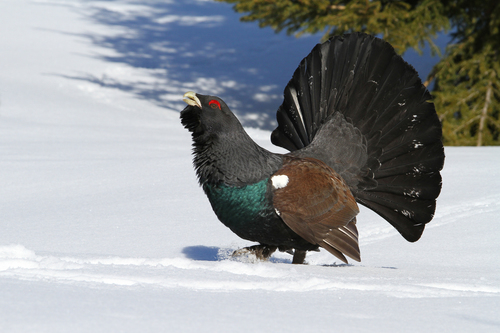 Western Capercaillie
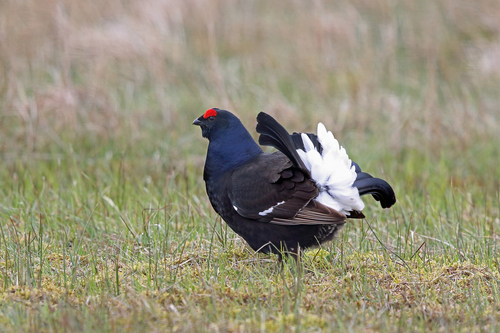 Black Grouse
In short
The most reliable way to separate Western Capercaillie from Black Grouse is by size and structure: capercaillie are enormous, bulkier than any other European grouse, with cocks nearly twice the mass of black grouse males. In flight or perched, capercaillie show a massive, heavy build and broad tail, while black grouse males are slimmer and have a distinctive lyre-shaped tail. Both species show strong sexual dimorphism, but even female capercaillie are much larger and longer than black grouse hens. Plumage differences are also clear in males: capercaillie cocks are dark with metallic green breast, while black grouse cocks are glossy black with a white wing bar and undertail. Females of both are cryptic, but capercaillie hens are larger and more coarsely barred above. Juvenile and immature wing patterns are not described as distinctive for either species in the sources, so focus on overall structure, tail shape, and size for field separation.
Identification tips
- Size is the first check: Even at a distance, capercaillie are much larger and bulkier than black grouse. If the bird looks goose-sized, it's a capercaillie; if it's closer to a large chicken, consider black grouse.
- Tail shape in males: Capercaillie cocks have a broad, rounded or slightly wedge-shaped tail; black grouse cocks show a lyre-shaped tail with long, outward-curving outer feathers, especially when displaying.
- Plumage in males: Capercaillie cocks are dark grey-brown with a metallic green breast and variable belly/undertail; black grouse cocks are glossy black with blue sheen, a bold white wing bar, and white undertail coverts.
- Female comparison: Capercaillie hens are much larger, with coarser brown, black, and silver barring above and buffy underparts; black grouse hens are smaller, more finely patterned, and less robust.
- White wing markings: Both species show some white on the wing, but black grouse cocks have a more obvious white wing bar in flight and at rest.
- Red eye wattle: Both species have a red wattle above the eye, most visible in displaying males, but this is not a reliable separator alone.
- Leg feathering: Capercaillie have heavily feathered legs, especially in winter, which can be seen at close range; black grouse legs are less obviously feathered.
- Flight style: Capercaillie are heavy and slow in flight, with deep, labored wingbeats; black grouse are quicker and more agile, with a direct, fluttery flight.
- Display behavior: Capercaillie display both in trees and on the ground, with dramatic posturing; black grouse display only on the ground, with tails fanned and necks inflated.
- Habitat context: Capercaillie are almost always in mature, dense forest; black grouse are more likely in open moorland, bogs, or forest edges.
- Vocalizations: Listen for the capercaillie's mechanical clicking and popping versus the black grouse's bubbling coo; these are distinctive in spring.
- Juvenile/immature birds: No distinctive age-specific wing or flight marks are described for either species, so rely on structure and size for young birds.
- Footprints in snow: Capercaillie leave much larger and broader tracks than black grouse, with distinctive 'snowshoe' toes in winter.
- Group size at leks: Black grouse leks can be much larger (dozens or even 100+ males in Russia); capercaillie leks are usually smaller.
- Contextual clues: If you see a very large, solitary grouse in deep forest, it's almost certainly a capercaillie; if in open country or at a large lek, black grouse is more likely.
Size
Western Capercaillie is by far the largest grouse in Europe, with males averaging 2885 g (and often over 4 kg) compared to black grouse males at around 1050 g. Capercaillie cocks reach 74–100 cm in length with a wingspan up to 125 cm, while black grouse cocks are about 60 cm long. Even female capercaillie (1.5–2.5 kg, 54–64 cm) are much heavier and longer than black grouse hens (750–1100 g, 45 cm). In the field, capercaillie appear massive and heavy-bodied, especially when compared to the more compact, lighter black grouse.
Plumage
Juvenile and immature wing patterns are not highlighted as diagnostic for either species, so focus on adult plumage and structure. Male capercaillie are dark grey to brown overall with a metallic green breast and variable black to white belly/undertail, plus a white spot on the wing bow. Black grouse cocks are glossy black with deep blue hues, a bold white wing bar, and striking white undertail coverts. The tail is the key: capercaillie have a broad, rounded or slightly wedge-shaped tail, while black grouse cocks have long, lyre-shaped outer tail feathers that curve outward. Both species have a red wattle above the eye, but this is more prominent in display. Females of both are cryptically colored, but capercaillie hens are larger, with coarser brown, black, and silver barring above and buffy underparts, while black grouse hens are smaller and more finely patterned. Both sexes of capercaillie have feathered legs, especially in winter.
Behaviour
Both species perform elaborate lekking displays in spring, but the capercaillie display is more dramatic and involves both tree and ground posturing, with the male fanning his tail and drooping wings. Black grouse males display on open ground, fanning their lyre-shaped tails and inflating their necks. Capercaillie cocks often display alone or in small groups, while black grouse leks can be larger, especially in eastern Europe. In flight, capercaillie are heavy and slow, with deep wingbeats; black grouse are more agile, with a faster, more direct flight. Both species are primarily ground-dwelling but will perch in trees, especially in winter.
Habitat
Western Capercaillie prefer mature, dense coniferous or mixed forests with clearings, often in upland or boreal regions. Black grouse favor moorland, steppe, or open woodland edges, often near shrubby or boggy areas, and are more likely to be seen in open country or at forest margins. While both can occur near woods, capercaillie are more strictly tied to deep forest, whereas black grouse are often seen in more open or transitional habitats.
Voice
Capercaillie males produce a unique courtship song: a series of double-clicks accelerating into popping and scraping sounds, described as a ping-pong ball dropping and a cork popping, followed by scraping. Black grouse males give a long, bubbling coo or murmur during their lek display, quite different in tone from the capercaillie's mechanical sounds. These vocalizations are most often heard at dawn in spring, and are distinctive if the bird is calling.